
- News
- World News
- US News
- US says not seeking regime change in Russia; walks back Biden's hint on deposing Putin
Trending
This story is from March 27, 2022
US says not seeking regime change in Russia; walks back Biden's hint on deposing Putin
The stunning unscripted remarks -- "For God’s sake, this man cannot remain in power" -- came at the tail end of a powerful speech that won wide acclaim in Europe and US, but caused a stir in diplomatic circles worldwide with speculation on whether Washington was raising stakes and seeking Putin's removal.
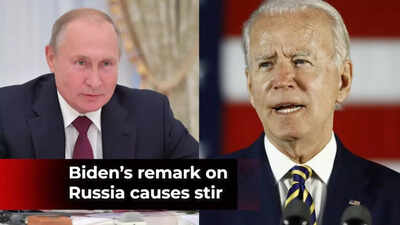
WASHINGTON: The United States has walked back President Joe Biden's ad-libbed remark during his speech in Poland on Saturday that Russia's President Vladimir Putin "cannot remain in power," clarifying that he (Biden) is not advocating regime change in Moscow.
The stunning unscripted remarks -- "For God’s sake, this man cannot remain in power" -- came at the tail end of a powerful speech that won wide acclaim in Europe and US, but caused a stir in diplomatic circles worldwide with speculation on whether he is raising stakes and seeking Putin's removal.
Russia responded curtly soon after the speech, with Kremlin spokesman Dmitry Peskov telling state news agencies: “That’s not for Biden to decide. The president of Russia is elected by Russians.”
"I think the president, the White House, made the point last night that, quite simply, President Putin cannot be empowered to wage war or engage in aggression against Ukraine or anyone else," Secretary of State Antony Blinken clarified in Israel during a press conference, adding, "As you know, and as you have heard us say repeatedly, we do not have a strategy of regime change in Russia -- or anywhere else, for that matter."
If the President misspoke, it added to his reputation for off-the-cuff remarks that appear to tumble out of his mouth too often as he trips over words, a fallibility sometime attribute to his speaking too fast to overcome a stuttering problem.
Earlier on Friday, the White House also had to clarify that the President was not signaling American boots on the ground in Ukraine when he told US paratroopers during a meeting in Poland about the situation in Ukraine, "You're going to see when you're there – some of you have been there – you're going to see women, young people, standing in the middle, in front of a damn tank, saying, 'I'm not leaving'."
Some US analysts said the latest Biden stumble, possibly caused by the momentum of his own rhetoric, could aggravate Putin and embolden him out of desperation to be even more confrontational, complicating any effort to restore peace.
"@potus just expanded US war aims, calling for regime change. However desirable it may be, it is not within our power to accomplish -- plus runs risk it will increase Putin's inclination to see this as a fight to the finish, raising odds he will reject compromise, escalate, or both," tweeted Richard Haass, a former administration official and president of the Centre for Foreign Relations.
"In last 24 hours there was a statement suggesting Russia might be reducing its war aims. Makes for an odd moment for US to expand its aims unless it has reason to believe doing so could help bring about internal change in Russia. Otherwise seems undisciplined/counter-productive," he added.
Outside of the flub, the speech, delivered at the historic Royal Castle in Warsaw, won high marks. Biden's Director of Speechwriting, Indian-American Vinay Reddy, who is the key wordsmith for the President, accompanied him on Air Force one, as did Neera Tanden, his senior advisor.
In his speech, Biden also reached out to the Russian people, telling them ("if you are able to listen") that they are not the enemy.
"I refuse to believe that you welcome the killing of innocent children and grandparents or that you accept hospitals, schools, maternity wards. This is not who you are. This is not the future you deserve for your families and your children.... This war is not worthy of you, the Russian people," he said.
But having called Putin a "war criminal" and a "butcher," a regime change, by whatever means, appears to be the only way there will be any high-level engagement between Washington and Moscow, with a break-down in communication between the two sides, something that did not happen even at the height of the Cold War.
The stunning unscripted remarks -- "For God’s sake, this man cannot remain in power" -- came at the tail end of a powerful speech that won wide acclaim in Europe and US, but caused a stir in diplomatic circles worldwide with speculation on whether he is raising stakes and seeking Putin's removal.
Russia responded curtly soon after the speech, with Kremlin spokesman Dmitry Peskov telling state news agencies: “That’s not for Biden to decide. The president of Russia is elected by Russians.”
US officials acknowledged that the remarks were not in the President's prepared speech, and clarified that his point was that Putin cannot be allowed to exercise power over his neighbors or the region. "He was not discussing Putin’s power in Russia, or regime change,” the White House told the media.
"I think the president, the White House, made the point last night that, quite simply, President Putin cannot be empowered to wage war or engage in aggression against Ukraine or anyone else," Secretary of State Antony Blinken clarified in Israel during a press conference, adding, "As you know, and as you have heard us say repeatedly, we do not have a strategy of regime change in Russia -- or anywhere else, for that matter."
If the President misspoke, it added to his reputation for off-the-cuff remarks that appear to tumble out of his mouth too often as he trips over words, a fallibility sometime attribute to his speaking too fast to overcome a stuttering problem.
Earlier on Friday, the White House also had to clarify that the President was not signaling American boots on the ground in Ukraine when he told US paratroopers during a meeting in Poland about the situation in Ukraine, "You're going to see when you're there – some of you have been there – you're going to see women, young people, standing in the middle, in front of a damn tank, saying, 'I'm not leaving'."
Some US analysts said the latest Biden stumble, possibly caused by the momentum of his own rhetoric, could aggravate Putin and embolden him out of desperation to be even more confrontational, complicating any effort to restore peace.
"@potus just expanded US war aims, calling for regime change. However desirable it may be, it is not within our power to accomplish -- plus runs risk it will increase Putin's inclination to see this as a fight to the finish, raising odds he will reject compromise, escalate, or both," tweeted Richard Haass, a former administration official and president of the Centre for Foreign Relations.
"In last 24 hours there was a statement suggesting Russia might be reducing its war aims. Makes for an odd moment for US to expand its aims unless it has reason to believe doing so could help bring about internal change in Russia. Otherwise seems undisciplined/counter-productive," he added.
Outside of the flub, the speech, delivered at the historic Royal Castle in Warsaw, won high marks. Biden's Director of Speechwriting, Indian-American Vinay Reddy, who is the key wordsmith for the President, accompanied him on Air Force one, as did Neera Tanden, his senior advisor.
In his speech, Biden also reached out to the Russian people, telling them ("if you are able to listen") that they are not the enemy.
"I refuse to believe that you welcome the killing of innocent children and grandparents or that you accept hospitals, schools, maternity wards. This is not who you are. This is not the future you deserve for your families and your children.... This war is not worthy of you, the Russian people," he said.
But having called Putin a "war criminal" and a "butcher," a regime change, by whatever means, appears to be the only way there will be any high-level engagement between Washington and Moscow, with a break-down in communication between the two sides, something that did not happen even at the height of the Cold War.

About the Author
Chidanand RajghattaEnd of Article
FOLLOW US ON SOCIAL MEDIA






Hot Picks
TOP TRENDING
Trending Stories
In World
Entire Website
- 'We were treated like slaves, made to work for 15 hours a day': Tricked into Ukraine war, 3 from Karnataka return home
- 'My father was on the flight': Jaishankar opens up about 1984 Air India hijack
- Airtel CEO Gopal Vittal sends letter to Reliance Jio, Vodafone-Idea, Tata Tele and BSNL CEOs; here's what he said
- Prince Harry to celebrate 40th birthday away from Meghan Markle
- Haitian immigrant pet-eating row: Ohio woman accused of eating cat is US citizen, video is not from Springfield
- Kejriwal out of jail; 'CBI arrest only to frustrate ED case bail': SC judge
- Donald Trump reveals what Laura Loomer is to his campaign: 'I don't control her'
- Hamster Kombat Daily Cipher Codes and Combo Cards for September 14, 2024: Unlock up to 1 million coins
- Laura Loomer's photo with Donald Trump viral. People ask where's Melania, where's wedding ring
- Garena Free Fire MAX redeem codes for September 13: Win in-game goodies and rewards
- Opposition offered to back me as prime minister, I refused: Nitin Gadkari
- CCTV footage at Nagpur bar deleted to shield BJP minister son?
- The new ‘green revolution’ will not feed India
- Encounter breaks out between security forces, terrorists in J&k's Poonch
- 'Tu suicide kar le': Paralympics champion Navdeep
- TN doctor held for morphing photos, videos of MBBS woman classmate
- Don’t rethink pink. Plane truth is we need women-friendly seats
- Bengaluru woman sparks controversy with comments about Swiggy delivery executive
- I feel ready to take up the challenge: India bowling coach Morne Morkel
- BJP MLA held over casteist abuse, bribery charges in Karnataka

Popular Categories
Hot on the Web
Top Trends
Trending Topics
World Largest HorseEID WishesGreen Apple BenefitsPriyanka Chopra TattooKottukkaali OTT ReleaseNarendra ModiGhaziabad Juice SellerHair LossSudha MurtyMalayalam ProducersIndia's Best Dancer 4Simi GarewalDilli BabuIndian National ParksLaung BenefitsVikas SethiApple iPhone 16Donald TrumpAadhar Card UpdateWordle Answer
Living and entertainment
Latest News
New season begins with renewed hope for BlastersPremier League: Erling Haaland hits another two in Man City's come from behind win over BrentfordMeerut building collapse: 3 dead; rescue operations continueDon’t rethink pink. Plane truth is we need women-friendly seatsWWE NXT Star Reunites With Father At TNA Victory RoadKashmir will soon get a government, but those blinkers are going to stay‘There is no affordable transport currently, the biggest problem in Goa is taxis’IIM Jammu hosts 'Fostering Academia and Industry Partnerships' event at BengalaruMP Bharat, TDP Andhra President Srinivas promise action to safeguard protection of steel plant workersLiverpool slump to shock 1-0 home defeat by Nottingham ForestHimanta urges banned ULFA(I) chief not to indulge in activity jeopardising future of Assam's youthActivists complain as showroom burns old papers; NMMC penalizes Rs 250 onlyVinith Venkatesh scores in ISL debut as Bengaluru FC edge past East BengalJitendra Jorwal takes charge as new Ludhiana deputy commissioner, vows seamless delivery of services'Hindi must be made acceptable, not imposed'37 year old beats fatty liver condition with unbelievable weight lossCong holds protests on second anniversary of MLA defectionsCouncillor's bro, 4 others held for hurling stones at Vande Bharat
Copyright © 2024 Bennett, Coleman & Co. Ltd. All rights reserved. For reprint rights: Times Syndication Service