
- News
- World News
- US News
- Putin expresses preference for Joe Biden over Donald Trump in upcoming US elections
Trending
This story is from February 15, 2024
Putin expresses preference for Joe Biden over Donald Trump in upcoming US elections
Russian President Vladimir Putin has openly expressed a preference for US President Joe Biden over Donald Trump in the upcoming November election. Putin's endorsement comes with an emphasis on Biden's predictability and extensive political experience. Putin's stance is noteworthy as it underscores the dynamics of US-Russia relations and the impact of leadership styles on international diplomacy.
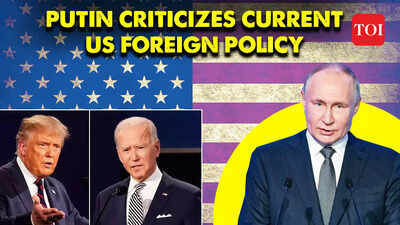
Putin has labeled Nato as a US foreign policy tool.
Russian President Vladimir Putin has voiced a preference for US President Joe Biden over Donald Trump for the upcoming November election, citing Biden's predictability and experience.
In an interview with Russian state television, Putin highlighted his readiness to work with any elected US leader but leaned towards Biden for his traditional political approach.
Despite recognizing Biden as a more favorable option, Putin did not shy away from criticizing current US foreign policy, especially regarding the situation in Ukraine.
Putin addressed speculation regarding Biden's health, saying he found it inappropriate to comment on such matters. He recalled their meeting in Switzerland in June 2021, where despite rumors of Biden's incapacitation, Putin observed him to be in good condition.
Trump reacted to Putin's comments at a rally in South Carolina on Wednesday evening, praising them as "a great compliment".
"I got along good with him, but he doesn't want to have me, he wants Biden," the former president said of Putin, adding: "Biden is going to give him Ukraine."
Putin also commented on Trump's recent statements regarding Nato, noting Trump's perspective on relations with allies and defense spending. "He has his own view on how relations with allies should develop," the Russian president on Trump's Nato comments.
He labeled Nato as a US foreign policy tool, implying the US's freedom to redefine its role within the alliance.
Interestingly, Putin expressed disappointment in the lack of challenging questions during his interview with former Fox News host Tucker Carlson, indicating a desire for more direct confrontation in discussions with Western media. This reflects a broader strategy to engage with and challenge Western narratives, particularly around the conflict in Ukraine.
(With inputs from agencies)
In an interview with Russian state television, Putin highlighted his readiness to work with any elected US leader but leaned towards Biden for his traditional political approach.
Despite recognizing Biden as a more favorable option, Putin did not shy away from criticizing current US foreign policy, especially regarding the situation in Ukraine.
Russia-West ties have hit a low point following Russia's military actions in Ukraine, actions Putin defends as necessary against perceived threats from Nato expansion.
Putin addressed speculation regarding Biden's health, saying he found it inappropriate to comment on such matters. He recalled their meeting in Switzerland in June 2021, where despite rumors of Biden's incapacitation, Putin observed him to be in good condition.
Despite his preference for Biden, Putin criticized the current US administration's policies, especially regarding Russia-West relations and the conflict in Ukraine. He blamed the Biden administration for what he sees as misguided actions and policies.
Trump reacted to Putin's comments at a rally in South Carolina on Wednesday evening, praising them as "a great compliment".
"I got along good with him, but he doesn't want to have me, he wants Biden," the former president said of Putin, adding: "Biden is going to give him Ukraine."
Putin also commented on Trump's recent statements regarding Nato, noting Trump's perspective on relations with allies and defense spending. "He has his own view on how relations with allies should develop," the Russian president on Trump's Nato comments.
He labeled Nato as a US foreign policy tool, implying the US's freedom to redefine its role within the alliance.
Interestingly, Putin expressed disappointment in the lack of challenging questions during his interview with former Fox News host Tucker Carlson, indicating a desire for more direct confrontation in discussions with Western media. This reflects a broader strategy to engage with and challenge Western narratives, particularly around the conflict in Ukraine.
(With inputs from agencies)

About the Author
TOI World DeskEnd of Article
FOLLOW US ON SOCIAL MEDIA



Hot Picks
TOP TRENDING
Trending Stories
In World
Entire Website
- Monster vs Monster: WWE announced massive match for this week's Monday Night Raw
- UPI transaction limit to change from September 16! Here are the new limits for various UPI payments
- File movement linked to weight of money: Nitin Gadkari
- Apple's biggest 'iPhone update' for year 2024, iOS 18, rollout starts today - September 16: India time and how to prepare your iPhone for iOS 18 download
- Arvind Kejriwal's resignation: Who will be next Delhi CM? Atishi seen as top choice
- UP medical aspirants converting religion to secure MBBS seats: A look at NEET UG admission criteria around minority reservation rules
- Protests against students wearing hijab in school play, principal forced to apologize for promoting religious harmony
- Pitru Paksha 2024 Date and Time: Know Significance of Shradh Paksha
- Andhra suspends 3 IPS officers for 'framing', arresting Mumbai actress
- The 3 Strongest Zodiac Signs: Powerhouses of the Zodiac Wheel
- 'Be cautious': VP Dhankhar reacts to Supreme Court's 'caged parrot' remark on CBI
- Docs sit down for talks with Mamata; minutes of meet to be recorded
- Will Atishi replace Arvind Kejriwal as Delhi CM?
- 'I had a birdie putt': Trump's first reaction after 2nd assassination bid
- Kohli's jersey hogs limelight in Pakistan during Babar Azam's match
- 'No talks with Pak till ...': Amit Shah accuses NC, Cong of 'nurturing' terrorism
- Cow vigilantes killing a Brahmin is the wake-up call India needed
- Apple's biggest 'iPhone update' for year 2024 rollout starts today
- Make It Priceless: Gift them a customized TOI Front Page. Know More
- 'Oppn insulted me but ... ': PM Modi hails achievements of his govt in first 100 days

Popular Categories
Hot on the Web
Top Trends
Who is Ryan RouthUPI Transaction LimitArvind Kejriwal ResignationNEET UG Admission CriteriaKolkata Doctor Rape CaseBorder Gavaskar TrophyRohit SharmaSports Stars Turned Power CouplesIBPS RRB Clark PO ResultDonald TrumpBianca Belair Net WorthIndia vs Korea LiveBMW Accident Madhya PradeshIndore BMW CrashPrince HarryMiami Dolphins OwnerLive Cricket Score
Trending Topics
Living and entertainment
Latest News
4 types of tea to improve gut health and ease digestive issuesWho was Illia 'Golem' Yefimchyk, the Belarusian bodybuilder who consumed 2.5 kg of meat and 108 sushi pieces daily before his death at 36?Vempalle Shareef's story is now a lesson for degree students in Andhra PradeshWhen Shah Rukh Khan performed 'Kanyadaan' at Farah Khan's wedding- See PICSBike rally held to raise voter awareness in Jammu and Kashmir's Doda ahead of assembly electionsFather-son duo Eugene and Dan Levy's dazzling entrance at the EmmysLiza Colon becomes 1st Latina to win Best Supporting Emmy Award'Oh no!': Hilarious goof-up leads to missed catch, leaves bowler in smile. WatchJr NTR on shooting under water scene for 35 days in 'Devara Part 1': It is an important sequence!Last Lunar Eclipse of 2024: What it means for your zodiac signTop NFL Superstars Who Are Vegan: Derrick Morgan, David Carter, Theo Riddick and moreAbhishek Kumar shares selfies with Alia Bhatt; recalls the time when he worked as a crowd artist in ‘Humpty Sharma Ki Dulhaniya’Jessica Gunning wins her 1st Primetime Emmy for 'Baby Reindeer'Shocking! Man celebrates birthday by lying among massive Pythons‘Stree 2’ star Shraddha Kapoor to reveal her character name! But there’s a catchSathiyan set to partner Sreeja in mixed doubles'Seven varsities in Odisha have potential to be in top 100'Capricorn, Daily Horoscope Today, September 16, 2024: Harmonious relationships with partners are likely
Copyright © 2024 Bennett, Coleman & Co. Ltd. All rights reserved. For reprint rights: Times Syndication Service