
- News
- World News
- US News
- 'Can you take on Russia yourselves?': How Donald Trump shattered UK's delusions of grandeur
Trending
'Can you take on Russia yourselves?': How Donald Trump shattered UK's delusions of grandeur
With that single question, Trump shattered decades of carefully maintained British diplomatic posturing, exposing a truth long known but rarely acknowledged: without America, Britain is militarily exposed. Or as Sir Humphrey Appleby said while echoing Winston Churchill: “The Americans will always do the right thing… after they’ve exhausted all the alternatives." But what if it didn’t as Trump joked, and led to Keir Starmer’s awkward chuckle.
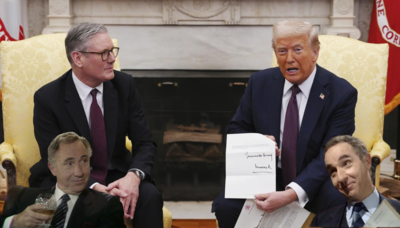
The British classic Yes, Minister has been off air for several decades, but if it were to be shot today, it might have a segment like this:
Bernard: "Prime Minister, I have an urgent update from Washington."
Jim Hacker: "Oh, splendid! Have they finally agreed to reaffirm our ‘special relationship’?"
Jim Hacker: "Ah. Well. And what did we say?"
Bernard: "The Prime Minister laughed nervously and mumbled something about 'shared commitments'."
Sir Humphrey: Aah power without responsibility, the prerogative of the ….
Bernard: Of the?
Sir Humprey: Let it be Bernard, this is a family-friendly publication.
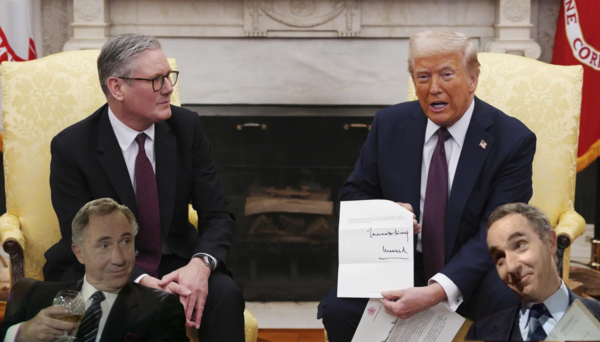
Of course, this exchange is entirely fictional—but reality wasn’t far off. During a joint press conference at the White House, Donald Trump delivered a moment of pure, unscripted bravado that left Keir Starmer speechless and the world watching. “Could you take on Russia by yourselves?” Trump asked, flashing his signature grin as Starmer let out an awkward chuckle.
With that single question, Trump shattered decades of carefully maintained British diplomatic posturing, exposing a truth long known but rarely acknowledged: without America, Britain is militarily exposed. Or as Sir Humphrey Appleby said while echoing Winston Churchill: “The Americans will always do the right thing… after they’ve exhausted all the alternatives." But what if it didn’t as Trump joked, and led to Keir Starmer’s awkward chuckle.
The Trump-Starmer Showdown: A One-Sided Affair
Starmer’s trip to Washington was meant to reaffirm US-UK ties, but it quickly turned into a masterclass in American dominance over British diplomacy. Every interaction underscored the reality that Trump held the cards, and Starmer was left playing catch-up.
Trump’s Mockery: A Not-So-Subtle Power Move
Trump’s “Russia” question wasn’t the only moment where he publicly belittled Starmer. Throughout their joint appearances, Trump repeatedly:
- Dominated the conversation, cutting Starmer off mid-sentence.
- Made patronizing remarks, calling him a “tough negotiator” but suggesting he didn’t “like that”.
- Dismissed Starmer’s attempts to engage, outright shutting him down when discussing Canada.
The UK’s Diminishing Role on the World Stage
While Trump’s brashness is nothing new, the subtext of these exchanges highlights Britain’s declining influence in global affairs. The UK has long relied on the illusion of power—talking big while knowing full well that its military and economic leverage depends on US backing.
Yet Trump’s handling of Starmer suggests that he doesn’t buy into Britain’s self-importance. In contrast, Trump’s meetings with France’s Emmanuel Macron felt more like a meeting of equals, with both leaders engaging in an animated and physical exchange. With Starmer, Trump treated him more like an afterthought—a symbolic but ultimately secondary player in global affairs.
The Putin Factor: Trump's Cozy Relationship With Moscow
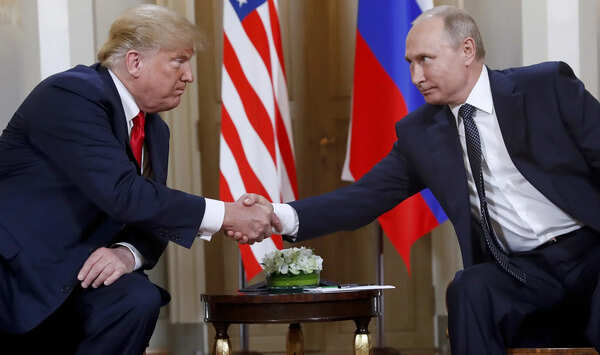
FILE - President Donald Trump, left, and Russian President Vladimir Putin shake hands at the beginning of a meeting at the Presidential Palace in Helsinki, Finland, July 16, 2018. (AP Photo/Pablo Martinez Monsivais, File)
Adding another layer of concern is Trump’s increasingly close ties with Russian President Vladimir Putin. His dismissive attitude toward Starmer came amid high-stakes negotiations on ending Russia’s invasion of Ukraine, during which Trump has been far more eager to accommodate Moscow’s demands than reinforce NATO’s resolve.
By posing the “Could you take on Russia alone?” question, Trump wasn’t just making an offhand remark—he was signaling a shifting power dynamic in which the US might no longer be the UK’s unquestioned protector. For a British government that has spent decades defining itself through its unwavering support for NATO and transatlantic unity, this was a chilling moment of diplomatic reality check.
JD Vance and the Ideological Divide
If Trump provided the spectacle, Vice President JD Vance brought the ideological confrontation. While Trump mocked Starmer, Vance attacked his policies—particularly on free speech and government control.
Vance has long criticized Britain’s restrictions on speech, and he wasted no time using Starmer’s visit to highlight what he calls the “authoritarian liberalism” of Europe. He specifically pointed to the case of Adam Smith-Connor, the British Army veteran fined for praying outside an abortion clinic, arguing that this reflects a broader suppression of free expression in the UK and across Europe.
Vance’s broader critique of Europe’s governance includes:
- Condemning Germany’s hate speech laws as overreaching.
- Calling out France’s crackdowns on religious speech in its efforts to combat extremism.
- Criticizing Ireland’s proposed hate speech bill as setting a dangerous precedent for state censorship.
The Musk Factor: The Billionaire’s War on Starmer
As if Trump and Vance weren’t enough, Elon Musk has also set his sights on Starmer. The billionaire, who has increasingly aligned himself with right-wing movements across the globe, has reportedly been consulting with UK conservatives on strategies to oust Starmer and undermine Labour’s leadership.
Musk’s interest in British politics reflects a broader trend of Silicon Valley billionaires intervening in global elections—often in favor of nationalist, anti-regulation candidates. Given Starmer’s pro-regulation stance on tech and AI, Musk likely sees him as a direct threat to his global ambitions.
With Musk bankrolling anti-Starmer campaigns, Trump mocking him to his face, and Vance dismissing his policies as authoritarian, Starmer now faces opposition from the most powerful figures in American politics and business.
What This Means for the UK-US Relationship
Starmer’s visit was supposed to reaffirm the special relationship, but it may have done the opposite.
The UK’s standing in Washington is clearly not what it used to be, and the dynamics are shifting in a few key ways:
- Britain can no longer rely on automatic American support—it will have to earn its relevance in US foreign policy.
- Trump’s transactional diplomacy means that the UK must offer tangible benefits, not just nostalgia, to maintain influence.
- If Vance continues to shape US policy, the UK’s legal and social policies will come under more scrutiny from Washington.
- His critique of Britain’s approach to free speech suggests that future US-UK tensions may not just be diplomatic, but deeply cultural.
- If Musk throws significant resources into anti-Starmer efforts, Labour could face unprecedented foreign interference in UK politics.
- The growing alliance between US tech billionaires and right-wing UK movements could shift the political landscape dramatically.Conclusion: A
The Trump-Starmer showdown was more than just an awkward press conference—it was a symbol of Britain’s shifting role in global politics. Trump’s Russia remark, Vance’s free speech attacks, and Musk’s campaign against Labour all highlight the increasingly fragile nature of the UK’s standing in Washington. For Starmer, the lesson is clear: if Britain wants to remain relevant, it needs a new strategy. Relying on past alliances and diplomatic pleasantries is no longer enough. In Trump’s world, power is projected, not assumed—and right now, Britain is looking more like a follower than a leader.

About the Author
TOI World DeskEnd of Article
FOLLOW US ON SOCIAL MEDIA






Photostories

Hot Picks
TOP TRENDING
Explore Every Corner
Across The Globe
IND vs NZWayne GretzkyTaylor SwiftCam NewtonBlake LivelyGisele BndchenBrad MarchandAnthony EdwardSidney CrosbyJordyn WoodsBrady TkachukAaron JudgeSteph CurryNBA Buyout RumorsNBA HalftimeAuston MatthewTaylor Swift AlbumWWE Elimination Chamber ResultRhea RipleyKevin OwensRoman ReignsLiv MorganThe RockErin AndrewsMicrosoft Outlook OutageBank HolidaysBank Holidays in MarchChampions Trophy ScheduleChampions Trophy Points TableICC Champions Trophy Live Streaming
Hot on the Web
Heart Blockage SymptomsChia Seeds BenefitsKrushna AbhishekTaarak Mehta Ka Ooltah ChashmahIbuprofen GuidePeppermint Oil For HairMagnesium Oil BenefitsKomodo Dragon vs King CobraWater Weight Loss TipsTanmay BhatGovindaElon MuskRanveer AllahbadiaOptical IllusionWall Sits BenefitsDoomsday FishRajinikanthMere Husband Ki Biwi CollectionChhaava Box Office CollectionChhaava Movie ReviewSadhguru Diet HabitsAshwagandha for Hair GrowthMorning Brain ExercisesUS National ParksUnique AnimalsBig Cat Safari DestinationFatty Liver Reducing FoodsBig Cats IndiaBaby Girl NamesDates Benefits
Trending Topics
India vs New ZealandCarlo ColaiacovoLamelo BallNodirbek YakubboevBrett FavreJimmy ButlerGiannis AntetokounmpoTravis KelceJoe BurrowTaylor SwiftLogan PaulTom BradyErin AndrewRob GronkowskiTravis HunterSouth Africa Cricket TeamChampions Trophy SemifinalMHT CET LLBUS National Anthem BooedVivian RichardNyt ConnectionsKing Legacy CodesDa Hood CodesWordle HintsInzamam Ul HaqDonald TrumpIndia vs New Zealand ScorecardChampions Trophy Points TableChampions Trophy ScheduleICC Champions Trophy 2025 Live Streaming
Popular Categories
HeadlinesSports NewsBusiness NewsIndia NewsWorld NewsBollywood NewsHealth+ TipsIndian TV ShowsTechnologyICC Champions TrophyIPLTravelEtimesHealth & FitnessHollywood NewsWeb SeriesWWEUS NewsNFLHow to watch IPL 2025How to watch IPL in CanadaHow to watch IPL in USACBSETechnology NewsInternational SportsAstrologyPublic HolidaysBank HolidaysIndia vs New ZealandWeather Today
Latest News
Meet cricketer Varun Chakravarthy's wife Neha Khedekar: Their heartwarming love storyBill Belichick and girlfriend Jordon Hudson dragged into new “security” controversy after the NC State event as fans troll JordonMove aside, ladies! Here are the best-dressed gentlemen in Oscars historyShraddha Kapoor's phone wallpaper features Rahul Mody affectionately hugging her in a mirror selfieJordanian troops shoot Kerala man trying to sneak into IsraelMrunal Thakur's advice to help stop hair fall is a total game changerZaheer Iqbal, Sonakshi Sinha's latest banter is too fun to miss; take a lookMakers confirm 2025 release for 'Metro In Dino'Twins' star Carlos Correa expresses no-surprise over Astros' decision to let go Alex BregmanHow Gujarat's Patel became Pakistan's Hussain: Deported from US, man reveals passport secretGabriella Demetriades shares 'little moments in the chaos' with beau Arjun RampalStray dog attacks surge along Salcete coastal beltIMD issues yellow alert for heat today, tomorrow, temp to hit 37CPreity Zinta takes on a religious trip from Prayagraj to Varanasi with her momVisitors can experience Kunbi weaving at SarasComunidades get nod to seek pvt development aidMeghan Markle drops adorable video of princess Lilibet playing candy land with "auntie" Serena WilliamsRane: 75 new ambulances to strengthen medical services
Copyright © 2025 Bennett, Coleman & Co. Ltd. All rights reserved. For reprint rights: Times Syndication Service