
- News
- World News
- Rest of World News
- US auction theory pioneers win Nobel economics prize
Trending
This story is from October 13, 2020
US auction theory pioneers win Nobel economics prize
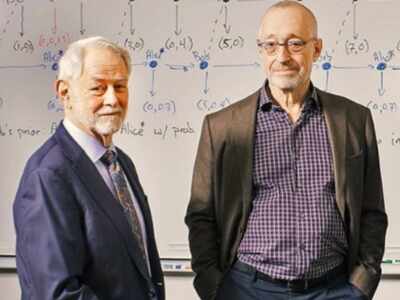
Image credit: Twitter/@Stanford
Two American economists won the Nobel Prize for improving how auctions work, research that underlies much of today’s economy — from the way Google sells advertising to the way telecom companies acquire airwaves from the government.
The discoveries of Paul Milgrom and Robert Wilson, both of Stanford University, “have benefitted sellers, buyers and taxpayers around the world”, the Nobel Committee said.
Among the insights of the two Stanford University economists is an explanation of how bidders seek to avoid the so-called “winner’s curse” of over-paying, and what happens when bidders gain a better understanding of their rivals’ sense of value. Milgrom and Wilson notably came up with formats for selling interrelated items simultaneously.
Wilson showed that rational bidders tend to place bids below their own best estimate of what he called the “common value” — that is, when the value of an item is deemed to be the same for everyone — for fear of paying too much. Milgrom complemented that with theories on “private values”, when the perceived value of something differs from bidder to bidder. He demonstrated that an auction format will give the seller higher expected revenue when bidders learn more about each other’s estimated values during the bidding process.
The effects of their work can be seen all around. “Online advertising is sold at auction,” said David Warsh, who tracks economic research at his blog Economic Principals. “That Google was able to adopt the method so quickly and seamlessly depended entirely on theory developed by Milgrom and his competitors and their students.” Last year the honour went to India-born Abhijit Banerjee, French-American Esther Duflo, and American Michael Kremer for their work on alleviating poverty.
The discoveries of Paul Milgrom and Robert Wilson, both of Stanford University, “have benefitted sellers, buyers and taxpayers around the world”, the Nobel Committee said.
Wilson was once Milgrom’s PhD adviser, and the two also happen to be neighbours. Reached by phone at his home in California, Milgrom said he received news of their win “in a strange way”. “I got a knock at my door from Bob Wilson,” he said. The two men tackled the tricky problem of making auctions work efficiently.
Among the insights of the two Stanford University economists is an explanation of how bidders seek to avoid the so-called “winner’s curse” of over-paying, and what happens when bidders gain a better understanding of their rivals’ sense of value. Milgrom and Wilson notably came up with formats for selling interrelated items simultaneously.
Wilson showed that rational bidders tend to place bids below their own best estimate of what he called the “common value” — that is, when the value of an item is deemed to be the same for everyone — for fear of paying too much. Milgrom complemented that with theories on “private values”, when the perceived value of something differs from bidder to bidder. He demonstrated that an auction format will give the seller higher expected revenue when bidders learn more about each other’s estimated values during the bidding process.
In 1994, US authorities used one of their auction designs to sell radio frequencies to telecom operators. Milgrom and Wilson (with help from Preston McAfee, now at Google) designed an auction format in which all the licenses were sold in one go. That format discourages speculators from buying up frequencies in a specific geographic area and then reselling them to big telecommunications firms seeking to patch together national or regional networks. The auction raised $617 million — selling frequencies that previously were handed out for virtually nothing — and became a model for countries from Canada to India. The format has also been used to auction off electricity and natural gas.
The effects of their work can be seen all around. “Online advertising is sold at auction,” said David Warsh, who tracks economic research at his blog Economic Principals. “That Google was able to adopt the method so quickly and seamlessly depended entirely on theory developed by Milgrom and his competitors and their students.” Last year the honour went to India-born Abhijit Banerjee, French-American Esther Duflo, and American Michael Kremer for their work on alleviating poverty.
End of Article
FOLLOW US ON SOCIAL MEDIA






Hot Picks
TOP TRENDING
Trending Stories
In World
Entire Website
- Centre seeks review of SC's mineral royalty judgment
- 'At 2:30 in the night, Rohit Sharma texted me and asked...'
- Schools closed across various states till 16th September: Here’s why
- Live wire snaps, boy recalls science lesson, saves lives with sister
- Many parts of Chennai face power supply disruption due to fire at Manali substation
- Aadhaar card update: Do you have to compulsorily update details on your Aadhaar every 10 years?
- Kevin Spacey allegedly demands $100,000 to vacate Baltimore residence, new owner says actor tries to 'paint himself as victim’
- Who is Jared Isaacman? Billionaire who stepped out of SpaceX capsule for first private spacewalk
- NMC approves expansion: GMC to offer 200 MBBS seats and more PG seats in 2024-25
- Veteran CPM leader Sitaram Yechury passes away
- 'BJP, using ED and CBI like its tota-maina': Sisodia after SC grants bail to Kejriwal
- 'Can't attend office': SC's bail conditions for Delhi CM Kejriwal
- ‘Illegal’ mosque or political agenda? Why’s there a new fire in Himachal?
- 'Stopped taking calls': Mayawati & Akhilesh blame each other for BSP-SP split
- Shreyas Iyer bats wearing sunglasses, falls for duck
- Ford to restart manufacturing of vehicles in Chennai plant after 3 years
- Sebi’s Madhabi Puri says she always does the right thing. Does she?
- Refund on iPhone 15 & 14: Apple's policy says conditions applied
- Hindu groups protest against illegal construction at Mandi mosque
- Why Rohit has been India's best batsman in WTC

Popular Categories
Hot on the Web
Top Trends
Trending Topics
Alia BhattMalaika Arora Father DeathArbaaz KhanNatasa StankovicMr Bachchan OTT ReleaseNational Parks In IndiaSelena GomezGOAT CollectionVikas Sethi DeathMalayalam ProducersIndia's Best Dancer 4Simi GarewalDilli BabuIndian National ParksLaung BenefitsVikas SethiApple iPhone 16SpaceXAadhar Card Update By Sept 14Wordle Answer
Living and entertainment
Latest News
Salman Khan surrounded by bodyguards as he arrives at Malaika Arora's mother's house to offer his condolences - WATCHJulie Chen to miss Big Brother live eviction for first time, taps Jerry O'Connell to hostBonedi baris hope for a peaceful start to PujoNIA raids pro-Khalistan preacher Amritpal Singh's relative's house in AmritsarA vision unfolds: How Levitation is crafting tomorrow’s enterprise solutionsTragedy strikes at fundraiser: Mother of two dies after marshmallow-eating competitionMan shot near Delhi's Greater Kailash-I gym, gang war suspected8 animals that reproduce without matingHow a balanced pH helps maintain your skin’s youthful appearanceStree 2 box office collection: Shraddha Kapoor and Rajkummar Rao starrer clocks Rs 539 croreISL-11 opener: Familiar foes back in businessBiden to host fourth quad summit with PM Modi, Albanese, and Kishida in Delaware on September 21: White HouseSanthy Balachandran turns screenwriter for Kalyani Priyadarshan and Naslen starrerDivya Bansal explores themes of human resilience, love and positive transformation in debut poetry bookFinancial graft probe against Sandip Ghosh: ED raids in Chinar Park, Tala & Kalindi in KolkataZodiac signs: What they regret and whyTecno Pova 6 Neo 5G phone announced in India: Price, features and other detailsNurse mutilates doctor's private parts, escapes rape bid
Copyright © 2024 Bennett, Coleman & Co. Ltd. All rights reserved. For reprint rights: Times Syndication Service