
- News
- World News
- Rest of World News
- Lai Ching-te elected as new president of Taiwan, what it means for ties with China
Trending
This story is from January 13, 2024
Lai Ching-te elected as new president of Taiwan, what it means for ties with China
Lai Ching-te of the ruling Democratic Progressive Party (DPP) was elected as the new president of Taiwan, succeeding Tsai Ing-wen. Beijing referred to Lai as a 'dangerous separatist' and a 'troublemaker'. Lai pledged to continue Tsai's cross-strait policies, including Taiwan's right to self-determination. Reacting to the election results, Beijing's Taiwan Affairs Office spokesperson Chen Binhua said the vote "will not impede the inevitable trend of China's reunification".
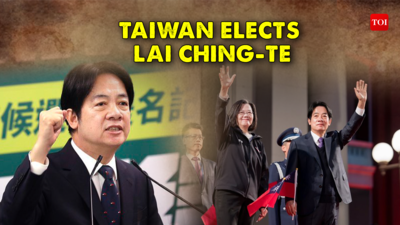
Lai succeeds Taiwan's first female leader, Tsai Ing-wen, who is reviled by China for standing up for the island’s autonomy.
Lai has pledged to continue Tsai’s cross-strait policies, including Taiwan’s right to self-determination in the face of China’s claim that the island is its territory.
China shrugs off results
Reacting to the election results, Beijing's Taiwan Affairs Office spokesperson Chen Binhua said the vote "will not impede the inevitable trend of China's reunification", adding that the results of the vote show that the DPP "cannot represent the mainstream public opinion on the island".
Chen added that the vote "will not change the basic landscape and development trend of cross-Strait relations".
Beijing's stance on "realising national reunification remains consistent, and our determination is as firm as rock," he said, adding that Beijing "firmly oppose(s) the separatist activities aimed at 'Taiwan independence' as well as foreign interference".
The election was watched closely by both Beijing and Washington, Taiwan's main military partner, as the two powers tussle for influence in the strategically vital region.
In a New Year's address, Chinese President Xi Jinping said the "unification" of Taiwan with China was "inevitable".
'Will safeguard Taiwan from China'
In his victory speech, Lai said he is "determined to safeguard Taiwan from threats and intimidation from China but that his primary responsibility is to maintain peace and stability".
Vowing to use dialogue to replace confrontation, Lai thanked supporters for showing the world how much Taiwan cherishes democracy.
Like Tsai, Lai plans to maintain tight links to the US, which supplies most of the island’s weapons, and build more ties with democracies in Europe and elsewhere.
Tsai was unable to seek re-election due to term limits after winning in 2016 and 2020.
Tough times ahead for Taiwan-China ties
Lai has now been given the unenviable task of navigating delicate relationships with two superpowers, China and US, who are increasingly asserting their dominance in the region with President Xi Jinping repeatedly saying that unification of Taiwan with mainland China is "inevitable".
Lai, who trained as a doctor and served as mayor of the southern city of Tainan, once called himself a “pragmatic worker for Taiwanese independence”, a phrase that angered Beijing and raised concerns in Washington about his ability to manage relations with China.
The 64-year-old has since softened his stance, and is open to talks with China — on an equal footing.
Will not settle for fake peace: Lai
While successive Chinese Communist leaders have vowed to eventually achieve "reunification", Xi has repeatedly said the Taiwan issue "should not be passed down generation after generation," linking the mission to his mid-century goal of "national rejuvenation."
Though Beijing has labelled Lai a "dangerous separatist", the new Taiwanese president has said he will maintain the status quo and pursue peace through strength.
"Peace is priceless and war has no winners," Lai told reporters in a press conference in which he appeared alongside his vice presidential running mate Hsiao Bi-khim.
However, "accepting China's one-principle proposition is not true peace," Lai said. "Peace without sovereignty is just like Hong Kong. It is fake peace".
Lai has stressed he will continue the policy direction of incumbent president Tsai Ing-wen and Taiwan will continue to build up its defence deterrence amid geopolitical tensions. "The pursuit of peace relies on strength, not the goodwill of the aggressor," Lai said, vowing to bolster Taiwan's military and economic strength.
(With inputs from agencies)

About the Author
TOI World DeskEnd of Article
FOLLOW US ON SOCIAL MEDIA



Hot Picks
TOP TRENDING
Popular Categories
Hot on the Web
Top Trends
Trending Topics
Devara CollectionBigg Boss Kannada 11 Launch Live UpdatePawan KalyanJungle SafariStree 2 OTT ReleaseRose GardenDevara CollectionOTT Release MovieMasala OmeletteEmergencyDevaraTaaza Khabar 2 Twitter ReviewDevara Movie ReviewHealthy RaitasSwatantrya Veer SavarkarColdplay India tour 2025Smartphone DealsApple Macbook Air M1Amazon SaleWordle Answer
Living and entertainment
Latest News
India shooter reports late for final, misses potential medal at Junior World ChampionshipsTumbbad re-release box office: The Sohum Shah starrer mints Rs 95 lakhs on third SaturdayAir Arabia launches early bird promotion on 500,000 seats from INR 5,727!"Is Taylor Swift Gonna Be in the Stands for the Chiefs vs. Chargers Showdown?"Aishwarya Rai Bachchan touches Nandamuri Balakrishna's feet as a sign of respect, the Telugu star blesses herHost Kiccha Sudeep to Bigg Boss Kannada 11 contestant Aishwarya Shindogi: Come back as a stronger personManipur CM Biren accuses Kuki militants of abducting 2 Manipuri youthsKhatron Ke Khiladi 14 winner: Karan Veer Mehra lifts the trophy and Krishna Shroff becomes the first runner-upWhat to expect after a facelift procedureColleagues remember braveheart Delhi Police constable Sandeep: 'Would rush to crime scene alone'Baloch Human Rights slam Pakistan and China, call it 'a failed state'India to maintain LAC troop deployment as trust deficit with China remainsWith $3.16 Million Lost in Game Checks, Can Haason Reddick Afford to Keep Holding Out?Haryana polls: Explain the 'compelling' circumstances, CEO asks authorities on Dera Sacha Sauda chief Ram Rahim's plea for temporary releaseUnion minister Nitin Gadkari invites Sachin Tendulkar for coffee at newly inaugurated bird park in Maharashtra's JamthaDrake Hogestyn, beloved 'Days of Our Lives' star, passes away at 70Virginia jury awards $300 million to women alleging sexual abuse at children's hospitalShah Rukh Khan and Suhana Khan's film 'King' to be announced on SRK's birthday: Report
Copyright © 2024 Bennett, Coleman & Co. Ltd. All rights reserved. For reprint rights: Times Syndication Service