
- News
- World News
- Pakistan News
- Global perception hardens on Pakistan as terrorist state
Trending
This story is from March 1, 2019
Global perception hardens on Pakistan as terrorist state
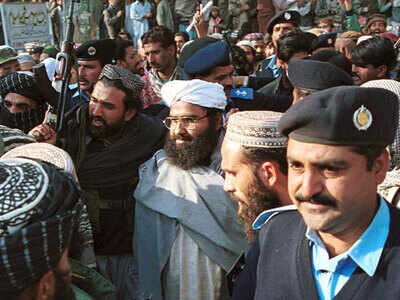
File photo of JeM chief Masood Azhar
Broad reactions and pronouncements from across the world show that Pakistan was seen as the serial provocateur who triggered yet another face-off and India was recognised as the victim who was reacting in self-defense to the aggravation.
It was the Trump White House that first laid down the line on this, making it clear soon after the Pulwama suicide bombing (and even before India’s attack on a terrorist camp inside Pakistan) that New Delhi had the right to self-defence, virtually greenlighting an Indian response.
Washington later described India’s attack on the terrorist camp as counter-terrorist action, setting the tone against any perception that New Delhi was the aggressor. Separately, France and Russia took the same line.
Even China, all too familiar with terror groups within Pakistan, did not challenge the description.
Although the Pakistani government was not directly implicated in the Pulwama attack, the forbearance of successive Pakistani establishments towards terror groups, and its military’s nurturing of what it regards at its “strategic assets,” irked policy makers in Washington to repeatedly speak of Pakistan’s supportive ecosystem for terror groups.
The Pakistani coddling of terror groups came into glaring focus on Friday when the country’s foreign minister Shah Mehmood Qureshi publicly glossed over the presence of Masood Azhar, leader of the Jaish-e-Mohammed, who has bragged about terrorist attacks on India, including the Pulwama bombing.
“Masood Azhar is in Pakistan, he is very unwell, he's unwell to the extent that he can't leave house because he is really unwell,” Qureshi purred on CNN about a globally designated terrorist, adding, “If they have evidence share with us so that we can convince the people and the judiciary.”
The foreign minister, who incidentally was visiting India during 26/11 attack and hurried back even as it transpired that the Pakistani intelligence agency ISI planned and executed the attack with its LeT jihadi assets, was called out for his brazen defence since Azhar was sprung from an Indian prison after the Kandahar hijacking in a prisoner-for-hostages swap. That would make Pakistan officially a violator of international norms and treaty.
All this has hardened the attitude of policy makers and legislators in the US where Pakistan hardly has any friends or defenders left.
After Pakistan’s Prime Minister Imran Khan warned of “miscalculation” by India that could lead the two dies down a slippery slope of war, Eliot Engel, chairman of the US House Foreign Affairs committee, responded, "To avoid the kind of miscalculation Pakistani Prime Minister Imran Khan rightly fears, Pakistani leaders must take demonstrable action against Jaish-e-Mohammed and the terrorist infrastructure on Pakistan's soil.”
“We affirm India's right to self-defence in response to attacks planned and executed by Pakistani-based terrorist groups designated by the United States and United Nations. We share your position that Pakistan must do more to combat these anti-India extremist groups that destabilise the region and urge you to use your authority to pursue a peaceful resolution to this conflict before it grows,” added Senators Jerry Moran from Kansas and Jeanne Shaheen from New Hampshire.
In Pakistan though, there did not appear to be the slightest change in attitude.
Pakistan reserves the right to respond to any aggression displayed against it as a matter of self-defence, the country army chief Qamar Javed Bajwa was quoted as telling the the military chiefs and ambassadors of major western powers and China even after being called out for being the aggressor and the burden of self-defense hoisted on India.
End of Article
FOLLOW US ON SOCIAL MEDIA









Photostories

Hot Picks
TOP TRENDING
Popular Categories
Hot on the Web
Top Trends
IND vs BAN Live ScoreIsrael Hezbollah WarRahul GandhiShan MasoodBryonna Burrows Net WorthIndian Team Fastest Test FiftyWTC Points TableUGC NET Result 2024GovindaWomen T20 World Cup Points TableWomen T20 World Cup ScheduleEarth Two MoonsKerala Lottery ResultAsteroid 2024 PT5DiddyTop Management Colleges of IndiaLive Cricket Score
Trending Topics
GovindaNavratri Colours 2024Deadpool and Wolverine OTT ReleaseNavratri WishesGandhi Jayanti WishesDevara CollectionGOAT OTT ReleaseGandhi Jayanti 2024Rajinikanth Health UpdateNavratri HistoryDevaraGovinda NewsDevara Movie ReviewHealthy RaitasSwatantrya Veer SavarkarColdplay India tour 2025Upcoming Smartphones In OctoberAmazon SaleSony Bravia 55 inch 4k Ultra HD TVWordle Answer
Living and entertainment
Latest News
Gunther finally accepts Sami Zayn’s challenge for the World Championship on WWE RAWCGPSC SSE Mains 2023 result declared: Check direct link hereMan orders iPhone with CoD option on Flipkart, kills delivery agentWhen Rishi Kapoor slammed Deepika Padukone and Sonam Kapoor for making immature remarks about Ranbir KapoorShark Tank India 4: Sharks begin shooting for the new season; Sahiba Bali and Ashish Solanki join as new hostsFestivals in October 2024: From Navratri, Dussehra to Diwali, check complete list hereShannon Sharpe compares Patrick Mahomes' current situation to Tom Brady's past as Chiefs adjust to roster changesIndia's factory growth cooled to eight-month low in September, PMI showsUCEED 2025 registration begins at uceed.iitb.ac.in, direct link to apply here: Check detailed admission scheduleReport: By 2035, EVs Expected to Use 6% to 8.7% of India's ElectricityKolkata hospital rape-murder: West Bengal junior doctors resume 'total cease work'Vijay's 'GOAT' gets an OTT release; official date announced!Haryana polls: Brick thrown at car in Dushyant Chautala's convoy in Jind; case filedMumbai vs Rest Of India: Irani Cup tie offers chance for hopefuls and rejects to impress selectorsCSK to connect with MS Dhoni in 'coming week', undecided on using IPL uncapped player ruleHow to use charcoal powder to whiten teethA night-long musical extravaganza, ‘Raat Pohalo Sharodo Praate’ to usher Devipokkho with unforgettable melodiesOlivia Culpo and Christian McCaffrey buy George Clooney's mansion for $14.5 million
Copyright © 2024 Bennett, Coleman & Co. Ltd. All rights reserved. For reprint rights: Times Syndication Service