Okunchi Matsuri
Okunchi Matsuri


Synopsis
One of the most unusual festivals celebrated in Japan, the Okunchi Festival in Nagasaki dates back to the 17th century, when many Chinese lived in the city and when both Dutch and Chinese traders regularly anchored their ships the … Read more
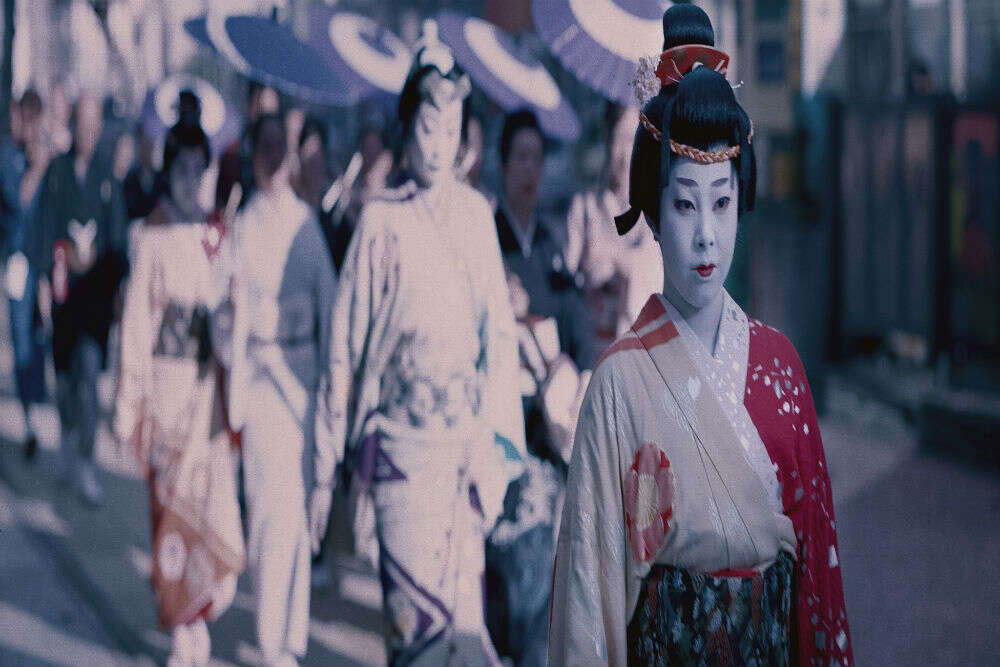 One of the most unusual festivals celebrated in Japan, the Okunchi Festival in Nagasaki dates back to the 17th century, when many Chinese lived in the city and when both Dutch and Chinese traders regularly anchored their ships there. For many years, the ruling shogun of Japan barred foreigners from other Japanese ports, and the few Dutch and Chinese ships that were allowed to stop in Nagasaki were the country's only point of contact with the non-Japanese world. The Okunchi Festival pays tribute to these traders by presenting both a Dutch dance and a Chinese dragon dance, along with processions, street fairs, and other entertainment.
The Dutch and Chinese dances are performed in an open area at the beginning of the many stairs that go to the Suwa Shrine. Two young women execute the Dutch dance, one of whom wears a false moustache and plays the part of a man. The two dancers bend at the waist, exchange coy smiles, and flirt with each other, to the amusement of the crowd. The Chinese dance features four dragons made out of cloth stretched over flexible frames. Each dragon conceals about a dozen dancers, who help it ‘dance’ with snakelike motions by manoeuvring the black rods attached to its body. The dragon dance re-enacts the legendary battle between darkness, symbolised by the dragon, and light, symbolised by the sun—a golden globe atop a long pole. Needless to say—the sun always wins.


In addition to dances, the Okunchi Festival also features the traditional procession of the mikoshi—the ornate palanquin on which the local deity is believed to descend for a ride as it is carried through the streets. The festival ends when the empty mikoshi returns to the shrine after the god has departed.

closecomments

Be the first one to review.
We have sent you a verification email. To verify, just follow the link in the message
end of article
Next story
Naga Fireball Festival
Visual Stories

10 pretty Indian villages to visit this year-end

8 castles in Germany straight out of a fairy-tale
8 tiger reserves every wildlife enthusiast should visit in India
10 animals that are easily spotted in Ranthambore National Park
How to prepare for a night safari in India?

9 rare animals to spot in the Western Ghats and where to find them


Trending Stories
6 incredible animals that are found only in India, and where tourists can see them
Russian traveller, now settled in India, shares 12 things that surprise her the most in this country
This remote village in Russia wakes up to “Hare Krishna”; how Indian travellers can reach here
7 countries where Indians can enjoy island vacations; all under INR 80,000!
48°C and counting: What India’s brutal heatwave is doing to summer travel plans




Comments (0)