
- News
- Sports News
- After Rio high, Indian gymnastics crash lands before Paris
Trending
This story is from August 1, 2024
After Rio high, Indian gymnastics crash lands before Paris
In 2016, when Dipa Karmakar finished fourth at the Rio Olympics, it wasn't just her performance that lived in the memory of Indian sports fans, it was also the term 'Produnova' that stayed.
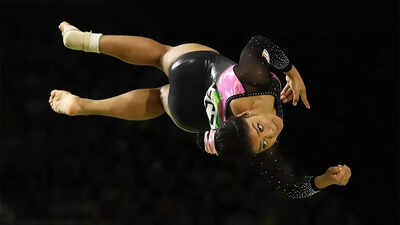
Pranati Nayak. (Photo by Mark Metcalfe/Getty Images)
The combination of Dipa and Produnova created a wave that many thought would inspire the generations to take a plunge in gymnastics in the country. Though the sport has been there in the country for years, Dipa was the first Indian gymnast to qualify for the Olympics.
However, four years later, it was only Pranati Nayak who qualified for the Tokyo Games. For Paris, India won't be sending any gymnasts. An advantage lost.
Eight years on since Rio, not much has changed in the sport. Gymnastics offers 55 medals at the Olympics, but India has not been able to tap the opportunity.
President of Gymnastics Federation of India (GFI), Sudhir Mittal, agrees that the political mess and a derecognition of the federation by the sports ministry for almost 10 years took the sport a few steps backward.
The working of the apex body for gymnastics in the country was marred by the infighting between two factions that led to the derecognition of the federation in 2011.
"Yes, the political trouble has somewhere restricted the progress of the sport. I wouldn't blame it alone on the political uncertainty, as there are other factors too that delayed the growth of the sport. I would say expensive equipment and various categories in the sport make conducting tournaments a herculean task. The cost to buy equipment is high and hence there are only a few state associations volunteering to host the Nationals," Mittal said.
Commonwealth Games champion Pranati Nayak seconds Mittal. "I can see now the juniors are performing well. But they are getting facilities only at a few centres. Bhubaneswar has very good facilities but I haven't seen other states and I can see there is a lot of improvement needed in terms of training facilities and equipment," Pranati says.
She recalls that she missed a music system when she started in 2002-03 in Kolkata. "When I started, there was no music system at our training centre in Kolkata, we got it only in 2021. Choreography is important for gymnasts," Pranati adds.
Growth stagnant, progress slow
Tanvi Jindal Shete, founder of Leap Gymnastics at JSW Sports, feels the absence of a structured approach has hurt the prospect of Indian gymnastics the most. "It is lack of a structured approach. In gymnastics, unless you've been practising since the age of 5, the system doesn't allow you to succeed. Suppose I'm 8-9 years old and have decided to take up gymnastics, it's very difficult for me to succeed in the system because the skills are so difficult to develop that by the time I've developed them, I'm not eligible to participate in that category. Due to that, a lot of children who might be interested in gymnastics don't take up the sport," Tanvi says.
Lack of good judges and conflict of interest
Another problem that mars the progress of Indian gymnastics is lack of quality judges. Tanvi highlights the need of having international-level judges to improve the standards of the sport. "Training of the coaches and judges in India is the need of the hour, because gymnastics is a subjective sport. The judges asses athletes based on difficulty and execution. While India has shown progress on difficulty, for example Deepa Karmakar and Pranati Nayak have a high D score, the execution is what is lacking because they lose a lot of points on execution which prevents them from moving forward, and a good judge can point out the problems at the national level," Tanvi says.
Kym Dowell, a former vice-president of the International Gymnastics Federation's technical committee, feels not just the gymnasts, but also the technical officials need to be trained through a systematic programme in India. "You have no one representing India at the Paris Games because you had only one or two (top gymnast). You need to have a lot to come through the system," the Australian says.
She feels in India, many coaches double up as judges during competitions. "In India, many coaches come up as judges. In Australia, we have judges who only judge. They should stick to their roles."
End of Article
FOLLOW US ON SOCIAL MEDIA








Top Sports News
TOP TRENDING
Explore Every Corner
Across The Globe
Popular Categories
Hot on the Web
Top Trends
IND vs AUSLas Vegas Cybertruck explosionVirat KohliDak Prescott vs Sarah JaneRohit SharmaBoston Celtics vs Minnesota TimberwolvesTop 10 US CollegesHailee SteinfeldCBSE 2025 Key ChangesKai CenatDallas MavericksJasprit BumrahIndiana Pacers vs Miami HeatJanuary Bank HolidaysRishabh PantCUET PG 2025 ApplicationJames Harden GirlfriendLive Cricket Score
Trending Topics
Living and entertainment
Latest News
NCP leader death case: Old enmity led to murder of Sachin Kurmi, 3 arrested, says Mumbai policeDelhi bizman suicide: Police to visit café owner's home to question kin, in-lawsDelhi air pollution: AQI closes in on 'very poor' zone; govt identifies 13 hotspots, 80 anti-smog guns to be installedBaba Siddique killing: BJP leader advises Salman Khan to 'apologise to Bishnoi community'BPSC exam row: This protest will continue, says Jan Suraaj chief Prashant KishorDelhi: DPCC notifies total ban on production, sale, use of firecrackers till January 1, 2025Rohit Sharma not even in 15 names on India's team sheet for Sydney Test'Shocked... He was family': Congress leader Priya Dutt pens heartfelt note for mentor Baba SiddiqueLeopard attempts to board minibus at Bengaluru's biological park, video goes viralNick Clegg steps down as meta chief global affairs officer to be replaced by…NCP leader Baba Siddique's last post on social media: '...happiness, peace and prosperity...'Udhay is my harshest critic; his feedback will be very honest: Kiruthiga UdhayanidhiSeven billionaires created by India’s IPO boom in 2024'No pulse, no cardiac activity': What Lilavati Hospital doctors said after Baba Siddique’s deathDelhi govt resumes crackdown on end-of-life vehicles after 8 months, here's everything you need to knowRam Charan's character Appanna to stutter in 'Game Changer': reports'Minimum decency should be maintained': Kolkata model’s outfit for Durga Puja pandal sparks debateBungalow No. 5 at Lutyen's Delhi to be Arvind Kejriwal's new home
Copyright © 2025 Bennett, Coleman & Co. Ltd. All rights reserved. For reprint rights: Times Syndication Service