
- News
- Sports News
- SAI may crack whip on some foreign coaches
Trending
This story is from September 13, 2018
SAI may crack whip on some foreign coaches
Some established foreign coaches in India may soon pay the price for their athletes’ poor performances at the Asian and Commonwealth Games, with the Sports Authority of India (SAI) about to begin a long-promised performance review of these highly-paid professionals.
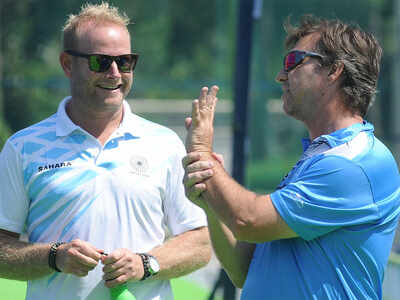
Indian Hockey coach Sjoerd Marijne and high performance director David John (TOI Photo)
Key Highlights
- SAI is about to begin a review of highly paid professional coaches
- The Rowing Federation of India (RFI) is unhappy with the training methods of 66-year-old Romanian Gioga
- Indian hockey’s director, David Ian John is under the spotlight after Indian men’s team finished a disappointing fourth at the CWG
NEW DELHI: Some established foreign coaches in India may soon pay the price for their athletes’ poor performances at the Asian and Commonwealth Games, with the Sports Authority of India (SAI) about to begin a long-promised performance review of these highly-paid professionals. SAI had promised such a review going into the Asiad in Jakarta-Palembang.
Some of the names on SAI’s radar include middle and long-distance coach Nikolai Snesarev, race walking coach Alexander Artsybashev, Indian women boxing performance director Raffaele Bergamasco and rowing coach Nicolae Gioga, among others. Foreign coaches are well paid in India, with most earning in the range of $6000-$8000 a month. Coaches involved with prominent sports like hockey earn ever higher.
The Rowing Federation of India (RFI) is unhappy with the training methods of 66-year-old Romanian Gioga and a termination of his contract looks likely. During the Asiad, Indian rowers won a gold and two bronze, but according to the RFI, the contingent could have returned with more medals had the coach not forced his gruelling training regime on rowers.
Bergamasco’s training methods are also in the spotlight after India’s women pugilists returned empty-handed from the Asiad, with none getting past the quarterfinal stage. In the Gold Coast CWG too, except for Mary Kom’s gold, none of the other women boxers managed a medal.
Mary Kom, incidentally, has her own coaching and support staff and only takes guidance from the Italian when part of the national camp. With Delhi hosting the women’s world boxing championships in November, Bergamasco might get a one-event extension.
Artsybashev’s coaching technique came under severe criticism after four of the country’s leading race walkers — KT Irfan, Manish Rawat, Sandeep Kumar and Soumiya B — were disqualified at the Asiad, with only 20km race walker Khushbir Kaur managing a fourth-place finish.
At the CWG, none of his trained athletes managed a creditable finish, returning empty-handed from the event, while Soumiya B was again disqualified. Artsybashev’s contract had already expired on April 29 but he was offered an extension till the Asiad.
Snesarev, on the other hand, hardly has any track athlete of note training under him now. All the middle and long-distance runners who participated at the CWG and Asiad were trained by other coaches. The Athletics Federation of India (AFI) isn’t interested in continuing with his services.
Indian hockey’s high-performance director, David Ian John, too is under the spotlight after the Indian men’s team finished a disappointing fourth at the CWG while, at the Asiad, the boys settled for a bronze after losing the semifinal to Malaysia. Indian men had won gold at the 2014 Asiad and SAI, it is expected, may ask for a detailed explanation from John. However, with the Hockey World Cup in Bhubaneswar a couple of months away, he may get to stay a little longer.
Trap-shooting coach Marcello Dradi, meanwhile, has been diagnosed with tumour and will undergo a surgery. It’s understood that Asiad was his last assignment.
Some of the names on SAI’s radar include middle and long-distance coach Nikolai Snesarev, race walking coach Alexander Artsybashev, Indian women boxing performance director Raffaele Bergamasco and rowing coach Nicolae Gioga, among others. Foreign coaches are well paid in India, with most earning in the range of $6000-$8000 a month. Coaches involved with prominent sports like hockey earn ever higher.
The Rowing Federation of India (RFI) is unhappy with the training methods of 66-year-old Romanian Gioga and a termination of his contract looks likely. During the Asiad, Indian rowers won a gold and two bronze, but according to the RFI, the contingent could have returned with more medals had the coach not forced his gruelling training regime on rowers.
Bergamasco’s training methods are also in the spotlight after India’s women pugilists returned empty-handed from the Asiad, with none getting past the quarterfinal stage. In the Gold Coast CWG too, except for Mary Kom’s gold, none of the other women boxers managed a medal.
Mary Kom, incidentally, has her own coaching and support staff and only takes guidance from the Italian when part of the national camp. With Delhi hosting the women’s world boxing championships in November, Bergamasco might get a one-event extension.
Artsybashev’s coaching technique came under severe criticism after four of the country’s leading race walkers — KT Irfan, Manish Rawat, Sandeep Kumar and Soumiya B — were disqualified at the Asiad, with only 20km race walker Khushbir Kaur managing a fourth-place finish.
At the CWG, none of his trained athletes managed a creditable finish, returning empty-handed from the event, while Soumiya B was again disqualified. Artsybashev’s contract had already expired on April 29 but he was offered an extension till the Asiad.
Snesarev, on the other hand, hardly has any track athlete of note training under him now. All the middle and long-distance runners who participated at the CWG and Asiad were trained by other coaches. The Athletics Federation of India (AFI) isn’t interested in continuing with his services.
Indian hockey’s high-performance director, David Ian John, too is under the spotlight after the Indian men’s team finished a disappointing fourth at the CWG while, at the Asiad, the boys settled for a bronze after losing the semifinal to Malaysia. Indian men had won gold at the 2014 Asiad and SAI, it is expected, may ask for a detailed explanation from John. However, with the Hockey World Cup in Bhubaneswar a couple of months away, he may get to stay a little longer.
Trap-shooting coach Marcello Dradi, meanwhile, has been diagnosed with tumour and will undergo a surgery. It’s understood that Asiad was his last assignment.
End of Article
FOLLOW US ON SOCIAL MEDIA
Visual Stories





Top Sports News
TOP TRENDING
Trending Stories
In Sports
Entire Website
- When Mohinder Amarnath called BCCI selectors 'a bunch of jokers'
- Exclusive: Rishabh Pant is biggest match-winner for India, and is yet to hit his prime, says Mohammad Kaif
- 'Play Dhoni, Sell Kohli, Bench Rohit': Michael Vaughan stuns cricket fans
- 'One of the best...': India fielding coach T Dilip lauds Yashasvi Jaiswal's catch at gully, praises Virat Kohli's intensity in the field
- When and where to watch England vs Australia 3rd ODI: Date, time, venue, squad, broadcast details
- Qatar to host relaunched FIFA Intercontinental Cup 2024, Real Madrid in final
- When MS Dhoni's young Indian team became World Champions
- Chess Olympiad: Arjun Erigaisi attributes teams' success to great bonding
- 'Relaxed rancho': R Ashwin compares the coaching styles of Gautam Gambhir and Rahul Dravid
- Will India rest Jasprit Bumrah; who will be third spinner - Kuldeep Yadav or Axar Patel? What's the game plan for Kanpur Test
- Muda case: BJP trying to destabilise Karnataka govt, says CM Siddaramaiah on HC order
- Badlapur locals happy with ‘encounter’ of Akshay Shinde, distribute sweets
- Why do Indians glorify overwork even if it kills them?
- Hospitals overwhelmed, tens of thousands flee Lebanon amid Israeli airstrikes
- Mice found on prasad packets at Mumbai's Siddhivinayak Temple; probe on
- Missiles in living room: Israel releases photos of Hezbollah’s arms in civilian homes
- Who knew a sore back could lead to a painful divorce?
- Apple cuts price of iPhone 15 & iPhone 14 models, here's new price list
- 'NRI business is fraud': SC junks Punjab govt's plea against HC verdict
- When Mohinder Amarnath called BCCI selectors 'a bunch of jokers'

Popular Categories
Hot on the Web
Top Trends
Trending Topics
Living and entertainment
Latest News
CG Vyapam admit cards released for HELT24 and FF124 exams at vyapam.cgstate.gov.in: Direct link to download hereSEBI fines Anil Ambani’s son Rs1cr for loan approvals without 'due diligence'Swara Bhasker-Fahad Ahmad's daughter Raabiyaa turns one; see how the doting parents celebrated the special day with cake, balloons and moreTest | War 2: Hrithik Roshan, Kiara Advani's romantic chemistry grabs attention in viral picsFamily kills rape survivor, frames 'rapist' out on bailEC to have 'zero tolerance' towards use of money power in Jharkhand assembly pollsThrowback: When Parineeti Chopra shined in yellow during her joyful haldi ceremony celebrationsAPPG pushes for Ayurveda integration in UK’s healthcare systemBorder Gavaskar Trophy: When Steve Smith had a 'brain fade' moment against IndiaICAI CA Final Exam for Nov 2024 postponed due to Diwali, new exam date announced: Check official notice hereEpic Last 'Monster' Standing match and more exciting matches announced for WWE RAW (9/30)Best Time To Upgrade To 4G & 5G Tablets: Lightning-Fast Performance At Unbeatable PricesEssential tips for building and maintaining a happy marriageWhen and where to watch England vs Australia 3rd ODI: Date, time, venue, squad, broadcast detailsThe Luckiest Zodiac Signs: Who's Got the Midas Touch?BJP plans protests over reopening of ‘old cases’When Remo D'Souza opened up about his heart attack and revealed how Salman Khan stayed in constant touch with his wife over the phoneWB ANM, GNM result 2024 out: Direct link to download rank card here
Copyright © 2024 Bennett, Coleman & Co. Ltd. All rights reserved. For reprint rights: Times Syndication Service