
- News
- Science News
- Saturn's rings are younger than the planet itself
This story is from January 18, 2019
Saturn's rings are younger than the planet itself
Saturn's rings appeared within the last 10- 100 million years. Saturn formed about 4.5 billion years ago, along with the rest of the planets and spent the bulk of its existence without the characteristic rings it is known for today. Astronomers have long believed the rings could be young, formed by collisions between the moons of Saturn or by a comet.
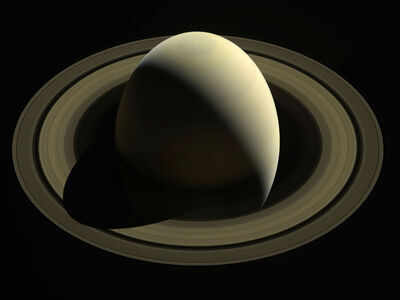
File photo shows one of the last full views of Saturn by the Cassini spacecraft acquired at a distance of approximately 870,000 miles: AFP
The sixth planet from theSun formed about 4.5 billion years ago, along with the rest of the planets in our solar system, and spent the bulk of its existence without the characteristic rings it is known for today.
Astronomers have long believed therings could be young, and perhaps formed by collisions between the moons of Saturn or by a comet that shattered in close proximity to theplanet.
Some of these answers have come into sharper focus because of Cassini, an unmanned US-European probe that launched in 1997 and ended in 2017 with a planned death plunge into Saturn's surface.
At the end of its mission, Cassini made 22 orbits, circling between Saturn and its rings, getting closer to them than any spacecraft in history.
By studying how the flight path of Cassini was deflected by the gravity of therings, scientists were able to deduce therings' mass and approximate age.
"Only by getting so close to Saturn in Cassini's final orbits were we able to gather the measurements to make the new discoveries," said lead author Luciano Iess of Sapienza University of
Rome.
Understanding therings' age and mass is "a fundamental goal of its mission," he added.
A lesser mass indicates youngerrings because as they age, therings would attract more debris and grow heavier.
Theringsare made up of 99 percent ice.
The study did not delve into the question of where therings came from, but supported theories such as a comet or moon collision.
End of Article
FOLLOW US ON SOCIAL MEDIA
Photostories

Hot Picks
TOP TRENDING
Popular Categories
Hot on the Web
Top Trends
Russell WilsonsMohammed ShamiTom BradyRishabh PantShantanu NaiduPakistan Cricket FanNobel Peace PrizeMahadev Betting AppNew UPI Transaction LimitRatan Tata DiesCBSE Class 10 12 Practical ExamPopular Schools in Navi MumbaiManagement Colleges of IndiaTop Medical Colleges of IndiaTop Engineering Colleges of IndiaTop Pharmacy Colleges of IndiaLive Cricket Score
Trending Topics
Diwali WishesDussehra 2024 QuotesDussehra WishesVettaiyan OTT ReleaseVettaiyan CollectionVettaiyan ReviewNatasa StankovicDevara CollectionBigg Boss 18Deepika PadukoneShraddha KapoorRatan Tata Passed AwayJigra Movie ReviewVettaiyan Movie ReviewSwatantrya Veer SavarkarDussehra 2024Elon MuskKing Legacy CodesUltimate Football Codes October 2024Wordle Answer
Living and entertainment
Latest News
Internship scheme: 193 companies post over 90,000 slots on portalApplications for new power connections among services moved exclusively onlineSara Arfeen Khan opens up about converting to Islam; says, 'I read all holy books and attended a lot of religious debates before converting'Amitabh Bachchan, Rambha, Khushboo and others check in on Govinda after gun misfire incident - ExclusiveCops on unusual hunt: For denturesDiscover 8 animals that suck blood for survivalHappy Dussehra 2024: Top 50 Wishes, Messages, Images and Quotes to Share with Your Loved OnesFortified-food plan faces questions from two PM panel membersKrushna Abhishek shares a heartwarming post for mama Govinda; says 'jab body mein adha blood supremely talented actor Govinda ka ho...'Could Tyreek Hill Return to the Chiefs? Cryptic Posts Fuel Trade SpeculationWith special access card, disabled people can skip Exposition queuesForex reserves drop $3.7 billion in week, most since start of AugustHow Green is your car?Robert Gronkowski Reacts to His Hilarious Impression in FX's American Sports Story: Aaron HernandezIf Rahul Gandhi fails to deliver, INDIA bloc may make LoP post rotational: BJP‘Kallanum Bhagavathiyum’: The Vishnu Unnikrishnan and Mokksha starrer is set to get a sequelAlia Bhatt, Bipasha Basu, Rhea Chakraborty and others seek blessings at Kajol and Rani Mukerji's Durga Puja pandal - See photosThane: Man dies in brawl over torn Rs 50 note
Copyright © 2024 Bennett, Coleman & Co. Ltd. All rights reserved. For reprint rights: Times Syndication Service