
- News
- Science News
- Nasa celebrates two years of James Webb with stunning images of the ‘Penguin and the Egg’ galaxies
Nasa celebrates two years of James Webb with stunning images of the ‘Penguin and the Egg’ galaxies
In celebration of the James Webb Space Telescope’s second anniversary, NASA released an image of colliding galaxies dubbed 'Penguin and the Egg.' The Penguin galaxy, once spiral, now mirrors a penguin due to gravitational interaction with the elliptical Egg galaxy, resulting in waves of star formation. The Egg galaxy remains relatively undisturbed by this dynamic process.
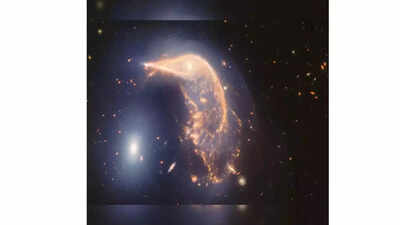
The "Penguin" galaxy was formerly a spiral galaxy but has now changed to resemble a penguin, complete with head, beak, and tail that fanned out. In the meantime, the elliptical "Egg" galaxy, which is home to many old stars, has managed to hold onto its small size. The goal of the James Webb Space Telescope is to discover and investigate, as this cosmic ballet highlights.
What is the James Webb telescope? What does it do?
The James Webb Space Telescope is the largest and most powerful space telescope ever built, studying the history of our Universe from the Big Bang to the evolution of our own Solar System. It orbits the Sun 1.5 million kilometres away from Earth, capturing images of early galaxies, observing objects in our solar system, and examining planets' atmospheres.
Merging of two galaxies
The "Penguin" galaxy in this remarkable image was formerly a spiral galaxy, but its interaction with the "Egg" galaxy has caused it to undergo a drastic transformation. The Penguin's spiral arms have taken on features like a beak, head, backbone, and tail because of the gravitational forces at work; its galactic centre glows like an eye. The Penguin galaxy, which is abundant in gas and dust, goes through waves of star formation as a result of its gravitational tug-of-war with the Egg galaxy.
In contrast, the "Egg" galaxy has managed to hold onto its tight elliptical shape. The Egg galaxy is not as disrupted or as star-forming as the Penguin galaxy, with its ageing stars and significantly less gas and dust. In the event that both galaxies had been spirals, the interaction would have produced tidal tails, which are gas and star-twisted trails. It would also have led to new star formation.
NASA reported that the Penguin has not been able to devour or warp the smaller-looking elliptical Egg galaxy because of the two galaxies' nearly similar masses.
Also Read: |Delta Aquariids meteor shower: When, where and how to watch the celestial event

About the Author
TOI Science DeskEnd of Article
FOLLOW US ON SOCIAL MEDIA
Photostories

Hot Picks
TOP TRENDING
Popular Categories
Hot on the Web
Top Trends
Top Largest Economies in the worldMohamed Muizzu India VisitIsrael Hezbollah WarTravis KelceAssembly Election Result 2024 DateENG vs SA Live ScoreSunil GavaskarKayla NicoleDipa KarmakarHaryana Assembly Constituencies 2024Top Pharmacy Colleges of IndiaDiddyWomen's T20 World CupTop MBA Colleges of IndiaT20 WC ScheduleWomen T20 World Cup Points TableLive Cricket Score
Trending Topics
Bigg Boss 18 Launch LIVE UpdatesBigg Boss Tamil 8 Contestants ListBigg Boss Tamil 8 Launch LIVE UpdatesNavratri Colours 2024Navratri Day 2 ColourDurga Puja 2024Bigg Boss 18 House PhotoDevara CollectionNita AmbaniDeepika PadukoneGovindaDevaraGovinda NewsDevara Movie ReviewSwatantrya Veer SavarkarColdplay India tour 2025Watch NFL Live StreamDress To ImpressCall Of Duty Black Ops 6Wordle Answer
Living and entertainment
Latest News
Ranveer Singh: I have a man crush on Tiger ShroffGhum Hai Kisikey Pyaar Meiin: Savi accuses Jigar of misbehaviourYouTube Shorts extends duration to 3 minutes5 must follow rules of Ayurveda to lose 5kg in 30 daysONGC Apprenticeship Recruitment 2024 registration begins: Check direct link hereWWE Hall of Famer Diamond Dallas Page signs new WWE Legends deal'Like a ghost': Manish Sisodia says Arvind Kejriwal has become PM Narendra Modi's 'sole obsession''Singham Again' Trailer: Ranveer Singh kisses wife Deepika Padukone's poster as she skips grand launch eventMy effort in internationalising Shatatantri Veena among the next generation seemingly paying dividends says Tarun Bhattacharya on his return from US TourOptical Illusion: Can you find who's the boss in this picture?'All teams will come to Pakistan for Champions Trophy': PCB chairman on India's participation‘Ke Prothom Kachhe Eshechi’s Mihi aka Radhika Karmakar makes an appearance in ‘Rannaghar’ with her motherVaibhav & Athulya Ravi's 'Chennai City Gangsters' trailerBest Gaming Laptops Under 60000 That Deliver High Performance'Toolkit used to open trunk, paper scanned': CBI gives full details of how UG-NEET paper was leaked'Nervous Nineties': Sachin Tendulkar’s 'unwanted' record in international cricketCleveland Browns coach Kevin Stefanski said the team is “not changing quarterbacks” after Deshaun Watson's poor performanceBigg Boss 18: Chum Darang and Shehzada Dhami lock horns as the latter passes comments on her ethnicity; here’s how she reacted
Copyright © 2024 Bennett, Coleman & Co. Ltd. All rights reserved. For reprint rights: Times Syndication Service