
- News
- NRI News
- NRI Achievers News
- Nine Indian American youths named 2011 Davidson Fellows
This story is from September 15, 2011
Nine Indian American youths named 2011 Davidson Fellows
Nine Indian Americans from around the country accounted for half of the 18 bright young people recently named 2011 Davidson Fellows who exemplify the extraordinary work that can be accomplished by students in the United States when given opportunities to excel.
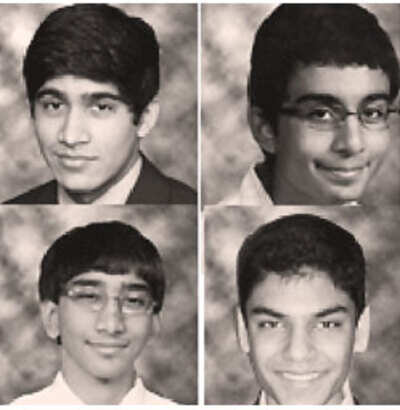
Nine Indian Americans from around the country accounted for half of the 18 bright young people recently named 2011 Davidson Fellows who exemplify the extraordinary work that can be accomplished by students in the United States when given opportunities to excel.
Based on their achievements in the fields of science, technology, mathematics, music and literature, four of the Indian American students will receive $25,000 while the other five will receive $10,000 scholarships from the Davidson Institute for Talent Development, a national non-profit organization headquartered in Reno, Nev., that supports profoundly gifted youth.
The $25,000 scholarship recipients are Arjun Aggarwal, 16, of Columbia, South Carolina; Siddhartha Jena, 17, of Bloomfield Hills, Mich.; Caleb Kumar, 15, of Blaine, Minn.; and Sunil Pai, 17, of Houston, Texas.
The $10,000 scholarship recipients are Cheenar Banerjee, 16, of Rochester, Minn.; Jayanth Krishnan, 17, of Mahopac, New York; Anirudh Prabhu, 16, of West Lafayette, Ind.; Shalini Ramanan, 17, of Richland, Wash.; and Raja Selvakumar, 15, of Alpharetta, Georgia.
Priyanka Menon, of Ann Arbor, Mich., received honorable mention for her work on “Indo-US Relations Through Philosophy and Literature.”
To win his $25,000 scholarship in the category of technology, Aggarwal created GNut-III, an Anthropometric Interactive Robot with Vision, Intelligence and Speech. He found the lack of an economically efficient and functional human robot has prohibited researchers from continuing to expand the field of robotics. To counter this, the GNut-III is economically efficient and functional for testing robotic algorithms.
In the science category, Jena demonstrated that the immediate effect of elevated cholesterol is dysfunction of active water, oxygen, and carbon dioxide transport by the red blood cells.
Using a spectrofluorometer and Zeta Sizer, he showed that exposure of red blood cells to two compounds, ONO-RS-082 and glyburide, results in an amelioration of cholesterol’s detrimental effects.
Also in the science category, Kumar developed an algorithm that automates the diagnosis of bladder cancer. The software is accurate, quick and inexpensive compared to current methods, and has the potential to provide faster, cheaper and more precise diagnoses of cytological diseases.
In science as well, Pai constructed an inexpensive, nanotechnology-based system to determine quantum energies of superoxide. By examining oxygen in the liquid phase instead of the gas phase, his potentiostat system can determine the quantum structure for the electron attachment reaction of oxygen to superoxide. This will offer new insights into biological and environmental processes.
In the category of technology for the $10,000 scholarship, Banerjee developed a method for emotion detection by computers.
In the science category, Krishnan developed an approach to infer regulatory mechanisms governing changes in gene expression and identified possible proteins that induce cancer.
In mathematics, Prabhu established the first nontrivial analytic lower bounds for odd perfect numbers. The search for odd perfect numbers is one of the oldest unsolved problems in mathematics.
In science, Ramanan worked with Bisdemethoxycurcumin, a natural dietary component of the spice turmeric, to test its effectiveness in treating cardiovascular diseases.
Also in science, Selvakumar developed the Gastro Microbial Fuel Cell. Based on the microbial fuel cell, the GMFC generates electricity using gastrobacteria to be used to power capsular nanobots.
Source: India West
End of Article
FOLLOW US ON SOCIAL MEDIA

Hot Picks
TOP TRENDING
Popular Categories
Hot on the Web
Top Trends
Trending Topics
Devara CollectionNavya Naveli NandaPawan KalyanJungle SafariStree 2 OTT ReleaseRose GardenDevara CollectionOTT Release MovieMasala OmeletteEmergencyDevaraTaaza Khabar 2 Twitter ReviewDevara Movie ReviewHealthy RaitasSwatantrya Veer SavarkarColdplay India tour 2025Smartphone DealsApple Macbook Air M1Amazon SaleWordle Answer
Living and entertainment
Latest News
WWE Superstar The Rock's Daughters: Everything You Need to Know About Simone, Jasmine, and TianaThe Power of Color: Zodiac Signs and Their Energetic HuesAir Arabia launches early bird promotion on 500,000 seats from INR 5,727!'That was the last time I saw my friend': Rahul Gandhi remembers Sitaram YechuryTulsi Gabbard calls Kamala Harris shameless as VP inspects US-Mexico border: 'No conscience'Guneet Monga says, 'films with American distributors should be sent for competition'SC handbook lists terms to be avoided to refer to persons with disabilities, provides alternativesScrap dealer dad celebrates son's board exam success by gifting multiple iPhones | Watch videoForeign investment hits record high with Rs 23,600 crore inflows this weekWatch: Pakistan Test team head coach Jason Gillespie to make changes only after...Ex-WWE Writer Vince Russo Voices Frustration Over Triple H's Handling of LA KnightQueen Camilla does not want King Charles to meet Prince Harry because...Mapusa rain surges past 4,000mm markCongress leader Pawan Khera asserts people of Haryana want change ahead of assembly electionsHow Nick Sirianni's game-changing call turned out to be a turning point in Parris Campbell’s careerZodiac Signs as Barbie Dolls: Finding Your Cosmic DollAnupam Kher, Ranvir Shorey express their delight as Khosla Ka Ghosla returns to theatres after 18 years: 'A new generation will experience its magic'Money mania! For IPL players, Jay Shah introduces a whopping match fee of Rs...
Copyright © 2024 Bennett, Coleman & Co. Ltd. All rights reserved. For reprint rights: Times Syndication Service