
- News
- Where can people in love go in Delhi: Ravish Kumar
This story is from November 30, 2015
Where can people in love go in Delhi: Ravish Kumar
The short love stories are practically love triangles – the two lovers and the city of Delhi being the main protagonists.
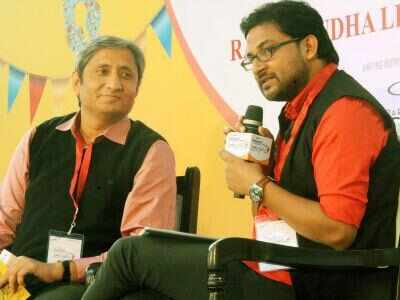
The short love stories are practically love triangles – the two lovers and the city of Delhi being the main protagonists.
The bite-sized single paragraph love stories by journalist and author Ravish Kumar are firmly embedded in the Delhi of the everyday. Not for him the grand, monumental, and famous landmarks like the Qutub Minar, or the recognizable lanes of central Delhi.
The stories navigate through the Brapullah flyover instead.
Ravish read from his book Ishq Mein Shahar Hona at the Times Lit Fest Delhi on Monday, along with Vineet Kumar who read from his Ishq Koi News Nahin. They call this short format of stories “Laprek” – an acronym for Laghu Prem Katha (Short love story). Ravish and Vineet, along with Girindra Nath Jha, had been writing their Laprek for an online audience on their Facebook feeds since 2012, before publisher Satyanand Nirupam spotted them. Ravish calls their stories “low budget ka pyaar” (low budget love). Written variously in the middle of traffic jams, and even public loos by Vineet’s own admission, the little stories have now been published as a compilation.
The love stories the two read out were centered on mundane daily tasks like shopping in Sarojini Nagar, riding the metro, and having momos from a Lajpat Nagar street corner. Lines like “Tum green line waale kabhi rapid line waalon ko nahin samajh paoge,” (You green line people will never understand the rapid line ones) drew much laughter and applause from the audience.
“If somebody falls in love in Delhi, where do they go? In the Delhi of coffee table books and NCERT textbooks, I would see the monuments the streets of old Delhi. I came here and had to familiarize myself with Govindpuri. And I realized the various Aggarwal Sweets corners are much more useful landmarks than the monuments,” said Ravish, before launching into a story about a couple struggling to find an intimate moment in an autorickshaw.
Despite the city of Delhi being the centerpiece of the stories, they retain a strong sense of being outsiders from smaller towns. Distant from the sparkly and posh world of India Habitat Center, and winding their way through Rithala in the metro. “There was always a city versus village dichotomy in what we would read, where the village was all pure and the city was the den of evil. We wanted to break that sense,” says Vineet.
End of Article
FOLLOW US ON SOCIAL MEDIA
Photostories

Hot Picks
TOP TRENDING
Popular Categories
Hot on the Web
Top Trends
Travis KelceIsrael Hezbollah WarIND vs PAK Live ScoreElection Exit PollsIND vs BAN Live ScoreKayla NicoleShan MasoodPrince WilliamAmethi Murder CaseAssembly Election Result 2024 LiveUGC NET ResultDiddyWomen's T20 World CupTop MBA Colleges of IndiaT20 WC ScheduleWomen T20 World Cup Points TableLive Cricket Score
Trending Topics
Bigg Boss 18 Launch LIVE UpdatesBigg Boss Tamil 8 Contestants ListBigg Boss Tamil 8 Launch LIVE UpdatesNavratri Colours 2024Navratri Day 2 ColourDurga Puja 2024Bigg Boss 18 House PhotoDevara CollectionGOAT OTT ReleaseDeepika PadukoneGovindaDevaraGovinda NewsDevara Movie ReviewSwatantrya Veer SavarkarColdplay India tour 2025Maa Durga 108 NamesNavratri JewellerySony Bravia 55 inch 4k Ultra HD TVWordle Answer
Living and entertainment
Latest News
49ers' Christian McCaffrey May Return in Week 7 Against Chiefs, Adam Schefter Shares Latest Injury UpdateBigg Boss Tamil 8: Sunitha Gogoi to dazzle with dance performance from Vijay’s film 'GOAT'Zodiac Sign Women Who Cherish Independence"Will form govt in both Haryana, J-K": BJP's Tarun Chugh on upcoming Assembly elections resultsCongress' Jairam Ramesh highlights 'three dark clouds' threatening Indian economy's growthRevealed: The real reason Taylor Swift was missing from Travis Kelce's birthday celebrationFans shower praises for Indira Krishna's role Paani Bai in Durga writes, "She's Lady Nana Patekar, Yeh toh Komolika ka bhi record todegi"Will Varun Dhawan, Shraddha Kapoor, and Kriti Sanon come together in 'Stree' x 'Bhediya' film?Bigg Boss Tamil 8: Actress Sachana Namidass to participate in the upcoming season?Amul ready to enter European market after US: MDFlash flooding kills three in northern ThailandIdentifying PCOS and when to seek help from professionalsYamuna river pollution hits record high in Delhi: Faecal coliform levels soar in SeptemberMayank Yadav set to become a capped player ahead of IPL auction'No need to think about India's foreign policy': BJP' Kavinder Gupta on Mirwaiz Farooq statementBigg Boss 18 Promo: Salman Khan reveals the theme of the season by predicting the contestants' future in the houseBigg Boss Tamil 8: Ex-contestant Pradeep Anthony to participate in the upcoming season?State reminds pvt med colleges to follow SC mandate, resume admissions; colleges wait for assurance on fee reimbursements
Copyright © 2024 Bennett, Coleman & Co. Ltd. All rights reserved. For reprint rights: Times Syndication Service