
5 paintings of Amrita Shergill and what makes them so extraordinary

5 paintings of Amrita Shergill and what makes them so extraordinary
Amrita Sher-Gil’s paintings feel alive in a way that resists easy classification. Born in 1913 to a Hungarian mother and Sikh aristocrat father, trained in Paris and transformed by India, she fused Western modernism with Indian subjects at a moment when Indian art was searching for a new voice. Her life was tragically short; she died at just 28, but in that brief span, she produced works that still feel daring, tender, and unsettlingly honest. Here are five of her most celebrated paintings and what makes each one extraordinary.
Image Credit: Wikipedia

Three girls (1935)
Perhaps Sher-Gil’s most iconic work, Three Girls, shows three young women sitting close together, wrapped in simple saris, their expressions distant and heavy with thought. Nothing dramatic is happening, and that is exactly the point.
What makes this painting remarkable is its psychological depth. The women are physically near yet emotionally isolated, each lost in her own interior world. Sher-Gil avoids prettiness; instead, she uses muted browns, ochres, and reds to suggest heat, stillness, and social constraint. Their slumped postures quietly hint at limited choices and unspoken resignation.
At a time when Indian women were often idealised or romanticised in art, Sher-Gil painted them with startling realism and empathy. The painting feels modern even today because it refuses sentimentality and instead asks the viewer to sit with discomfort and quiet truth.
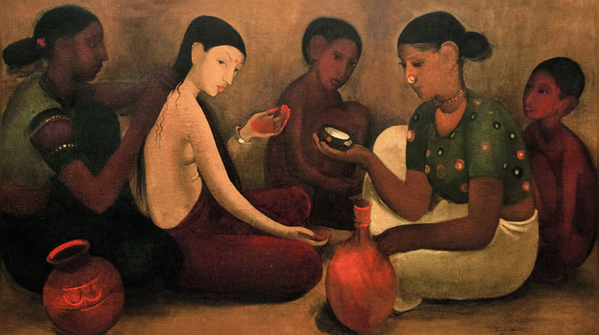
Bride’s toilet (1937)
In Bride’s Toilet, Sher-Gil depicts women preparing a bride before her wedding, an intimate domestic ritual usually hidden from public view. The figures cluster together, absorbed in their task, while the bride herself sits in the centre, thoughtful rather than celebratory.
What elevates this scene is its emotional ambiguity. Marriage is conventionally associated with joy, yet Sher-Gil gives the bride a subdued, almost apprehensive presence. The warm reds and earthy tones glow, but the mood remains restrained.
Compositionally, the painting echoes miniature traditions in Indian art, with its flattened space and close grouping of figures, while also carrying the influence of European realism. It becomes a bridge between cultures, with Indian subject matter rendered with a cosmopolitan painter’s eye.

Self-portrait (1930)
Sher-Gil painted several self-portraits, but the one from 1930, created when she was just 17 and studying in Paris, is especially arresting. She looks directly at the viewer, shoulders bare, eyes alert and questioning.
What makes this portrait extraordinary is its fearless honesty. There is no attempt to soften her features or present herself as demure. Instead, she appears confident, curious, and intensely self-aware, a young woman claiming her identity at a time when such bold self-representation was rare.
The restrained colour palette and controlled brushwork show her technical mastery, but the emotional power comes from the gaze. It is steady, almost challenging, as if she is asking the world to take her seriously long before it was ready to do so.

Village scene (1938)
In works like Village Scene, Sher-Gil turned her attention fully toward rural India. The figures are sturdy and monumental, their bodies simplified into broad shapes that feel rooted to the land.
What distinguishes this painting is its dignity. Sher-Gil does not portray village life as picturesque or exotic. Instead, she emphasises physical labour, endurance, and quiet routine. The earthy reds and browns mirror the soil itself, binding people and place together.
There is also a sculptural quality to the figures, influenced by Ajanta frescoes and Indian temple art. Sher-Gil was not merely documenting rural life; she was searching for a visual language that felt authentically Indian while remaining modern.
South Indian villagers going to market (1937-38)
Another late masterpiece, South Indian Villagers Going to Market, captures a group of women walking together, baskets balanced, bodies angled rhythmically across the canvas.
What makes it unforgettable is movement and unity. The figures form a slow, graceful procession, almost musical in their repetition. Their faces are calm, their steps purposeful. Sher-Gil’s brushwork becomes broader here, less concerned with detail and more with flow and mass.
The painting celebrates everyday life without romantic excess. These are not symbolic figures; they are working women moving through the heat and dust of ordinary days. In giving them such compositional weight and grace, Sher-Gil quietly elevates routine labour into something monumental.

Why these paintings still matter
Across these works runs a common thread: Sher-Gil’s refusal to idealise. She painted women thinking rather than posing, villagers enduring rather than performing, and herself looking back at the viewer instead of away. Her colours are rich but restrained, her compositions deliberate, and her subjects grounded in lived experience.
What makes Amrita Sher-Gil extraordinary is not just her technical brilliance but also her empathy and her courage. She looked at India, and at herself, without illusion, and in doing so created images that still feel intimate, searching, and unmistakably modern nearly a century later.
Featured In lifestyle

MORE FROM ETIMES
life & style