Trending
This story is from November 25, 2012
Open house
With a playwright, director and actor in the family, a play turns into a housewarming gift
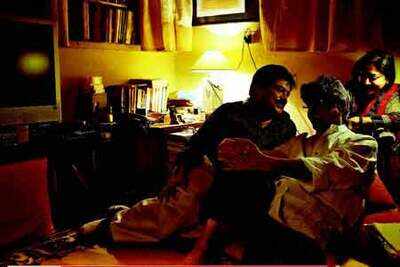
With a playwright, director and actor in the family, a play turns into a housewarming gift
It’s a room large enough to hold three happy people, a mob of books, table lamps trained to scatter gentle light, a picture of Urdu-Persian poet Mirza Ghalib and a framed sheet of frail paper that carries Ghalib’s couplet in his own handwriting.
But two sketches hold pride of place at scriptwriter Javed Siddiqui’s Four Bungalows office — a sketched interpretation of the climax of Shatranj ke Khiladi made by its director Satyajit Ray, and a drawing by late artist MF Husain inspired by Siddiqui’s Hindi play, Aapki Soniya. “Husain was a great friend. As soon as I had finished narrating the script, he handed the sketch over to me, saying, ‘here’s your poster’,” smiles Siddiqui about the sequel to the legendary production Tumhari Amrita, that’s enjoyed a 20-year run.
“It was the third play that my son-inlaw Salim (Arif) directed for our theatre group Essay Communications.”
Minutes later, Arif arrives, kicking off banter over repeated rounds of chai. The trio quickly clarifies that they don’t operate as ‘professionals’. “We just sit and chat. And it’s while talking that something interesting springs up, and we decide if we’d like to turn it into something,” explains Siddiqui.
Theatre, in the family’s words, is a mad passion best pursued collectively. In fact, a few years ago, when Lubna and Arif bought a new apartment at Oshiwara, Siddiqui decided to plan a house-warming gift. The two were presented a play — Mulla Re Mulla.
The trio’s intention is to pursue theatre of a certain kind, with an emphasis on language and literature. This principle manifests itself in productions like Hum Safar, Kachche Lamhe and Kharaashein.
Despite the common goal, creative differences are inevitable, they admit. But arguments rarely travel back home. “After a point, I detach myself. I become the audience. I don’t take myself too seriously,” says Arif. “That’s a great quality about him,” smiles Lubna.
Siddiqui says working with his children sharpens the challenge. “When I am working with the two of them, my duty doubles. I fight, stage walkouts, make things difficult for them — it’s all for the good of theatre.” At home, Lubna says, he is ‘papa’. “He turns into Javed Siddiqui when it comes to work. But like us, he too is receptive to feedback.”
What helps is an internal specialisation of sorts. Siddiqui handles the writing, Arif helms direction and Lubna takes the stage. And Arif is happy to be the backbencher. “I always let my writers have the final word. It’s their play. The play is always known by the writer. The director is just an interpreter of the story.”
Siddiqui is unwilling to gobble credit. The director, he explains, is the one to figure the pulse of the audience. “I sit in a corner in my room jotting down notes based on my conviction.”
In the case of their 2006 production Kachche Lamhe — based on Gulzar’s short story Seema — the climax was altered a few times before they blocked the final act. “Salim (Arif) created something that was not in my mind or Gulzar’s. And it worked,” exults Siddiqui.
“And what about the actor?” Lubna asks in mock protest.
The couple met through Siddiqui’s wife Farida, who was working along with a young Arif on the costumes of Shyam Benegal’s 53-episode historical-drama Bharat Ek Khoj, based on Jawaharlal Nehru’s book, The Discovery of India. “My mother would invite him over for a meal, and he’d end up having long chats with my dad,” she says. “I’d think to myself, someone who connect with papa has to be a genius!”
Arif throws her a warm smile, their eyes locked in dialogue. Siddiqui teases. “Would you like me to leave the room?” A pause later, he continues, “I didn’t want her to marry anyone other than an artiste. I was truly happy with their alliance,” says Siddiqui.
We let the writer have the last word.
Reema.Gehi @timesgroup.com
It’s a room large enough to hold three happy people, a mob of books, table lamps trained to scatter gentle light, a picture of Urdu-Persian poet Mirza Ghalib and a framed sheet of frail paper that carries Ghalib’s couplet in his own handwriting.
But two sketches hold pride of place at scriptwriter Javed Siddiqui’s Four Bungalows office — a sketched interpretation of the climax of Shatranj ke Khiladi made by its director Satyajit Ray, and a drawing by late artist MF Husain inspired by Siddiqui’s Hindi play, Aapki Soniya.
“It was the third play that my son-inlaw Salim (Arif) directed for our theatre group Essay Communications.”
“It’s very hectic. Salim is at the recording,” says Siddiqui’s actor daughter Lubna Salim. The team is in the midst of manic rehearsals for Yudhishthir aur Draupadi, the dramatised version of Pavan K Varma’s English poem exploring Yudhishthira’s relationship with Draupadi. Which brings us to the fourth pillar of the team. The poem has been translated and adapted by famed lyricist and writer Gulzar, who, Siddiqui says, likes to silently soldier on with writing at his Pali Hill home.
Minutes later, Arif arrives, kicking off banter over repeated rounds of chai. The trio quickly clarifies that they don’t operate as ‘professionals’. “We just sit and chat. And it’s while talking that something interesting springs up, and we decide if we’d like to turn it into something,” explains Siddiqui.
Theatre, in the family’s words, is a mad passion best pursued collectively. In fact, a few years ago, when Lubna and Arif bought a new apartment at Oshiwara, Siddiqui decided to plan a house-warming gift. The two were presented a play — Mulla Re Mulla.
The trio’s intention is to pursue theatre of a certain kind, with an emphasis on language and literature. This principle manifests itself in productions like Hum Safar, Kachche Lamhe and Kharaashein.
Despite the common goal, creative differences are inevitable, they admit. But arguments rarely travel back home. “After a point, I detach myself. I become the audience. I don’t take myself too seriously,” says Arif. “That’s a great quality about him,” smiles Lubna.
Siddiqui says working with his children sharpens the challenge. “When I am working with the two of them, my duty doubles. I fight, stage walkouts, make things difficult for them — it’s all for the good of theatre.” At home, Lubna says, he is ‘papa’. “He turns into Javed Siddiqui when it comes to work. But like us, he too is receptive to feedback.”
What helps is an internal specialisation of sorts. Siddiqui handles the writing, Arif helms direction and Lubna takes the stage. And Arif is happy to be the backbencher. “I always let my writers have the final word. It’s their play. The play is always known by the writer. The director is just an interpreter of the story.”
Siddiqui is unwilling to gobble credit. The director, he explains, is the one to figure the pulse of the audience. “I sit in a corner in my room jotting down notes based on my conviction.”
In the case of their 2006 production Kachche Lamhe — based on Gulzar’s short story Seema — the climax was altered a few times before they blocked the final act. “Salim (Arif) created something that was not in my mind or Gulzar’s. And it worked,” exults Siddiqui.
“And what about the actor?” Lubna asks in mock protest.
The couple met through Siddiqui’s wife Farida, who was working along with a young Arif on the costumes of Shyam Benegal’s 53-episode historical-drama Bharat Ek Khoj, based on Jawaharlal Nehru’s book, The Discovery of India. “My mother would invite him over for a meal, and he’d end up having long chats with my dad,” she says. “I’d think to myself, someone who connect with papa has to be a genius!”
Arif throws her a warm smile, their eyes locked in dialogue. Siddiqui teases. “Would you like me to leave the room?” A pause later, he continues, “I didn’t want her to marry anyone other than an artiste. I was truly happy with their alliance,” says Siddiqui.
We let the writer have the last word.
Reema.Gehi @timesgroup.com
End of Article
FOLLOW US ON SOCIAL MEDIA








Photostories
Featured In Lifestyle

Popular Categories
Entertainment NewsBollywood NewsTollywood NewsKollywood NewsMollywood NewsMovie ReviewsLatest Hindi MoviesLatest Tamil MoviesMX PlayerParenting TipsHome RemediesWeight LossBeauty TipsParenting TipsHindi VideosHindi Video SongsBhojpuri Music VideosLatest Telugu MoviesBhojpuri Music VideoHindi TV News
Trending in Entertainment
Latest MoviesBollywood MoviesHollywood MoviesTamil Movies 2024Telugu Movies 2024Malayalam Movies 2024Kannada Movies 2024Marathi Movies 2024Bengali Movies 2024Top Rated Movies 2024Best Hindi MoviesBest English MoviesBest Telugu MoviesBest Tamil MoviesBest Malayalam MoviesBest Kannada MoviesBest Bengali MoviesUpcoming Hindi MoviesBest Movies Of All TimeBest Hindi Movies of All Time
Trending in Etimes
Horoscope TodayNumerology Predictions TodayDinner With TrumpTim WalzIvanka TrumpJose LopezKristina JoksimovicJoe WilsonTrump Eating The Dogs SongGermany NewsKamala HarrisPrince HarryPatriot Day 2024Diabetes RiskHappy Mindfulness Day 2024Trump Vs HarrisJoe JonasPositive Thinking Day 2024Dave Bautista
Trending in TV
Trending in Lifestyle
Trending in Regional
Movie Reviews
Berlin ReviewThe Buckingham Murders ReviewSpeak No Evil ReviewVisfot ReviewThalapathy Is The G.O.A.T ReviewRebel Ridge ReviewDetective Conan vs. Kid the Phantom Thief ReviewBeetlejuice Beetlejuice ReviewPad Gaye Pange ReviewA Wedding Story ReviewThe Diary Of West Bengal ReviewTikdam ReviewKinds Of Kindness ReviewAfraid Review
Upcoming Hindi Movies
Upcoming Regional Movies
Latest News
PM Modi's Sunday roadshow in Jamshedpur cancelled due to heavy rain4 types of tea to improve gut health and ease digestive issuesFour Zodiac Signs That Are Hard to Control'Message for Modi': Opposition takes jab at BJP over Nitin Gadkari's 'PM post' claimNetflix denies filmmaker Soham Shah’s plagiarism allegations over Squid Games, says claim holds 'no merit'Weekly Career Horoscope, September 15 to September 21, 2024: Read your weekly astrological work predictions for all zodiac signsZodiac Signs That Crave a Luxurious Lifestyle"Miami Dolphins Owner Stephen Ross Eyes Multi-Billion Dollar Deal: The $7 Billion Power Play"Rajkummar Rao hails Kareena Kapoor Khan's The Buckingham Murders as a 'gripping thriller'MoS Finance likely to be convenor of GoM on GST compensation cessCoin Master free spins and coins for 15 September, 2024: Earn 7 million coins using today’s linksHow to set up partner sharing in Google PhotosNoida authority fraud: 2 arrested in Rs 3.9 crore scam linked to fake bank accountsCouncillor's bro, 4 others held for hurling stones at Vande BharatCancer, Weekly Horoscope, September 15 to September 21, 2024: Encounter a busy week filled with unexpected challengesDoctor posts morphed clip of med classmate, held in Tamil NaduWeekly love Horoscope, September 15 to September 21, 2024: Read your weekly astrological romantic predictions for all zodiac signsCBI arrests Ghosh, police station in-charge in rape-murder case
Other Group Sites -
ETimes is an Entertainment, TV & Lifestyle industrys promotional website and carries advertorials and native advertising.