
- News
- lifestyle
- home-garden
- 6 simple hacks to reduce your induction cooking bill
6 simple hacks to reduce your induction cooking bill

6 simple hacks to reduce your induction cooking bill
Induction cooking is often praised for its quick and safe method of cooking, yet consumption often spikes due to inefficient user interface interactions and poor cookware choices in the average home. Unlike gas stoves, which can be heated up and down instantly with the flick of a wrist, induction technology utilises direct magnetic coupling, making efficiency highly dependent on vessel geometry and material composition that affect its performance (such as how you are cooking them and what type of pot you are using).
The US Department of Energy and Energy Star, among other organizations, have conducted studies showing that although induction is one of the most efficient ways to cook (almost 90 per cent efficient), if you make any little error, such as using the wrong sized pot or leaving a lid off of your pot while cooking, you will cause a huge amount of energy loss. To use induction more efficiently, examples include soaking grains prior to cooking them or using the residual heat from your stove after cooking to heat your food further. Thus, making adjustments, using the right cookware and operating your induction stove properly will allow you to save money by reducing your electric rates for cooking without sacrificing the quality of your meals.

Using the right utensils for an induction cooktop
Induction relies on electromagnetic fields to excite iron molecules within cookware. Studies have shown that the best cookware for induction cooking is cast iron or magnetic stainless steel, which can transfer up to 90 per cent of energy. If you use non-magnetic or warped-bottom pans on an induction cooktop, you will lose a lot of energy through the pan and compromise thermal transfer, forcing the unit to draw more current to maintain temperatures.
PC: Google Gemini

Avoid using high power on the induction cooktop
Induction is fast at heating water; however, it is wasteful to operate at full power throughout the cooking cycle. The precise temperature control of induction allows you to use lower settings to keep heat consistent while avoiding the energy spikes and convection losses associated with convective heat loss and high-wattage cycling, thus using less electricity.
PC: Google Gemini

Cooking with the lid on the induction cooktop
Using a lid turns your cooking vessel into a closed thermodynamic system, minimising latent heat of vaporisation and radiant energy loss produced during the boiling process. This results in the need for less energy to maintain the vessel at a boiling temperature. Research has shown that uncovered vessels. will lose a lot of energy to the environment. Therefore, to offset this loss of energy, the induction coil must use additional power to keep the induction cooktop operating.
PC: Google Gemini
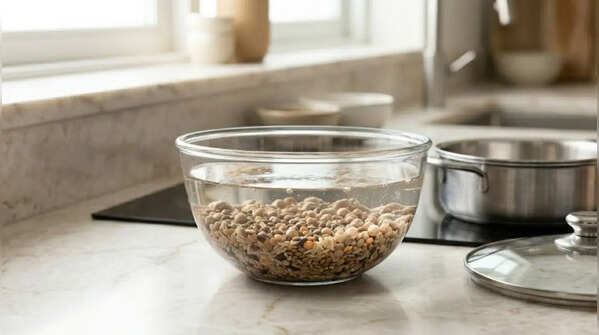
Pre-soak food before cooking
Pre-soaking legumes and grains can be employed as a passive hydration strategy to accelerate starch gelatinisation to reduce cooking times. By allowing the legumes and grains to absorb water before heating them, the starch gelatinisation process happens much faster. This results in the induction appliance being switched on for less time, directly resulting in the use of fewer total kilowatt-hours for the preparation of each meal.
PC: Google Gemini

Keep the surface of your induction cooktop clean
The induction coil transfers energy cleanly to a clean glass-ceramic surface because nothing is creating a thermal or physical gap that interferes with the magnetic flux density. By keeping the surface clean, you ensure the electromagnetic field between the induction coil and the surface is unimpeded, allowing for maximum energy transfer.
PC: Google Gemini
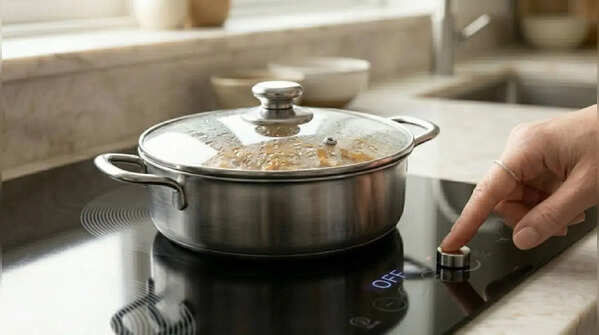
Switch off the induction cooktop on time
Induction surfaces have lower operating temperatures than electric coils. The cookware that gets heated also has a significant heat capacity, allowing for continued cooking via conduction after deactivation. If you turn off your unit before the cookware has completed cooking, it will still complete cooking due to the heat that the metal has absorbed and will therefore use minimal to no electricity to finish cooking.
PC: Google Gemini
Featured In lifestyle

