- News
- lifestyle
- health-fitness
- health-news
- Specialists: Have we done enough to tackle cancer?
Trending
This story is from February 22, 2016
Specialists: Have we done enough to tackle cancer?
Introspection marks 75th year of TMH
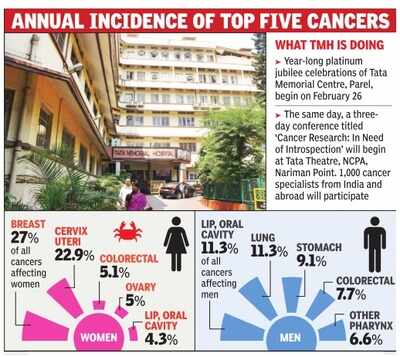
Around 1,000 oncologists across the country and the world will attend a three-day conference, titled 'Cancer Research: In Need of Introspection', which begins on Friday. Tata Memorial Hospital was inaugurated on February 28, 1941. "The cancer research landscape globally seems to be dominated by an almost missionary zeal towards unravelling more and more biological (genomic, epigenomic, transcriptomic, etc) information for every single tumour and therapeutic intervention envisaged around this framework," said an article published in the latest edition of Lancet Oncology to mark platinum jubilee celebrations.
"This research has yielded a very large amount of 'omics' data for practically every cancer type," said one of the authors, Dr Rakesh Jalali, a radiation oncologist at Tata Memorial Hospital. "The initial successes of some targeted therapies (for example, imatinib for a single-mutation driven cancer) led researchers to naively believe that cancer could be conquered after all, and this conquest was only a matter of time."
But as director Dr Rajendra Badwe pointed out, in most cases, research has only managed a 2-3% improvement in overall survival rates. "Technological advances in cancer management for both diagnostics and therapeutics are also growing at a rapid pace. Modern technologies (eg, robotic surgery and proton radiotherapy) are being embraced with enthusiasm, with all centres wanting to adopt new technologies just because the other centre has, disregarding the scientific rigour that they need before adopting them in routine clinical practice," said the Lancet article.
Dr Badwe told TOI, "We need to launch a fact-finding mission. Are we really helping patients, and, if yes, to what extent?" The conference is hence an "honest appraisal" on whether current research and therapeutic strategies are appropriate and whether the resources available are being optimally used in a meaningful way.

About the Author
Malathy IyerEnd of Article
FOLLOW US ON SOCIAL MEDIA
Visual Stories








Tired of too many ads?go ad free now
Featured In Lifestyle
Tired of too many ads?go ad free now
Hot on the Web
Brain Boost HabitsJaat Box Office CollectionSikandar Box Office CollectionGood Bad Ugly Box Office CollectionSshura Khan Pregnancy NewsBengali New Year WishesBaba Vanga PredictionChhaava OTT ReviewWorst Drinks For KidneySuperfoods For KidneyGulzarChia Seeds BenefitsSoha Ali KhanWorld Largest Snake GatheringSuniel ShettyMadhuri DixitRandeep HoodaRatna Pathak ShahNational ParksSuperfoods For Kidney HealthParth SamthaanManiesh PaulSoha Ali KhanUS VisaMouni RoyHina KhanAkshay KumarDivyanka TripathiTejasswi PrakashSouth India Hill Stations
Trending Topics
Latest MoviesBollywood MoviesHollywood MoviesTamil Movies 2025Telugu Movies 2025Malayalam Movies 2025Kannada Movies 2025Marathi Movies 2025Bengali Movies 2025Top Rated Movies 2025Best Hindi MoviesBest English MoviesBest Telugu MoviesBest Tamil MoviesBest Malayalam MoviesBest Kannada MoviesBest Bengali MoviesUpcoming Hindi MoviesBest Movies Of All TimeBest Hindi Movies of All TimeTaylor SwiftAnushka SharmaAkshaye KhannaAmeesha PatelNadia KhanJack BlackBen AffleckSoha Ali KhanKim KardashianEllen Pompeo
Popular Categories
Aries April HoroscopeTaurus April HoroscopeGemini April HoroscopeCancer April HoroscopeLeo April HoroscopeVirgo April HoroscopeLibra April HoroscopeScorpio April HoroscopeSagittarius April HoroscopeCapricorn April HoroscopeAquarius April HoroscopeEntertainment NewsBollywood NewsTollywood NewsKollywood NewsMollywood NewsMovie ReviewsLatest Hindi MoviesLatest Tamil MoviesParenting TipsHome RemediesWeight LossBeauty TipsParenting TipsHindi VideosHindi Video SongsBhojpuri Music VideosLatest Telugu MoviesBhojpuri Music VideoHindi TV News
Latest News
Why did a one-year-old girl from Michigan contract measles despite vaccination?Soha Ali Khan opens up on Ranbir Kapoor, Alia Bhatt's decision to keep their daughter Raha away from public eye: 'We've seen that if parents...'Want to live longer? Follow THESE expert-approved tips for longevitySikandar box office collection Day 17: Collection fall to Rs 25 lakh as Salman Khan starrer struggles to cross Rs 110 crore markBabil Khan reacts to his mother Sutapa Sikdar's comment about his depression due to the pressure of matching up to Irrfan: 'My adversities made me...'Amid spectre of violence, a muted New Year in MurshidabadSure! Here's the headline in sentence case:'They’ve taken a hatchet': Joe Biden accuses Trump of wrecking social security in first major speech post-presidencySC to hear today bunch of pleas against provisions of '95 waqf Act'Jaat' box office collection day 6: The Sunny Deol, Randeep Hooda starrer crosses Rs 50 crore after a decent Tuesday numberRJD, Congress kick off talks over seats, campaigningHarvey Weinstein's #MeToo retrial: No jurors picked on first day5.6-magnitude quake rattles southern PhilippinesSC frowns upon HC judge's 'rape survivor invited trouble' remarkIn HC, Nagpur civic chief apologises for bulldozing homes of riot accused'Over a year in jail': SC gives bail to ex-IAS officerWaqf violence: 2 bros held for killing dad-sonHow can bank open locker sans holder's nod: High courtUP boy slapped by classmates waits for funds despite SC order