
What did the Indian Railways’ menu look like in the 1990s?

What did the Indian Railways’ menu look like in the 1990s?
Long before app-based ordering, QR menus, and sealed Rail Neer bottles became standard, eating on Indian trains in the 1990s was a far more tactile affair. Meals arrived on steel trays or melamine plates, chai sloshed in thick glass tumblers, and the smell of frying cutlets drifted in from station platforms. Catering was decentralised, run largely by zonal railways, pantry cars, refreshment rooms, and private contractors, years before the creation of the Indian Railway Catering and Tourism Corporation.
Menus were often printed on simple paper slips or painted on boards near station stalls. Prices were modest, choices limited, and availability depended on the route and time of day. Yet there was a certain predictability to it all, a comforting familiarity regular travellers came to expect.
The result was a menu that felt regional and practical and was built around dishes that could survive reheating on a moving train. For millions of passengers, these meals became inseparable from the journey itself, as memorable as the scenery sliding past barred windows or the whistle that announced another halt in the night. Food was not an add-on but part of the rhythm of long-distance travel, marking time between stations and naps. So what did travellers actually find when the pantry car door swung open or a vendor called out from the platform? Here is what typically appeared on Indian Railways’ menus in the 1990s.
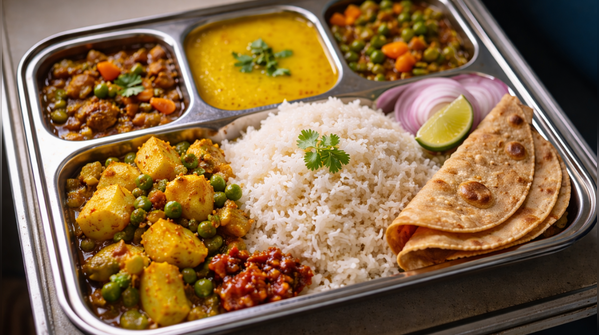
Veg sections: the backbone of the 1990s railway meal
Vegetarian food formed the most consistent and widely available part of onboard catering. Across long-distance Mail and Express trains, the staples were:
Standard veg thali
• Steamed rice or chapatis
• Plain yellow dal
• One or two vegetable curries - aloo-gobi, mixed veg, cabbage or beans
• Pickle and sometimes sliced onions
Rice-based comfort dishes
• Vegetable pulao
• Khichdi, especially on overnight runs, because it reheats well
Breakfast items (route-dependent)
• Aloo paratha with curd and pickle
• Upma
• Idli or pongal on southern routes
• Bread-butter or toast from pantry cars
Snacks between meals
• Samosas and kachoris
• Veg cutlets
• Grilled sandwiches
• Pakoras at major stations
Portions were practical rather than indulgent, designed to be filling without being elaborate. The flavours leaned mild, with familiar spices that appealed to passengers from different regions sharing the same compartment for hours.
Premium services like Rajdhani or Shatabdi trains generally offered a slightly more curated veg spread, but the heart of the menu remained simple, filling, and familiar.

Non-veg sections: limited but prized
Non-vegetarian dishes existed, though they were more carefully regulated because of storage and preparation constraints. Variety depended heavily on route, pantry-car facilities, and contractor capacity.
Typical offerings included:
• Egg-based dishes
• Omelette for breakfast
• Egg curry with rice or rotis
• Chicken preparations
• Simple chicken curry
• Chicken biryani on select routes
• Occasional mutton dishes
• Served more often at station refreshment rooms than inside ordinary coaches
In lower classes or on trains without strong pantry services, many travellers relied on platform vendors at large junctions for freshly cooked non-veg snacks rather than ordering onboard.

Extras and desserts: Practical and shelf-friendly
Desserts in the 1990s were not elaborate plated affairs. They leaned toward items that travelled well and stayed fresh for hours.
Common sweet endings or add-ons included:
Indian mithai
• Soan papdi
• Gulab jamun in syrup tubs
• Panjiri or besan laddoos
Packaged treats
• Cream biscuits
• Fruitcake slices
• Glucose biscuits
• Bananas, oranges, or apples sold by hawkers during halts
At major stations, refreshment rooms sometimes stocked regional sweets, giving passengers a quick sugar rush before the whistle blew.
These desserts were less about indulgence and more about comfort. A box of soan papdi shared across berths or a packet of biscuits passed around during long conversations became part of the journey itself. Sweetness, in those compartments, often tasted like companionship and time moving gently forward.

Beverages and water: Chai ruled everything
If one flavour defined railway travel in the 1990s, it was tea.
• Hot drinks
• Milky chai served in glass tumblers or steel cups
• Filter coffee on southern routes
• Occasional soups on long hauls
• Cold drinks
• Bottled sodas from station kiosks
• Lassi or flavoured milk on a few routes
• Drinking water
• Bottled water was available at big junctions, mostly from private brands
• A nationwide standard railway brand had not yet arrived
• Many passengers still carried their own flasks or filled bottles at stations

How catering worked then
Understanding the 1990s railway menu means understanding the system that powered it. Catering was not centrally uniform but managed through a patchwork of railway zones, pantry cars, station refreshment rooms, and private contractors. What you ate often depended less on a national template and more on geography, logistics, and the specific train you boarded. Some long-distance express trains had functioning pantry cars where meals were cooked in compact, swaying galleys. Others relied almost entirely on vendors at major station halts, where trays of rice plates, cutlets, and tea were loaded swiftly before departure.
There were no QR codes, no pre-booked meal apps, and no digital feedback forms to standardise taste or presentation. Orders were scribbled on paper pads, shouted across narrow corridors, and tallied mentally by stewards who knew regular passengers by face. The human element shaped the experience as much as the recipe did.
Supplies were sourced locally wherever possible, which meant ingredients reflected the state the train was passing through. A journey through the South might feature more rice-based options, while northern routes leaned heavier on rotis and parathas. Even tea tasted slightly different across regions.
Menus were shaped by constraint. Food had to survive heat, motion, and unpredictable delays. It needed to be cooked in bulk, reheated safely, and handed out quickly through narrow aisles. That decentralised ecosystem explains why journeys felt distinct. Unlike today’s standardised, app-based ordering systems, the 1990s experience carried regional quirks, inconsistencies, and a certain rough-edged charm that varied from route to route.
Featured In Food

MORE FROM ETIMES
life & style