
- News
- India News
- Ready for talks with govt, but will first discuss repealing agri laws: Farmer leaders
Trending
This story is from December 12, 2020
Ready for talks with govt, but will first discuss repealing agri laws: Farmer leaders
Threatening to further intensify their protest, farmer leaders on Saturday said they are ready to hold talks with the government but will first discuss repealing of the three new farm laws. Farmer leader Kanwalpreet Singh Pannu said that thousands of farmers will start their 'Delhi Chalo' march from Rajasthan's Shahjahanpur through the Jaipur-Delhi Highway at 11 am on Sunday.
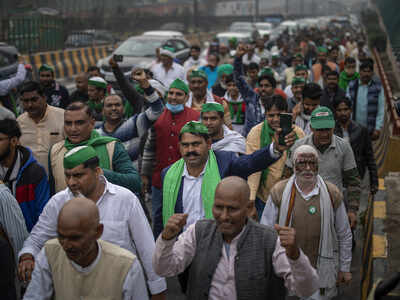
NEW DELHI: Threatening to further intensify their protest, farmer leaders on Saturday said they are ready to hold talks with the government but will first discuss repealing of the three new farm laws.
Addressing a press conference at Singhu Border, farmer leader Kanwalpreet Singh Pannu said that thousands of farmers will start their 'Delhi Chalo' march from Rajasthan's Shahjahanpur through the Jaipur-Delhi Highway at 11am on Sunday.
Live updates: Farmers protest
He said that farmers from other parts of the country are also on their way to join the protesters here and they will take the agitation to the next level in the coming days.
Farmer union leaders will also sit on a hunger strike between 8am and 5pm on December 14 against the new laws, he said.
Pannu alleged the government tried to weaken the agitation, but that the protesting farmers did not let it happen. He vowed to keep the protest peaceful.
The government on Friday asked the protesting farmers to be vigilant against their platform being misused, saying some “antisocial” as well as “Leftist and Maoist” elements were conspiring to spoil the atmosphere of the agitation which has been going on for over two weeks now.
Photographs of some protesters at the Tikri border seen holding posters demanding release of activists arrested under various charges had gone viral, prompting agriculture minister Narendra Singh Tomar to say that these “antisocial elements” are conspiring to spoil the atmosphere of the peasants' movement under the guise of farmers.
'Hopeful next round of talks will lead to conclusive result'
Meanwhile, Haryana deputy chief minister Dushyant Chautala on Saturday said he is hopeful the next round of talks between the Centre and the unions will take place in the next 24-40 hours.
After meeting Union agriculture minister Narendra Singh Tomar in the national capital, Chautala said the crop procurement at the government-decided MSP (minimum support price) would be ensured for each farmer till the time he was part of the state government.
Chautala, who also met defence minister Rajnath Singh and food, railways and commerce minister Piyush Goyal earlier in the day, also said the Haryana government is stable as of now and his party has a strong position on the MSP issue.
Chautala, who has been facing pressure from the opposition and some Haryana farmers to withdraw from the BJP-led government in the state, had earlier said he will resign if the MSP system is threatened. Asked whether the alliance government in Haryana was stable, Chautala said on Saturday, "Yes ... till we ensure MSP, we will be stable."
"I am hopeful that in the next 24-40 hours, there will be another round of talks and some conclusive statement can come out of that," the Jannayak Janta Party (JJP) leader added.
Enacted in September, the three farm laws have been projected by the government as major reforms in the agriculture sector that will remove the middlemen and allow farmers to sell their produce anywhere in the country.
However, the protesting farmers have expressed apprehension that the new laws would pave the way for eliminating the safety cushion of Minimum Support Price and do away with the mandi system, leaving them at the mercy of big corporates.
Addressing a press conference at Singhu Border, farmer leader Kanwalpreet Singh Pannu said that thousands of farmers will start their 'Delhi Chalo' march from Rajasthan's Shahjahanpur through the Jaipur-Delhi Highway at 11am on Sunday.
Live updates: Farmers protest
He said that farmers from other parts of the country are also on their way to join the protesters here and they will take the agitation to the next level in the coming days.
“If the government wants to hold talks, we are ready, but our main demand will remain the scrapping of the three laws. We will move onto our other demands only after that,” the farmer leader said.
Farmer union leaders will also sit on a hunger strike between 8am and 5pm on December 14 against the new laws, he said.
Pannu alleged the government tried to weaken the agitation, but that the protesting farmers did not let it happen. He vowed to keep the protest peaceful.
The government on Friday asked the protesting farmers to be vigilant against their platform being misused, saying some “antisocial” as well as “Leftist and Maoist” elements were conspiring to spoil the atmosphere of the agitation which has been going on for over two weeks now.
Photographs of some protesters at the Tikri border seen holding posters demanding release of activists arrested under various charges had gone viral, prompting agriculture minister Narendra Singh Tomar to say that these “antisocial elements” are conspiring to spoil the atmosphere of the peasants' movement under the guise of farmers.
'Hopeful next round of talks will lead to conclusive result'
Meanwhile, Haryana deputy chief minister Dushyant Chautala on Saturday said he is hopeful the next round of talks between the Centre and the unions will take place in the next 24-40 hours.
After meeting Union agriculture minister Narendra Singh Tomar in the national capital, Chautala said the crop procurement at the government-decided MSP (minimum support price) would be ensured for each farmer till the time he was part of the state government.
Chautala, who also met defence minister Rajnath Singh and food, railways and commerce minister Piyush Goyal earlier in the day, also said the Haryana government is stable as of now and his party has a strong position on the MSP issue.
Chautala, who has been facing pressure from the opposition and some Haryana farmers to withdraw from the BJP-led government in the state, had earlier said he will resign if the MSP system is threatened. Asked whether the alliance government in Haryana was stable, Chautala said on Saturday, "Yes ... till we ensure MSP, we will be stable."
"I am hopeful that in the next 24-40 hours, there will be another round of talks and some conclusive statement can come out of that," the Jannayak Janta Party (JJP) leader added.
Enacted in September, the three farm laws have been projected by the government as major reforms in the agriculture sector that will remove the middlemen and allow farmers to sell their produce anywhere in the country.
However, the protesting farmers have expressed apprehension that the new laws would pave the way for eliminating the safety cushion of Minimum Support Price and do away with the mandi system, leaving them at the mercy of big corporates.
End of Article
FOLLOW US ON SOCIAL MEDIA






Hot Picks
TOP TRENDING
Trending Stories
In India
Entire Website
- Malaika Arora's father Anil Arora dies by suicide in Mumbai
- 7 Key Reasons Why UPSC is the Toughest Exam in India
- 9/11 Remembrance Day: Key moments from the deadliest attack on US
- Howard University: 10 landmark firsts of the institution that shaped Kamala Harris
- Earthquake of magnitude 5.8 strikes Pakistan, tremors felt in Delhi, neighbouring areas
- Who were Barack Obama's challengers in 2008 and 2012 US presidential elections?
- 'A in INDIA alliance': Rahul Gandhi's slip-up during address to Indian-Americans goes viral
- Trump vs Harris: Betting markets reveal who’s expected to win the US presidential debate
- IGNOU December 2024 Term-End Exam: Registration Details, Important Dates, and Fee Structure
- Top 10 TED Talks to Boost Confidence and Success for Female Students
- Harris emerges unscathed from debate, dancing around her flip-flops
- After Kolkata docs set new demands, Mamata govt says 'not ready to accept'
- Why is creamy layer argument in SC/ST quotas so controversial?
- 'They would be in jail if ...': Kharge's attack draws BJP's 'Emergency' retort
- The Multan Mystery: When Dravid left Tendulkar stranded at 194*
- Ayushman Bharat scheme to be expanded to cover elderly above 70
- Is this India’s chance to replace Bangladesh as world’s clothing factory?
- Apple iPhone 16 vs iPhone 15: Which iPhone to buy and why
- Watch: PM Modi participates in Ganpati Puja at CJI's house
- MAGA's wild debate theories: Kamala's 'earphones' to 'witchcraft'

Popular Categories
Hot on the Web
Top Trends
Trending Topics
Deepika PadukoneMalaika Arora Father DeathArbaaz KhanJayram RaviAishwarya Rai BachchanSlat WaterWeight GainGOAT CollectionVikas Sethi DeathMalayalam ProducersIndia's Best Dancer 4Simi GarewalDilli BabuIndian National ParksLaung BenefitsVikas SethiiPhone 16Dubai Princess Sheikha MahraMG Windsor EvWordle Answer
Living and entertainment
Latest News
Manju Warrier expresses gratitude for birthday wishes: "Forever humbled and grateful"Jiiva and wife escape with minor injuries after a road accidentThe Zodiac Signs Most Naturally Inclined to HealingWhy Banyan trees survive for centuries and spread indefinitely?Telangana government pushes for increased flood relief from CentreShilpa Shetty and Raj Kundra spotted at the Siddhivinayak Temple; video insideNBA 2K25 locker codes September 2024: Locker codes revealed and know how to reveal themDonald Trump and Kamala Harris shake hands as they meet for first time on debate stage: Watch the 'awkward' momentBRS pushes for disqualification of turncoat MLAs after High Court rulingKamala may have won debate. But election is still too close to callPrince William’s commitment to a lasting marriage with KateVarun Dhawan shares unfiltered reaction to Janhvi Kapoor's 'Daavudi' song from 'Devara: Part 1': 'So freaking good...''On basis of fairness and equality': Bangladesh seeks good relations with India, says YunusJr NTR starrer 'Devara: Part 1' completes censorship formalities; receives UA certificateJalen Ramsey demands action against Miami Police following Tyreek Hill's pulled from car49ers RB Christian McCaffrey misses win over JetsWWE Superstar Blames the Company for Failing to Utilize Omos’ PotentialArbaaz Khan spotted outside Malaika Arora's house along with police after the tragic news of her father's demise by alleged suicide - WATCH VIDEO
Copyright © 2024 Bennett, Coleman & Co. Ltd. All rights reserved. For reprint rights: Times Syndication Service