
- News
- India News
- Raw deal: Small tanneries shut shop, many lose jobs
Trending
This story is from November 17, 2015
Raw deal: Small tanneries shut shop, many lose jobs
The beef scare is hitting the leather industry hard. Importers from Germany, France, Italy and the US, unsure about supplies from India, are looking to players such as Pakistan.

"There's a raw-material scarcity," says M Rafeeque Ahmed, chairman, Council for Leather Exports (CLE), adding the industry is experiencing a 15% slowdown because of a shortage of hides.

"Buyers are no longer confident about placing orders. One of the largest foreign exchange earners, the leather industry is under threat because of a man-made crisis," says Ramesh Juneja, regional chairman-east, CLE. The commerce ministry's target of doubling export from $6.5 billion in 2014-15 to $13 billion in 2019-20, made under PM Modi's Make in India project, he says, "may now get jeopardised".
Kanpur, with over 400 tanneries, is suffering. Many small units have shut shop, others are laying off daily wagers, says Hafizur Rehman, president, Kanpur Small Tanners' Association.
Though cow slaughter is legal in Bengal, which accounts for nearly half of leather exports, it sources hides from states like UP. "Bengal generates only 35% of the hide processed here. Units with export commitments are in a fix. As deliveries stall, their goodwill gets diluted," says Imran Ahmed Khan, of CLE, adding some exports are for mega brands like Louis Vuitton, Prada and Gucci.
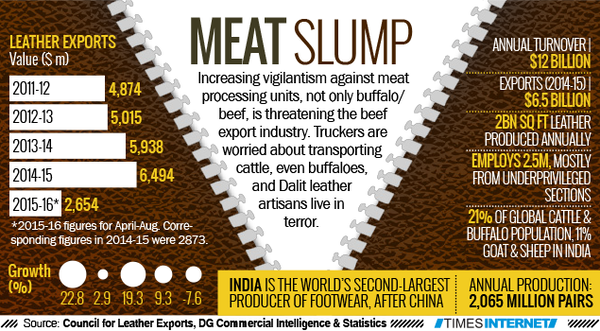
"Exports to Germany have fallen 24%; France 20%. Not so long ago, leather units in Kolkata refused orders. Now we're hunting for orders," Khan says.
Fayyaz Qureshi, a hide trader from Aurangabad, says before Maharashtra's beef ban, 70,000 to 80,000 skins were procured every month from Marathwada alone. "Now we've stopped buying any type of animal skin, fearing right-wing activists and police. It'd take much effort to prove the skin we bought isn't of a cow," he explains.
The magnitude of scare is such that the practice of farmers selling dead cattle has stopped at many places. Hide traders would buy dead animals and sell the hides to tanneries. "I can't risk my life for a few hundred rupees," says Shaukat Qureshi, hide dealer from Jaipur.
(INPUTS FROM SUBHRO NIYOGI, KOLKATA, APARNA RAMALINGAM, CHENNAI, SYED RIZWANULLAH, AURANAGABAD, SHOEB KHAN, JAIPUR, ISHITA MISHRA, AGRA & FAIZ SIDDIQUI, KANPUR)
End of Article
FOLLOW US ON SOCIAL MEDIA








Photostories

Hot Picks
TOP TRENDING
Popular Categories
Hot on the Web
Top Trends
Vinesh Phogat ElectionHisar Election Result 2024Election Results 2024Haryana Election Result 2024Jason KelceJammu Kashmir Election Result 2024Israel Hezbollah WarHardik SinghAakash ChopraHaryana Assembly Constituencies 2024Top Pharmacy Colleges of IndiaGurugram Election ResultWomen's T20 World CupTop MBA Colleges of IndiaT20 WC ScheduleWomen T20 World Cup Points TableLive Cricket Score
Trending Topics
Alia BhattBigg Boss Tamil 8 Contestants ListAjay DevgnNavratri Colours 2024Sanjay Leela BhansaliDurga Puja 2024Bigg Boss 18 House PhotoDevara CollectionBigg Boss 18Deepika PadukoneGovindaDevaraGovinda NewsDevara Movie ReviewSwatantrya Veer SavarkarColdplay India tour 2025Watch NFL Live StreamDress To ImpressCall Of Duty Black Ops 6Wordle Answer
Living and entertainment
Latest News
India set to discuss surge in silver imports with UAEAmbala Cantt Assembly Election Result 2024: BJP's big gun Anil Vij leading in early trendsAquarius, Daily Horoscope Today, October 08, 2024: . You are likely to receive recognition5 of gang involved in extortion, robberies, nabbed; 3 pistols,18 rounds recoveredNavratri as Spiritual Detox: 9 days to cleanse your mind, body and soulUrban apathy drags voter turnout in HaryanaWhy are the CEOs of most luxury brands stepping down?Alia Bhatt just cannot keep calm on watching 'Singham Again' trailer, says 'all the dynamite in one frame' for the big multi-starrer led by Ajay DevgnGurgaon Haryana Assembly Elections Results 2024: BJP's Mukesh Sharma leading as per early trendsMelania: What Donald Trump and Barron said about bestseller before releaseNCERT to triple textbook production, aims to print 150 million books this year: Edu ministerMonetary policy committee meet: RBI moving closer to rate cutWatch: Team India arrives in Delhi ahead of 2nd T20I against Bangladesh'I own a Glock and yes, I’ve fired It,' says Kamala on 60 Minutes; rules out solo talks with PutinEr Rashid calls for keeping govt formation on hold to press for statehood restorationHarivanshrai Bachchan believed that his son Amitabh Bachchan was a reincarnation of his father: 'Uske roop mein mere pitaji ki aatma aa rahi hai'Kathua (SC) Assembly Election Result 2024: BSP's Sandeep Majotra leading in early trendsHappy Durga Puja 2024: Best Messages, Quotes, Wishes, and Images to Share on Durga Puja
Copyright © 2024 Bennett, Coleman & Co. Ltd. All rights reserved. For reprint rights: Times Syndication Service