
- News
- India News
- Organ donations rise, lack of infrastructure plays spoilsport
Trending
This story is from August 6, 2015
Organ donations rise, lack of infrastructure plays spoilsport
The rate of organ donations has increased in India over the last few years thanks to increased awareness and government’s efforts to ease procedures.

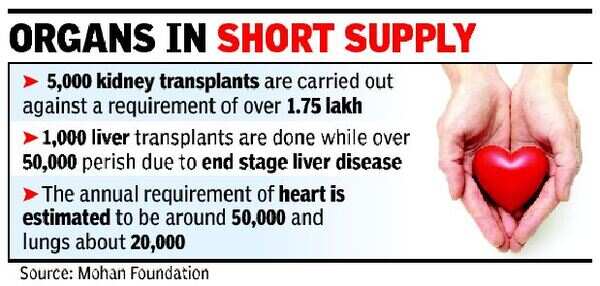
Organ donation rate in India after brain death increased from 0.05 per million population in 2006 to 0.34 per million population in 2014, estimates by Mohan Foundation, a not for profit organization that coordinates organ donation and transplantations activities in India.

In 2014, there were 411 organ donors after brain death. This resulted in the transplantation of 720 kidneys, 354 livers, 54 hearts and 16 lungs.
Doctors say while transplantation of liver and kidney are easier, organs like heart and lung are very difficult mainly because of the time limitation. For instance, in case of heart, the organ has to be transplanted within four hours of taking it out.
“Organs cannot be stored. Therefore, there is a need for preparedness and equipment to be able to transplant at the earliest without losing time,” says Dr Avnish Seth, director, Fortis Organ Retrieval & Transplant. According to Dr Seth, even as there is more awareness about organ transplant now, in 2014 around 50 donors were lost across the country because of problems like time lag, lack of equipment, unpreparedness etc.
Experts say it is time to move on to donation after circulatory death (DCD), where organs are retrieved for the purposes of transplantation after death is confirmed using circulatory criteria. However, the challenge includes how to identify patients as suitable potential DCD donors, how to support and maintain the trust of bereaved families etc.
Doctors also point out challenges in terms of a countrywide data base. “There is a need for a central database which can indicate the demand and supply without a time lag,” says Dr Kewal Krishan, senior consultant –cardiovascular surgery, Max Hospital. According to Dr Krishan, there is a sheer dearth of infrastructure and logistics for transferring an organ from one spot to another, posing a major hurdle in transplants even as awareness among people have increased.
Several hospitals are now working towards creating a system which can keep organs alive for a longer time even as patients are declared brain dead. Besides, more emphasis on green corridors and air lifting is given by private as well as public sector, says Dr Seth.
“We are engaging with authorities and government officials to bring in more awareness. There are countries like Spain and Australia which have done very well and we are trying to import expertise from there to make it happen in India,” Dr Seth said.
End of Article
FOLLOW US ON SOCIAL MEDIA







Photostories

Hot Picks
TOP TRENDING
Popular Categories
Hot on the Web
Top Trends
Ratan TataRatan Tata HospitalisedIND vs BAN Live ScoreRatan Tata DiesNew UPI Transaction LimitWorld First Top 10 TrillionairesStock Market TodayKerala Lottery ResultElection Results 2024Tom BradyIsrael Hezbollah WarSuryakumar YadavManagement Colleges of IndiaTop Medical Colleges of IndiaTop Engineering Colleges of IndiaTop Pharmacy Colleges of IndiaLive Cricket Score
Trending Topics
Diwali WishesBigg Boss Tamil 8 Contestants ListBhool Bhulaiyaa 3 TrailerDurga Puja WishesSanjay Leela BhansaliVettaiyan ReviewBigg Boss 18 House PhotoDevara CollectionBigg Boss 18Deepika PadukoneShailesh LodhaDevaraColdplayNational Film Awards 2024Swatantrya Veer SavarkarColdplay India tour 2025Watch NFL Live StreamDress To ImpressRatan Tata DeathWordle Answer
Living and entertainment
Latest News
Ratan Naval Tata: The inspiring journey of Padma Vibhushan laureate and golden-hearted business tycoonSamantha Ruth Prabhu shares playtime with Chinmayi Sripaada's daughter, says 'It took her 4.5 seconds to disown her parents'Mohanlal remembers late TP Madhavan: ‘His love and affection were akin to that of a father towards me'Buy only from Sanatanis, says Akhara ParishadIshan Kishan named Jharkhand captain for Ranji TrophyPadma Vibhushan industrialist Ratan Tata dies at 86Ratan Tata: The industry titan with a golden heartManifesting with the 10/10 Portal: Zodiac-based guide for 2024Only a true creative genius can spot the odd unicorn in 12 seconds!NCR gets ready to say alvida Ravan, yet again"We all still love him": TNA producer and former Knockouts Champion hopes for AJ Styles’ return to the companyProducer Vijay Kiragandur reveals major updates on Yash starrer 'KGF 3' and Rishab Shetty starrer 'Kantara 2'Can simple lifestyle changes really keep the flu at bay?Watch: Hardik Pandya pulls off a stunning running catchBehind the NFL's Facade: Can Jim Trotter's Allegations Force Change or Will It All Be Swept Under the Rug?Tovino Thomas calls ‘Bharathanatyam’ starring Saiju Kurup a ‘very satisfying watch’ - See postWhat you need to know about urinary tract infections: Are you at risk?Bigg Boss 18: Karan Veer Mehra opens up about losing his father at the age of 10; says 'Main apne dad ki death par nahi roya'
Copyright © 2024 Bennett, Coleman & Co. Ltd. All rights reserved. For reprint rights: Times Syndication Service