
- News
- India News
- Organ donation day: Keep giving, carry on living
Trending
This story is from August 13, 2015
Organ donation day: Keep giving, carry on living
Lakhs of people die waiting for an organ.

However, even if there was a donor available for every patient who needed an organ, gaps in the system starting from infrastructure required to harvest the organ and transporting it, to the prohibitive cost of the surgery would make transplant an inaccessible option for bulk of these patients.
READ ALSO: Organ donations rise, lack of infrastructure plays spoilsport
Unlike many developed countries where the government or insurance companies fund transplant surgeries, in India, most patients have no help in financing the cost of the transplant.

According to Dr Anil Prasad Bhatt, senior consultant nephrologist and transplant surgeon in Holy Family Hospital in Delhi, compatible blood group kidney transplant can cost anything between Rs 3.5 lakh and Rs 5.5 lakh which includes the cost of pre operation patient evaluation. "Today it is possible to do even incompatible blood group kidney transplant. But it could cost as much as Rs 8-Rs 15 lakh.
In the months following the transplant,
immunosuppressants alone could cost Rs 15,000 to 20,000 per month.At the end of one year the cost goes down to Rs 8,000 to 10,000 per month, which is roughly what the patient has to spend for the rest of his or her life on immunosuppressants," explained Dr Bhatt.
READ ALSO: Government will get cracking on organ donation policy in a week: Nadda
In a government hospital for poor patients, such as AIIMS, the entire transplant and accompanying costs like pre-transplant evaluation of a patient, dialysis and so on are done free of cost. For Below Poverty Line (BPL) patients there is a National Illness Assistance Fund which provides for the cost of one year of immunosuppression. But after that the patient still has to be able to afford roughly Rs 8,000 per month for immunosuppressants. AIIMS does roughly 150-200 kidney transplants in a year and the waiting list is very long. A few other government hospitals have a transplant programme but they have not picked up speed due to various reasons such as shortage of trained surgeons, required infrastructure and so on.
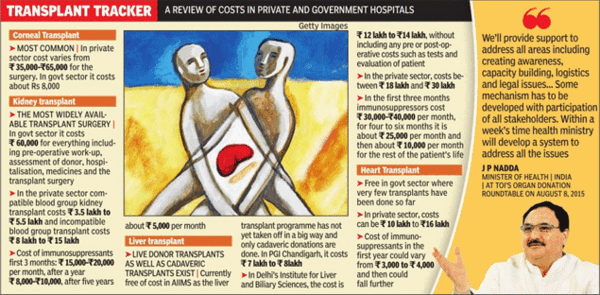
When it comes to liver transplant, the cost is even more prohibitive. In the private sector, the cost of the transplant package could vary from Rs 18 lakh to 26 lakh depending on the centre. These packages cover only the transplant surgery, 13-18 days of hospitalisation and charges for a few postoperative consultations with the doctor. It does not cover pre-operative tests which could cost Rs 1.5 lakh to Rs 2 lakh or the post-operative tests which could cost another Rs 1 lakh to 1.25 lakh.
"Even after the transplant there are enormous costs in the first few months such as tests to be done and immunosuppressants which alone could cost about Rs 20,000 per month. After a year the cost per month could drop to about Rs 10,000 a month," said the brother of a liver transplant patient.
In Delhi, there is just one hospital in the public sector doing quite a few liver transplants, the Institute of Liver and Biliary Sciences funded by the Delhi government. However, even here liver transplant package could cost Rs 14 lakh without including pre and post-operative costs. AIIMS has only a cadaveric liver transplant programme and does barely two or three in a year.
Similarly, heart transplant costs at least Rs 16 lakh in the private sector and, as with other organ transplants, patients have to take immunosuppressants for the rest of their lives. With the public sector offering no real alternative, most patients are forced to access the private sector for transplants. "I got a kidney transplant two years back in a private hospital which cost me Rs 5.76 lakh. As a transplant recipient, you have several expenses such as the regular blood tests that have to be done every two months other than the supplements and immunosuppressants to be taken every day. Poor people cannot afford either the surgery or the recurring cost every month and so they probably have to decide against getting the transplant," asked Kirti Pareek who spoke of meeting families who had sold their land to get their family member treated.
READ ALSO: ‘Country must aim for one per million organ donor rate by 2020’
If no system is put in place by the government to help fund the cost of transplants, India's organ transplant programme would become one accessible only for a small section of those rich enough to afford the surgery and treatment costs.
End of Article
FOLLOW US ON SOCIAL MEDIA










Photostories

Hot Picks
TOP TRENDING
Popular Categories
Hot on the Web
Top Trends
PAK W vs SL W Live ScoreLiv Morgan Car CollectionSSC CGL Answer KeyTrichy School Bomb ThreatIsrael Hezbollah WarKerala Lottery ResultsRohit SharmaBrittany MahomesUP Police Constable ResultSeth Rollin Car CollectionTirupati Laddu CaseICC Women t20 World CupWomen's T20 World CupTop Management Colleges of IndiaT20 WC ScheduleWomen T20 World Cup Points TableLive Cricket Score
Trending Topics
Samantha Ruth PrabhuNavratri Colours 2024Navratri WishesHappy Navratri 2024 WishesNaga ChaitanyaDevara CollectionGOAT OTT ReleaseRajinikanthRajinikanth Health UpdateNavratri HistoryDevaraGovinda NewsDevara Movie ReviewHealthy RaitasSwatantrya Veer SavarkarColdplay India tour 2025Upcoming Smartphones In OctoberNavratri JewellerySony Bravia 55 inch 4k Ultra HD TVWordle Answer
Living and entertainment
Latest News
ICC Women’s T20 World Cup ninth-edition: Will India capture their first title? Key players, schedule, and where to watchMohammad Azharuddin skips ED summons in money laundering caseTirupati Laddu row: Pawan Kalyan backs Naidu's statement on ghee adulteration, says CM spoke about issue at internal party meetingBeard Trimmer with Titanium Blades: Style Your Beard to Perfection with Unmatched SharpnessPower outages, water shortages emerge as Hurricane Helene smashes US' SoutheastEver wondered how business and corporate laws provide organisations with a competitive edge? Learn their nuances with IIM Calcutta5 must follow rules of Ayurveda to lose 5kg in 30 daysMicrosoft launches developer feedback program to address Xbox platform pain pointsKiara Advani shakes up the internet with her backless crochet and ruffle-dressNavarathri is all about inspiration and motivation: Shivani NarayananBank of America faces outage leading to zero balance glitches, hilarious memes flood social mediaThere’s a huge angle of woman empowerment also in our story of Ram and Vaishnavi: Shiv SagarSSC CGL Answer Key 2024 released for Tier 1 exam, raise objections by Oct 6: Direct link hereGlobal Chess League 2024: Indians in action, teams, format, scoring system, timeSomen Mishra sets record straight on Alia Bhatt and Vasan Bala 'Jigra' controversy: We were DYING to get Alia on boardThis Is Why Tarot Cards Are Classified As Potential, Consciousness, Subconscious And SuperconsciousKiran Rao arrives at Aamir Khan's first wife Reena Dutta's house to attend her father's last rites - WATCH videoRachel Zegler discusses 'Snow White', defends herself over backlash on comments
Copyright © 2024 Bennett, Coleman & Co. Ltd. All rights reserved. For reprint rights: Times Syndication Service