
- News
- India News
- On govt’s plea, Supreme Court defers Article 35A hearing till January
Trending
This story is from September 1, 2018
On govt’s plea, Supreme Court defers Article 35A hearing till January
The petitioners have questioned the provision’s legality, claiming it discriminates between J&K’s permanent residents and other Indians in voting, employment, getting seats in educational and professional institutions and owning property, as also on the basis of gender.
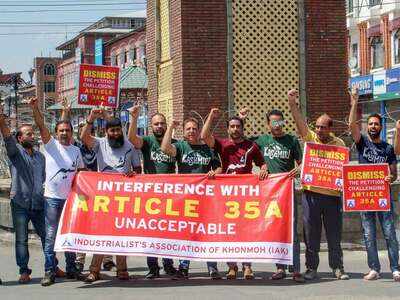
Traders along with locals display a banner and placards during a protest march against the petitions challenging validity of Article 35A, in Srinagar. (PTI File Photo)
NEW DELHI: The Supreme Court on Friday gave in to repeated requests from the J&K government and the Centre to defer till the second week of January hearing on petitions challenging validity of Article 35A of the Constitution.
The petitioners have questioned the provision’s legality, claiming it discriminates between J&K’s permanent residents and other Indians in voting, employment, getting seats in educational and professional institutions and owning property, as also on the basis of gender.
There was pandemonium before a bench of CJI Dipak Misra and Justices A M Khanwilkar and D Y Chandrachud as a clutch of advocates for the petitioners stoutly countered the request for adjournment by attorney general K K Venugopal and additional solicitor general Tushar Mehta, appearing for the Centre and J&K, respectively.
Before adjourning, the bench made a light-hearted comment that the issue was more than 60 years old and there was no urgency in taking it up. But former solicitor general Ranjit Kumar said if the SC could expeditiously take up the challenge to the centuries-old tradition barring women in the age group of 10-50 years from Sabarimala temple, why not this case, which involved a provision that was ex-facie unconstitutional as well as gender discriminatory? The bench said no constitutional issue was involved in the Sabarimala case.
In between, lawyers tried to argue that a woman permanent resident of J&K was deprived of owning property just because she married a man of her choice from outside the state. “Is this constitutional?” Kumar asked. adding that the woman’s children were barred in government-run professional colleges.
ASG Mehta conceded there could be an issue of gender discrimination in the Presidential Order [The Constitution (Application to Jammu & Kashmir) Order, 1954]. “Given the ground situation in the state, which will see panchayat polls from September till December, the time is not appropriate to hear the matter. Let the polls be over and the court can take up the issue,” he said.
The petitioners have questioned the provision’s legality, claiming it discriminates between J&K’s permanent residents and other Indians in voting, employment, getting seats in educational and professional institutions and owning property, as also on the basis of gender.
There was pandemonium before a bench of CJI Dipak Misra and Justices A M Khanwilkar and D Y Chandrachud as a clutch of advocates for the petitioners stoutly countered the request for adjournment by attorney general K K Venugopal and additional solicitor general Tushar Mehta, appearing for the Centre and J&K, respectively.
Before adjourning, the bench made a light-hearted comment that the issue was more than 60 years old and there was no urgency in taking it up. But former solicitor general Ranjit Kumar said if the SC could expeditiously take up the challenge to the centuries-old tradition barring women in the age group of 10-50 years from Sabarimala temple, why not this case, which involved a provision that was ex-facie unconstitutional as well as gender discriminatory? The bench said no constitutional issue was involved in the Sabarimala case.
Kumar said constitutional issues were involved in the temple case as right to profess and practice religion was argued with vehemence.
In between, lawyers tried to argue that a woman permanent resident of J&K was deprived of owning property just because she married a man of her choice from outside the state. “Is this constitutional?” Kumar asked. adding that the woman’s children were barred in government-run professional colleges.
ASG Mehta conceded there could be an issue of gender discrimination in the Presidential Order [The Constitution (Application to Jammu & Kashmir) Order, 1954]. “Given the ground situation in the state, which will see panchayat polls from September till December, the time is not appropriate to hear the matter. Let the polls be over and the court can take up the issue,” he said.
End of Article
FOLLOW US ON SOCIAL MEDIA





Hot Picks
TOP TRENDING
Trending Stories
In India
Entire Website
- Breathtaking cosmic catwalk! SpaceX makes history with first-ever private spacewalk
- 2 Army officers thrashed, their female friend gang-raped in Madhya Pradesh
- Bangladesh announce Test squad for India tour
- Top fastest trains in the world: From China's CR Harmony to Germany's ICE
- Amid Shannon Sharpe Viral Video, Former ESPN Host Michelle Beadle Reacts Claiming It Was Not Her
- Ayushman Bharat insurance scheme expanded to cover elderly above 70
- 'Will be demolished if... ': Himachal minister's assurance amid Shimla mosque row
- Mumbai's Haji Ali and Mahim dargahs cancel Eid shamiana
- Garena Free Fire MAX redeem codes for September 11, 2024: Win free room cards, skins, diamonds, pet skins, and more rewards today
- GK for students: Top 8 Largest Mammals in the World
- 'Deal with it': Oppn vs BJP over PM Modi attending Ganpati Puja at CJI's house
- In the (y)ear of conspiracy theories, Trump hears insults galore
- Actor dies in his sleep. Why sudden heart attacks are killing Indians
- Adani Group rejects Hindenburg claim of $310 mn asset freeze in Swiss banks
- On Mamata's 'ready to resign' offer, protesting docs say 'want justice'
- UK court finds Pakistani guilty of killing Tamil restaurant manager
- Pictures, videos: Why there is no other beach like this in India
- Planning to buy iPhone 16? How much Apple will give for iPhone 12 & others
- IAF wants Tejas jet production to be ramped up as US delays engines supply
- ‘Want peace & dignity, not graveyard for Kashmiris’: Engineer Rashid

Popular Categories
Hot on the Web
Top Trends
Trending Topics
Alia BhattMalaika Arora Father DeathArbaaz KhanNatasa StankovicMr Bachchan OTT ReleaseNational Parks In IndiaSelena GomezGOAT CollectionVikas Sethi DeathMalayalam ProducersIndia's Best Dancer 4Simi GarewalDilli BabuIndian National ParksLaung BenefitsVikas SethiiPhone 16Microsoft 365 OutageCsir Ugc Net 2024Wordle Answer
Living and entertainment
Latest News
India successfully flight tests surface-to-air missileDigest this: Unhealthy gut may be linked to Parkinson’s diseaseCSIR UGC NET 2024 result declared: Steps to download scorecards at csirnet.nta.ac.in'Played a big role in turning the cricket around': Ricky Ponting applauds Virat Kohli’s brilliance as India’s former captainAadhaar card update: Do you have to compulsorily update details on your Aadhaar every 10 years?Single Indians are now choosing slow, meaningful dates over-elaborate outings, reveals an online dating platform’s surveyWho was Illia 'Golem' Yefimchyk, the Belarusian bodybuilder who consumed 2.5 kg of meat and 108 sushi pieces daily before his death at 36?Pakistan: Bilawal cautions Shehbaz govt against political victimisation, points to Imran Khan's caseVijay Varma reveals he was DROPPED from 'Sacred Games' at the last minuteMahindra Thar Roxx with VIN 0001 to be auctiond for charity: How to registerWWE Star Discusses Why Sid Vicious Deserves a Hall of Fame SpotVijay Sathya-starrer 'Dhil Raja' to release in SeptemberHarvard University Sees Drop in Black Freshman Enrollment Post-Supreme Court Ruling on Affirmative ActionCatching up with sports stars in DelhiSalman Khan surrounded by bodyguards as he arrives at Malaika Arora's mother's house to offer his condolences - WATCHCMF Buds Pro 2 by Nothing review: Big delivery on a budgetMallika Sherawat makes big screen comeback in Rajkummar Rao's 'Vicky Vidya Ka Woh Wala Video'; director reveals why he cast herArbaaz Khan spotted outside Malaika Arora's house along with police after the tragic news of her father's demise by alleged suicide - WATCH VIDEO
Copyright © 2024 Bennett, Coleman & Co. Ltd. All rights reserved. For reprint rights: Times Syndication Service