
Laughter, the best therapy
What is life without laughter? But humour is no laughing matter, it can help heal, if not cure diseases, and make life bearable in general. But what’s the science behind it? And what has Valluvar said about humour? This week’s episode, which marks the 100th episode of this column, unravels all these and more.
Team TOITNN
Thirukkural with the Times explores real-world lessons from the classic Tamil text ‘Thirukkural’. Written by Tamil poet and philosopher Thiruvalluvar, the Kural consists of 1,330 short couplets of seven words each. This text is divided into three books with teachings on virtue, wealth, and love and is considered one of the great works ever on ethics and morality. The Kural has influenced scholars and leaders across social, political, and philosophical spheres.
Motivational speaker, author and diversity champion Bharathi Bhaskar explores the masterpiece.
This week’s episode, which marks the 100th episode of this column, unravels all these and more. Today's episode looks at what is life without laughter and what Valluvar said about humour.
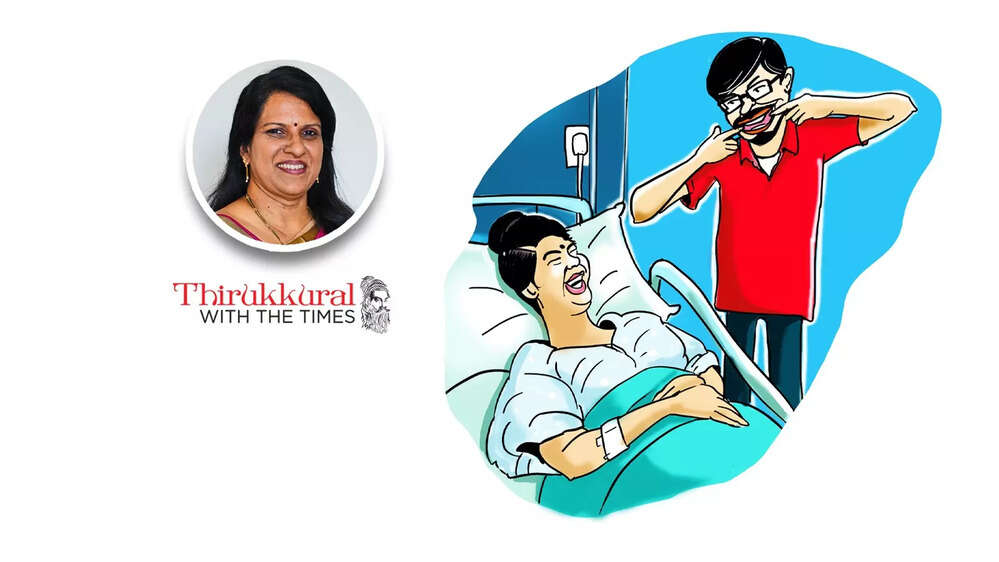
A couple of years ago, I was hospitalised with a serious illness. I had just been shifted from the ICU to a regular room and was feeling drained and frustrated as two nurses and a doctor tried to find a vein on my arm. My husband entered the room, and instead of asking how I was, picked up the bill. Annoyed, I snapped at him.
Without missing a beat, he launched an impromptu performance, the skilled mimic that he was. "Madam," he said, in Shahrukh Khan’s voice, "I'm here, right?” and then asked me about my health in Amitabh Bachchan’s baritone. "If I ask once, it’s like asking a hundred times,” he continued with Rajinikanth’s swagger, followed by imitations of MGR, M R Radha and M N Nambiar. Soon, I was laughing, so were the medical staff.
In those ten minutes, the hospital room turned into a theatre of joy. My mood lifted as effortlessly as a dark cloud would, revealing sunshine beneath. They say laughter is the best medicine — and at that moment, I imbibed its strength. It melted away my anger, and for the first time in days, I felt lighter, more hopeful. That night, I slept peacefully. The staff attributed my restful slumber to the hearty laughter of the evening. As I later read, laughter indeed releases endorphins, the body’s natural feel-good chemicals, that promote a sense of overall well-being.
Humour, I realised, holds immense power. It helps us navigate life’s roughest seas with grace. It provides us with perspective, allowing us to see the triviality in things we once considered monumental.
In everyday life, things often go wrong. You switch to a seemingly faster queue at the immigration and the one you just left speeds up. These situations can frustrate us to no end, but if we see them through the lens of humour, as part of Murphy’s Law — If something can go wrong, it will — they become more bearable.
Humour also brings people together. I once thought humour was only for entertainers in public speaking. But my co-speaker Raja once wisely said, "Say it with a smile. Make people laugh at themselves, and you’ll win their hearts." The piece of advice transformed my connection with the audience and made me more at ease on stage.
American presidents Abraham Lincoln and Ronald Reagan were both masters at lightening up difficult moments. When accused of being two-faced, Lincoln quipped, "If I had two faces, would I be wearing this one?"
Reagan, in response to being told he wasn’t working hard enough, joked, "Hard work never killed anybody, but why take a chance?"
Humour provides relief from stress in our daily lives as well. At work, a well-timed quip such as Vadivelu’s "Aaniye pidunga vendaam" (Don’t have to pull out any nail) can dissolve tension instantly. Such moments remind us that no matter how bad things seem, humour creates a shift in perspective.
Even ancient wisdom speaks of the power of laughter. Thiruvalluvar warns that those who cannot laugh live in darkness, even in daylight:
Nagalvallar Allaarkku Maayiru Gnaalam
Pagalum Paarpattandru Irul
"Behold the men who cannot laugh, in the wide world
They see nothing but darkness even during the day."
Motivational speaker, author and diversity champion Bharathi Bhaskar explores the masterpiece.
This week’s episode, which marks the 100th episode of this column, unravels all these and more. Today's episode looks at what is life without laughter and what Valluvar said about humour.
A couple of years ago, I was hospitalised with a serious illness. I had just been shifted from the ICU to a regular room and was feeling drained and frustrated as two nurses and a doctor tried to find a vein on my arm. My husband entered the room, and instead of asking how I was, picked up the bill. Annoyed, I snapped at him.
Without missing a beat, he launched an impromptu performance, the skilled mimic that he was. "Madam," he said, in Shahrukh Khan’s voice, "I'm here, right?” and then asked me about my health in Amitabh Bachchan’s baritone. "If I ask once, it’s like asking a hundred times,” he continued with Rajinikanth’s swagger, followed by imitations of MGR, M R Radha and M N Nambiar. Soon, I was laughing, so were the medical staff.
In those ten minutes, the hospital room turned into a theatre of joy. My mood lifted as effortlessly as a dark cloud would, revealing sunshine beneath. They say laughter is the best medicine — and at that moment, I imbibed its strength. It melted away my anger, and for the first time in days, I felt lighter, more hopeful. That night, I slept peacefully. The staff attributed my restful slumber to the hearty laughter of the evening. As I later read, laughter indeed releases endorphins, the body’s natural feel-good chemicals, that promote a sense of overall well-being.
Humour, I realised, holds immense power. It helps us navigate life’s roughest seas with grace. It provides us with perspective, allowing us to see the triviality in things we once considered monumental.
In everyday life, things often go wrong. You switch to a seemingly faster queue at the immigration and the one you just left speeds up. These situations can frustrate us to no end, but if we see them through the lens of humour, as part of Murphy’s Law — If something can go wrong, it will — they become more bearable.
Humour also brings people together. I once thought humour was only for entertainers in public speaking. But my co-speaker Raja once wisely said, "Say it with a smile. Make people laugh at themselves, and you’ll win their hearts." The piece of advice transformed my connection with the audience and made me more at ease on stage.
American presidents Abraham Lincoln and Ronald Reagan were both masters at lightening up difficult moments. When accused of being two-faced, Lincoln quipped, "If I had two faces, would I be wearing this one?"
Reagan, in response to being told he wasn’t working hard enough, joked, "Hard work never killed anybody, but why take a chance?"
Humour provides relief from stress in our daily lives as well. At work, a well-timed quip such as Vadivelu’s "Aaniye pidunga vendaam" (Don’t have to pull out any nail) can dissolve tension instantly. Such moments remind us that no matter how bad things seem, humour creates a shift in perspective.
Even ancient wisdom speaks of the power of laughter. Thiruvalluvar warns that those who cannot laugh live in darkness, even in daylight:
Nagalvallar Allaarkku Maayiru Gnaalam
"Behold the men who cannot laugh, in the wide world
They see nothing but darkness even during the day."
Popular Categories
Hot on the Web
Top Trends
IPL 2025 RetentionMumbai Indians Retention ListKing CharlesUP Police Constable ResultUS Election 2024 LiveIPL 2025 Full Retention ListKamala HarrisCSK Retention ListDiwali 2024 LiveKKR Retention ListDelhi Capital Retention ListRCB Retention ListDelhi AQI TodayZac TaylorIPL Remaining PurseIsrael Iran WarDiwali 2024World Test Championship
Trending Topics
Diwali WishesSalman KhanDiwali 2024 WishesTop Diwali WishesAmaran Social ReviewDiwali 2024 Puja TimingKaun Banega Crorepati 16Diwali Pooja TimingDevara OTT ReleaseVicky Vidya Ka Woh Wala Video CollectionAbhishek BachchanAnanya PandayRishad Yusuf Death NewsSmriti MandhanaOptical illusionDiwali Bank HolidaysMaroon 5Wordle Answer
Living and entertainment
Latest News
Horoscope Today, November 1, 2024: Read your today's astrological predictionsWho is Karthik Naralasetty? Indian-American tech innovator who could be Texas’s youngest mayorAmericans brace for gridlock amid talk of voter fraud and stolen electionRajesh Khanna's special Diwali connection with Supriya Pathak's father'Breaking party to obtain power was inappropriate': Sharad Pawar slams Ajit Pawar's factionGT Retention List 2025: Full list of Gujarat Titans Players retentions before IPL 2025 mega auction'It's black day for us': Mehbooba Mufti on J&K's UT foundation dayTrump rides garbage truck to troll Harris and Biden: The best memes and jokesIndia's growth can't be dependent on a few groups: Kotak'One nation, one election impossible': Mallikarjun Kharge reacts to PM Modi's remarksAll hail Red Espresso! The South African beverage rises as a global super-drinkAmitabh Bachchan allegedly ignores Aishwarya Rai and skips mentioning Aaradhya on his quiz show amid divorce rumours with Abhishek BachchanWhen Sara Ali Khan said her job as an actor was done before her film releasesLaxmi Puja 2024: Date, City Wise Puja Muhurat, Puja Vidhi, Laxmi Mantra and Laxmi Mata AartiLSG Retention List 2025: Full list of Lucknow Super Giants retentions before IPL 2025 mega auctionShabana Azmi shares photos from her Diwali bash; says 'Happy Diwali Sabko'Diwali 2024: Stress-free tips for hosting a memorable Diwali feastQuentin Tarantino praises Lady Gaga, Joaquin Phoenix for their performance in 'Joker: Folie a Deux'
Copyright © 2024 Bennett, Coleman & Co. Ltd. All rights reserved. For reprint rights: Times Syndication Service