
- News
- India News
- What is Article 35A and how is it significant to J&K?
Trending
This story is from August 3, 2019
What is Article 35A and how is it significant to J&K?
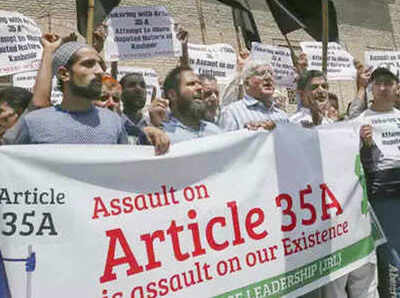
Earlier, former chief minister Omar Abdullah said that Governor Malik has assured his party that no moves are planned on repealing articles 370 and 35A of the Constitution, or the state's trifurcation.

What is Article 35A?
Article 35A of the Constitution empowers J&K legislature to define state's "permanent residents" and their special rights and privileges. It was added to the Constitution through a Presidential order of 1954 with the then J&K government's concurrence.
What is its significance to J&K?
* Through 1927 and 1932 notifications, Dogra ruler of the princely state of J&K, Maharaja Hari Singh made a law that defined state subjects and their rights. The law also regulated migrants to the state. J&K then joined India through the instrument of accession signed by its ruler Hari Singh in October 1947.
* After J&K's accession, Sheikh Abdullah took over reins from the Dogra ruler. In 1949, he negotiated J&K's political relationship with New Delhi, which led to the inclusion of
Article 370 in the Constitution.
* Article 370 guarantees special status to Jammu and Kashmir, restricting Union's legislative powers over three areas: defence, foreign affairs and communications.
* However, under the 1952 Delhi Agreement between Abdullah and Nehru, several provisions of the Constitution were extended to J&K via presidential order in 1954. Article 35A was also inserted then into the Constitution.
* J&K's separate Constitution was framed in 1956. It retained Maharaja's definition of permanent residents of the state which means: All persons born or settled within the state before 1911 or after having lawfully acquired immovable property resident in the state for not less than ten years or prior to that date. All emigrants from Jammu and Kashmir, including those who migrated to Pakistan, are considered state subjects. The descendants of emigrants are considered state subjects for two generations.
* Permanent resident law prohibits non-permanent residents from settling permanently in the state, acquiring immovable property, government jobs, scholarships and aid.
* However, the law was interpreted as discriminatory against the J&K women. It disqualified them from their state subject rights if they married non-permanent residents. But, in a landmark judgment in October 2002, the J&K high court held that women married to non-permanent residents will not lose their rights. But the children of such women won't have succession rights.
Why is Article 35A being debated?
* An NGO, We the Citizens, challenged Article 35A in the Supreme Court in 2014 on grounds that it was not added to the Constitution through amendment under Article 368. It was never presented before Parliament, and came into effect immediately, the group argued.
* In another case in the SC, two Kashmiri women argued that the state's laws, flowing from 35A, had disenfranchised their children.
End of Article
FOLLOW US ON SOCIAL MEDIA









Hot Picks
TOP TRENDING
Trending Stories
In India
Entire Website
- Mysuru-based woman’s startup bags top honour
- Unni Vavavo a hit again, thanks to Alia Bhatt’s kid
- 'Don’t drag us into your agenda’: SC dismisses NCPCR plea seeking SIT probe into Jharkhand shelter homes
- 'Opened multiple bank accounts': Rs 382 crore tax notice leads to Aadhaar, PAN misuse scam in Thane
- Flyers denied airport lounge access, issue sorted in evening
- 10 most stressed states in the U.S. in 2024; check out the list
- Delhi's maximum temperature soars to 37°C, rain likely to return tomorrow
- "We Have Decided To Part Ways Respectfully": WWE Hall of Famer Announces Separation from Wife Wendy Barlow
- This is what Damian Priest said about Jey Uso’s Intercontinental Championship win
- 49ers’ Christian McCaffrey Travels to Germany for Achilles Treatment: What It Means for His Season
- Lipstick leads to transfer of Tamil Nadu's woman duffedar
- Heavyweights in battle as J&K votes in 2nd phase today
- Why renaming Port Blair as Sri Vijaya Puram is a mockery of history
- Single bullet mark found on left side of Badlapur Pocso accused's head: Autopsy report
- After row over judge's Pakistan remark, Karnataka HC curbs on sharing live feed
- Youth unemployment rate in Kerala among highest in India
- After flirting with China, is Maldives back to loving India?
- Apple cuts price of iPhone 15 & iPhone 14 models, here's new price list
- Jaishankar raises safety of minorities in Bangladesh meet
- India's biggest and 5th largest IPOs get Sebi nod

Popular Categories
Hot on the Web
Top Trends
Trending Topics
Living and entertainment
Latest News
Commanders Clap Back at Cam Taylor-Britt’s Pregame Trash Talk In A Clever And Humorous Way'Virat shuru hoga Australia se': Basit Ali says Kohli's low scores vs Bangladesh not an issueAstrology-Inspired Characters in Movies: A Cosmic Connection on the Big ScreenAstrology-Infused Plotlines: The Cosmic Connection in Bollywood and HollywoodShan Masood likely to be retained Pakistan captain for England Test seriesAfter row over judge's Pakistan remark, Karnataka HC curbs on sharing live feedSeven dead, three injured in truck and auto rickshaw collision in Madhya PradeshAmazon launches a ‘bonus program’ for its employees to boost its AI salesSweden accuses Iran of cyberattack tied to Quran burning controversyAmericans can order free COVID-19 tests beginning this month'Sheba' tree, grown from a 1,000-year-old seed, shows promising anti-cancer qualities: StudyKhatron Ke Khiladi 14: Krishna Shroff fails to recognize the vegetable; Bharti Singh's reaction leaves everyone in splitsSilent killer who left no telltale signs of his late-night visitBest Laptops Under 80000: Steal Deals On Flipkart's Big Billion Days SaleFred Warner Net Worth, Current Salary, Accomplishments and MoreWhy you should avoid falling for your best friendAlia Bhatt reveals she and Ranbir Kapoor chose Raha's name at Jr NTR's house: 'He wished to pick the same name for his daughter'Devi Sri Prasad receives overwhelming reactions from fans for performing 'Pushpa: The Rise' song 'Srivalli' at the ModiandUS event-WATCH
Copyright © 2024 Bennett, Coleman & Co. Ltd. All rights reserved. For reprint rights: Times Syndication Service