
- News
- India News
- India's daily Covid-19 cases now at 10% of second wave peak: Government
Trending
This story is from June 22, 2021
India's daily Covid-19 cases now at 10% of second wave peak: Government
India's daily Covid-19 cases are now at 10% of the daily cases that were being recorded at the peak of the second wave in May, which is a decline of almost 90%, said the government on Tuesday. Union health secretary Rajesh Bhushan said, "We are now reporting almost 90% decline in India's daily Covid-19 cases as compared to the highest peak reported on May 7," he said.
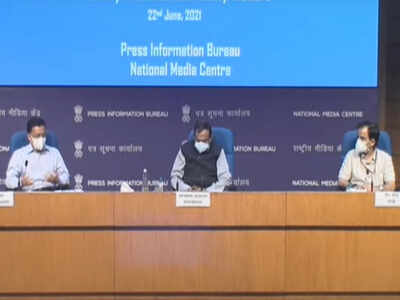
Addressing a joint press briefing, Union health secretary Rajesh Bhushan said, "We are now reporting almost 90 per cent decline in India's daily Covid-19 cases as compared to the highest peak reported on May 7," he said.
India had recorded 4.14 lakh cases on May 7, the highest single-day rise of Covid-19 cases in the country since the beginning of the pandemic. A month later, the daily case count came under one lakh and as of Tuesday morning, India had reported 42, 640 cases in the last 24 hours.
Between June 15 and June 21, there were 553 districts in the country where the positivity rate was less than 5 per cent, said Bhushan.
Delta plus in 9 countries; Delta variant in 80
The highly infectious Delta variant (B.1.617.2) of Covid-19 which was first surfaced in India is now found in 80 countries, said Bhushan. While the Delta variant is considered a 'variant of concern' (VoC), one of its mutation Delta Plus (AY.1) is considered a 'variant of interest' (VoI).
Coronavirus Live Updates
Delta Plus found in nine countries, namely, the United States, United Kingdom, Portugal, Switzerland, Japan, Poland, Nepal, China and Russia. India has 22 cases of Delta Plus variant, said the health ministry official.
Bhushan said that both Covishield and Covaxin are effective against the Delta variant. "But to what extent and what is the proportion of antibody that they produce, that we would share with you shortly," he said.
Several countries interested in CoWin platform
Union health secretary Bhushan said that in spite of criticism at times, the CoWIN platform has mostly received praises.
"It has established itself as a very robust, all-inclusive, simple IT-based platform. Therefore, a large number of countries are interested in taking the technology & using it," said the top ministry official.
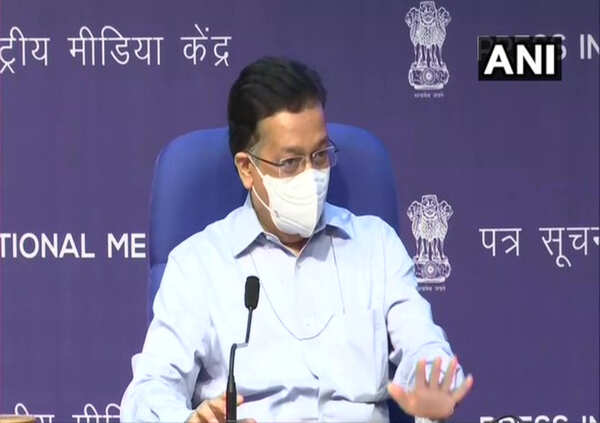
India would be happy to share the tech know-how behind India's CoWin platform with interested countries, said Union health secretary Rajesh Bhushan
Bhushan said that India is organising a webinar for the countries that are interested in India's CoWin platform. He added that India would be happy to share the technology.
"The National Health Authority, Union health ministry and the ministry of external affairs (MEA) are planning a global webinar in which such potentially interested countries would be invited and we would be more than willing to share the technology and solution with them," he said.
India records vaccine milestone
Bhushan said that India achieved a historic milestone of 88.09 lakh doses administered in a single day on June 21. However, the gender disparity continues in the nationwide vaccination drive.
Madhya Pradesh administered the highest number of doses over 17 lakh. Among the top ten states, over 11 lakh doses were administered in Karnataka, over 7 lakh in Uttar Pradesh, 5.75 lakh in Bihar, 5.15 lakh in Haryana and Gujarat, 4.60 lakh in Rajasthan, 3.97 lakh in Tamil Nadu, 3.85 lakh in Maharashtra and 3.68 lakh in Assam.
When asked how did India manage to achieve the highest single-day jump in vaccinations, Bhushan said that the milestone was not sudden but a result of "coordinated planning".
"Between June 1 and 21, the average daily vaccination was 34,62,841. So, a jump to 88 lakh is possible. We have now demonstrated that if there is enough vaccination and information available, we can administer vaccines to a large number of people," said Bhushan.
Vaccination increases in rural areas; gender disparity continues
"46 per cent of the people who received the vaccine yesterday were women and 53 per cent were men. We have to work on this imbalance, create awareness among women and bring them forward," said Dr VK Paul, member-health, Niti Aayog.
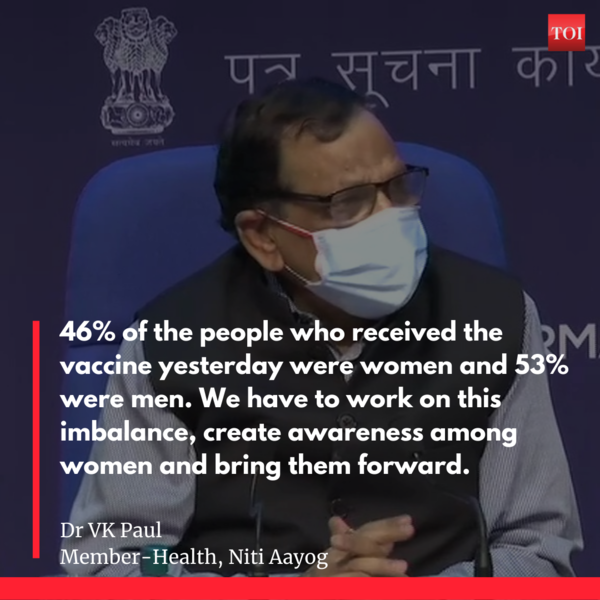
Paul said that rural coverage of vaccines has been remarkably emphasized. Of the total vaccines administered on Monday, 63.7 per cent were in villages and 36 per cent in urban areas.
"More than half of the doses administered over the last few weeks were inoculated in rural areas, which makes it clear that rural outreach is possible. We are fully hopeful and confident that it is completely possible for us to cover rural areas," said the Niti Aayog member.
(With inputs from vacancies)
End of Article
FOLLOW US ON SOCIAL MEDIA




Photostories

Hot Picks
TOP TRENDING
Popular Categories
Hot on the Web
Top Trends
Stock Market TodayBasit AliBrittany MahomesRavichandran AshwinBabar AzamKanpur Test Match RecordsUGC NET Result 2024Tirupati LadduIndia T20 WC SchedulePPF CalculatorBryonna Burrows Net WorthWomen T20 World Cup Points TableWomen T20 World Cup ScheduleIND vs PAK T20 WC MatchDiddyTop Management Colleges of IndiaLive Cricket Score
Trending Topics
GovindaNavratri Colours 2024Solar Eclipse 2024 TimesNavratri WishesGandhi Jayanti WishesDevara CollectionGOAT OTT ReleaseGandhi Jayanti 2024Rajinikanth Health UpdateNavratri HistoryDevaraGovinda NewsDevara Movie ReviewHealthy RaitasSwatantrya Veer SavarkarColdplay India tour 2025Upcoming Smartphones In OctoberAmazon SaleSony Bravia 55 inch 4k Ultra HD TVWordle Answer
Living and entertainment
Latest News
Ananya Panday unveils her Amol Palekar-inspired look in quirky BTS PICS from 'CTRL’Sanjay Dutt celebrates 'Gandhigiri', shares a scene from 'Lage Raho Munna Bhai'Govinda's bullet injury: Mumbai police not convinced with actor's version but rule out foul playGovt proposes to bring motorcycles under ‘contract carriage’ by amending MV ActHaircuts and colours to try out this PujoTriptii Dimri denies skipping the Jaipur event after allegations of charging an appearance feeMaharashtra assembly polls: Deputy CM Ajit Pawar meets Union home minster Amit Shah amid Mahayuti tensions over NCP, seat-sharingWatch: Orry channels Aishwarya Rai in a hilarious tribute to Shah Rukh Khan and Amitabh Bachchan starrer 'Mohabbatein'NFL insider reveals Raiders’ asking price for star wide receiver Davante Adams amid trade speculationAnanya Panday on being called the upcoming Alia Bhatt: I can't touch what she has doneWhy you must run in the morning on an empty stomachManipur CM Biren Sing bats for political talks to resolve crisis in stateSolar eclipse 2024 date and time: When is Surya Grahan in October? Will it be visible in India?Best anti-ageing workouts for strength and flexibilityArya's film faces controversy for not paying junior artists on timeGomathi Priya and Vetri Vasanth's 'Siragadika Asai' completes 500 episodesAndhra Pradesh minister asks officials to prepare for election to water users' associationExclusive- Ishq Jabariya's Lakshay Khurana reveals how Mahatma Gandhi’s teachings helped him in tough times: Early in my career, I faced several rejections...
Copyright © 2024 Bennett, Coleman & Co. Ltd. All rights reserved. For reprint rights: Times Syndication Service