
- News
- India News
- Covid-19: India must have strategic Oxygen reserve like petrol & diesel, NTF tells SC
Trending
This story is from June 25, 2021
Covid-19: India must have strategic Oxygen reserve like petrol & diesel, NTF tells SC
The Supreme Court appointed National Task Force has recommended building a strategic oxygen reserve, on the lines of petroleum products, to combat future waves of Covid pandemic while appreciating the Centre's hard work in maintaining the liquid medical oxygen (LMO) supply to states during the critical second wave of Covid.
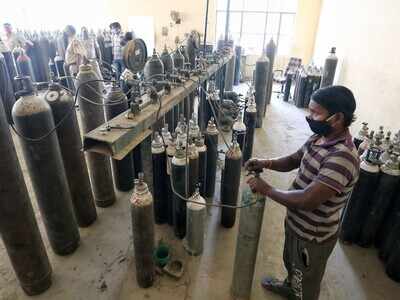
Representative image
"We should have strategic reserves of oxygen for the country to cover 2-3 weeks’ consumption, similar to the arrangement made for petroleum products.Similarly, all hospitals should have a buffer capacity for Emergencies," said the SC-appointed NTF in its report filed before the apex court. It said urgent efforts are needed to further scale up LMO production in preparation of the next wave of the pandemic.

The NTF also recommended that 18 big cities, including Delhi and Mumbai, must have LMO infrastructure to meet at least 50% of their peak O2 requirement. "There should be a strategy to manufacture oxygen locally or in the neighbourhood for the big cities to fulfill at least 50% of their LMO demand, as road transportation is vulnerable. This may be taken up in respect of Delhi and Mumbai on priority, due to their population density. All 18 metro cities must be made oxygen independent, with at least 100 MT storage in the city itself," it said.
It recommended "adequate procurement, filling, and timely supply of the oxygen cylinders to the hospitals and facilities in nursing homes, tier-2 and 3 cities, districts and rural areas, covid care centres, and other health care facilities specially created for Covid patients should be calculated and ensured."
"As the rural hospitals are dependent on cylinders and concentrators (non-LMO sources), there is a need to shift pressure swing adsorption (PSA) plants towards vulnerable areas. Cylinder turnaround time also needs to be efficient. Adequate number of cylinders must be kept as a buffer. The rural and semi-urban areas preparation should be prioritized henceforth. Oxygen cylinder filling and storage in rural areas is important; hence, central filling stations are to be considered in districts/rural areas," NTF recommended.
On May 8, a bench of Justices D Y Chandrachud and M R Shah had faulted the Centre's oxygen allocation methodology during the Covid second wave and drew health experts from all over India to set up a jumbo NTF to devise a scientific formula for rational and equitable allocation of oxygen to states, audit O2 utilisation and recommend means to augment its production.
Members of the NTF, convened by Cabinet Secretary, are Bhabatosh Biswas, ex-VC of West Bengal University of Health Sciences, Kolkata; Devender Singh Rana and Saumitra Rawat of Sir Ganga Ram Hospital, Delhi; Devi Prasad Shetty of Narayana Healthcare, Bengaluru; Gagandeep Kang and J V Peter of Christian Medical College, Vellore, Tamil Nadu; Naresh Trehan of Medanta, Gurgaon; Rahul Pandit of Fortis Hospital, Mumbai; Shiv Kumar Sarin of Institute of Liver and Biliary Science, Delhi; Dr Zarir F Udwadia from Mumbai; and Union health secretary Rajesh Bhushan.
Giving statistics, the NTF said daily production of LMO increased from 5,700 MT per day in August last year to a high of 9,690 MT on May 13 this year. Daily LMO supply in February was 1,292MT and 1,459 MT in March, and was increased to 4,923 MTs in April and 8,520 MTs in May. "The NTF recognized the enormity of the challenge and appreciated the steps taken by the Government of India," it said.
The NTF considered ideal daily LMO supply needed for a 100-bed hospital, with 25% ICU beds, and pegged the requirement at 1.5 MT (11,55,000 litres). As per the Central government methodology (an ICU bed needs 24lt/min and a non-ICU bed 10 lit/min), a 100-bed hospital with 25% ICU beds would need 19,44,000 litres of LMO daily. It said each hospital must have a round-the-clock oxygen monitoring team.
It said, "Each hospital with 100 or more beds, should be encouraged to have an LMO installation. A cryogenic storage tank for LMO should be insisted upon for every hospital in metropolitan areas. All hospitals, including medical colleges and district hospitals, must have pressure swing adsorption (PSA) technology to produce oxygen for inhouse consumption... All district hospitals should have PSA plants with compressors so that they can manage their own load as well as fill cylinders for CHC/PHC/Ambulances."
"There is an urgent need to increase production of LMO from about 5% - 8% of gaseous industrial oxygen. Govt should support and subsidize concerned industries...Technology to be put in place to convert nitrogen plants to oxygen producing plants in case of an emergency situation...Focus should also be placed on cylinders, gaseous oxygen and arrangement of cylinder fillers. CO2 cylinders from beverage industries may also be converted to oxygen cylinders," it recommended.
The NTF said, "In emergency, implementation of management of Oxygen Grid with 10-12 regional production sites is required . The storage hubs with state and district storage spokes should be in place for any emergent situation. Long haul connectivity through Rail from the production hub to the storage hubs, with the last mile connectivity as a spoke model transported by trucks. The LMO production hubs should be so located that the transport distance even by rail is preferably less than 24 hours."
It recommended creation of a state oxygen dashboard, which will monitor both supply and demand, including real-time data on available infrastructure, beds & actual oxygen consumption at each health-facility. Each State should have access to reserve tankers depending on the dynamics of pandemic to meet demand supply mismatch, it said, but insisted that allocation of tankers to states during a pandemic may be taken over by the Centre in times of emergency. About 20% buffer capacity of the state’s requirement should be created for allocation over and above baseline demand for allocation to states with rising cases, it said.
End of Article
FOLLOW US ON SOCIAL MEDIA










Photostories

Hot Picks
TOP TRENDING
Popular Categories
Hot on the Web
Top Trends
Haryana Election ResultNew UPI Transaction LimitHurricane MiltonRBI Monetary Policy MeetingWorld First Top 10 TrillionairesStock Market TodayTravis KelceElection Results 2024Biblical TreeJammu Kashmir Election Result 2024Israel Hezbollah WarHardik SinghAakash ChopraJammu Kashmir Election Winners ListTop Engineering Colleges of IndiaTop Pharmacy Colleges of IndiaLive Cricket Score
Trending Topics
Tulsi KumarBigg Boss Tamil 8 Contestants ListAjay DevgnNavratri Colours 2024Sanjay Leela BhansaliDurga Puja 2024Bigg Boss 18 House PhotoDevara CollectionBigg Boss 18Deepika PadukoneShailesh LodhaDevaraGovinda NewsNational Film Awards 2024Swatantrya Veer SavarkarColdplay India tour 2025Watch NFL Live StreamDress To ImpressCall Of Duty Black Ops 6Wordle Answer
Living and entertainment
Latest News
After crackdown, Hyderabad’s infamous ‘bride bazaar’ moves onlineA historic victory for "Kallanum Bhagavathiyum" on Amazon PrimeHurricane Milton: Why Tampa area is so vulnerable to stormsUP Muslim family creates 80-feet pollution-free Ravan effigy for DussehraEthel Kennedy, widow of Senator Robert F Kennedy Sr suffers stroke in sleep, hospitalisedMozambique votes in tense election likely to see ruling party winSum 41’s Deryck Whibley accuses former manager of sexual abuse in new memoirHyundai aims to raise up to $3.3 billion in record India IPOLibra, Daily Horoscope Today, October 09, 2024: Today is a test of your resiliencePrabhas starrer 'Kalki 2898 AD' gears up for its release in JapanMan declares income of Rs 9.6k, pays tax on Rs 43.5L after US earnings addedKerala lottery results: Thiruvonam bumper BR-99th winners for 09 October 2024; first prize Rs. 25 crore, second prize Rs 1 crore and third prize Rs. 50 lakhsZodiac Signs Most Likely to SucceedPatanjali Foods gets CCI nod for Rs 1,100-crore buyout of parent's home & personal care businessDocumentary suggests Bitcoin creator Satoshi Nakamoto is developer Peter ToddDry Anjeer vs soaked Anjeer: Which one's better for a glowing skin?Happy Durga Puja 2024: Best Messages, Quotes, Wishes, and Images to Share on Durga PujaShweta Bachchan Nanda reveals Amitabh Bachchan and Jaya Bachchan's great skin is due to mustard oil: 'They never had cosmetic treatments or procedures done'
Copyright © 2024 Bennett, Coleman & Co. Ltd. All rights reserved. For reprint rights: Times Syndication Service