
- News
- India News
- Afghan president calls on Modi, discusses terror, trade ties
Trending
This story is from October 25, 2017
Afghan president calls on Modi, discusses terror, trade ties
Tired of numerous rounds of peace dialogues till now, most Kashmiris preferred to stay silent on the Centre’s decision to appoint former Intelligence Bureau chief Dineshwar Sharma as its interlocutor to carry out a sustained dialogue with all sections of Kashmiri society to restore peace in the state.
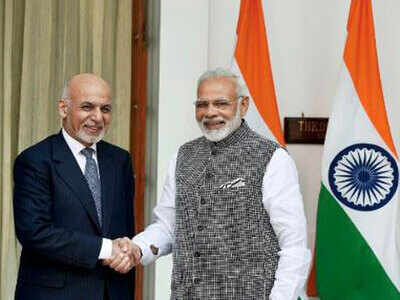
Prime Minister Narendra Modi with Afghan President Ashraf Ghani (L).
NEW DELHI: Dealing with cross-border terrorism, especially a firm resolve to ensure closure of state-sponsored terror sanctuaries, topped the agenda for India-Afghanistan dialogue on Tuesday as Prime Minister Narendra Modi hosted Afghan President Ashraf Ghani for what was the latter's fourth visit to India in the past three years.
The two countries also held detailed discussions on regional connectivity and trade with Modi telling Ghani that India is ready to receive Afghan trucks at the Wagah/ Attari border. Ghani warned Islamabad, while addressing a gathering later at the Vivekananda International Foundation, that Afghanistan will restrict Pakistan's access to central Asia if it prevented the Afghan trucks from accessing the Indo-Pak border.
Speaking at length on the issue of terrorism, Ghani said it was time now for Pakistan to make a choice. Identifying terrorism as a major challenge facing the region, Ghani, in a clear reference to Pakistan, said unfettered support is being provided to terror groups which are destabilising the entire region.
"Sanctuaries are provided, logistics are provided, training is provided, ideological base is provided...Pakistan has come to a juncture and it needs to make a choice," he said. "Our reaction will be determined by its choices," he added.
Asked about defence cooperation with India, he referred to supply of four attack helicopters to Afghan Air Force by India.
"Our collaboration with India is very open. We are delighted with the four helicopters. More Mi 35 helicopters are welcome," he said. The Afghan president also said that Kabul wanted a "push back from Pakistan vis-a-vis the
According to a statement issued by India, the support extended by India in the defence and security fields, including training of thousands of Afghan defence and security personnel, was positively assessed with India agreeing to extend further assistance depending upon the needs of the Afghan defence and police forces.
The talks took place hours before the arrival of US Secretary of State Rex Tillerson who wants India to expand its economic and developmental assistance to Afghanistan.
In the meeting, Modi reiterated India's support for a negotiated political reconciliation in Afghanistan that is Afghan- led, Afghan-owned and Afghan-controlled. It was emphasised that renunciation of violence and terror; and closure of cross border safe havens and sanctuaries were essential for any meaningful progress and lasting peace.
"Both sides agreed that the recent convergence and alignment of views at regional and international arenas have created opportunities for bringing peace, security and stability in Afghanistan. It was agreed to further deepen the bilateral strategic dialogue and consultations at all levels in order to achieve the shared objectives," said the statement issued by India.
Issues related to connectivity were discussed in detail. The establishment of the air freight corridor was acknowledged as an important factor in providing Afghan farmers a direct and easy access to the Indian market. The government said that efforts for early operationalisation of the Chahabahar Port, including the shipments of wheat in coming weeks to Afghanistan through the Port, was considered as a step that would shape new trade and transit opportunities for landlocked Afghanistan.
The two countries also held detailed discussions on regional connectivity and trade with Modi telling Ghani that India is ready to receive Afghan trucks at the Wagah/ Attari border.
Speaking at length on the issue of terrorism, Ghani said it was time now for Pakistan to make a choice. Identifying terrorism as a major challenge facing the region, Ghani, in a clear reference to Pakistan, said unfettered support is being provided to terror groups which are destabilising the entire region.
"Sanctuaries are provided, logistics are provided, training is provided, ideological base is provided...Pakistan has come to a juncture and it needs to make a choice," he said. "Our reaction will be determined by its choices," he added.
Ghani said the new South Asia strategy announced by the Trump Administration was a "game changer" as it recommends multi- dimensional condition-based approach for the region. "And it (the strategy) singled out India for engagement in this approach," he said.
Asked about defence cooperation with India, he referred to supply of four attack helicopters to Afghan Air Force by India.
"Our collaboration with India is very open. We are delighted with the four helicopters. More Mi 35 helicopters are welcome," he said. The Afghan president also said that Kabul wanted a "push back from Pakistan vis-a-vis the
Taliban and not a peace process managed with them by Islamabad.
According to a statement issued by India, the support extended by India in the defence and security fields, including training of thousands of Afghan defence and security personnel, was positively assessed with India agreeing to extend further assistance depending upon the needs of the Afghan defence and police forces.
The talks took place hours before the arrival of US Secretary of State Rex Tillerson who wants India to expand its economic and developmental assistance to Afghanistan.
In the meeting, Modi reiterated India's support for a negotiated political reconciliation in Afghanistan that is Afghan- led, Afghan-owned and Afghan-controlled. It was emphasised that renunciation of violence and terror; and closure of cross border safe havens and sanctuaries were essential for any meaningful progress and lasting peace.
"Both sides agreed that the recent convergence and alignment of views at regional and international arenas have created opportunities for bringing peace, security and stability in Afghanistan. It was agreed to further deepen the bilateral strategic dialogue and consultations at all levels in order to achieve the shared objectives," said the statement issued by India.
Issues related to connectivity were discussed in detail. The establishment of the air freight corridor was acknowledged as an important factor in providing Afghan farmers a direct and easy access to the Indian market. The government said that efforts for early operationalisation of the Chahabahar Port, including the shipments of wheat in coming weeks to Afghanistan through the Port, was considered as a step that would shape new trade and transit opportunities for landlocked Afghanistan.
End of Article
FOLLOW US ON SOCIAL MEDIA




Hot Picks
TOP TRENDING
Trending Stories
In India
Entire Website
- 'We were treated like slaves, made to work for 15 hours a day': Tricked into Ukraine war, 3 from Karnataka return home
- 'My father was on the flight': Jaishankar opens up about 1984 Air India hijack
- Airtel CEO Gopal Vittal sends letter to Reliance Jio, Vodafone-Idea, Tata Tele and BSNL CEOs; here's what he said
- Prince Harry to celebrate 40th birthday away from Meghan Markle
- Haitian immigrant pet-eating row: Ohio woman accused of eating cat is US citizen, video is not from Springfield
- Kejriwal out of jail; 'CBI arrest only to frustrate ED case bail': SC judge
- Donald Trump reveals what Laura Loomer is to his campaign: 'I don't control her'
- Hamster Kombat Daily Cipher Codes and Combo Cards for September 14, 2024: Unlock up to 1 million coins
- Laura Loomer's photo with Donald Trump viral. People ask where's Melania, where's wedding ring
- Garena Free Fire MAX redeem codes for September 13: Win in-game goodies and rewards
- Canada sees dip in post-secondary Indian students
- Neeraj finishes 2nd, misses title by 0.01 meters at DL Final
- Digest this: Unhealthy gut may be linked to Parkinson’s disease
- Trump defends 'loony' Laura Loomer amid MAGA meltdown
- State's duty to compensate owners for land acquired: SC
- Kolkata horror: Ex-principal, policeman arrested for destruction of evidence
- Can Sebi chief Madhabi Puri Buch survive this storm of allegations?
- Bengaluru woman sparks controversy with comments about Swiggy delivery executive
- Omar Abdullah says If BJP gets fewer seats tomorrow, it will...
- Mamata's olive branch to doctors fails to end RG Kar impasse - Top developments

Popular Categories
Hot on the Web
Top Trends
Trending Topics
World Largest HorseEID WishesGreen Apple BenefitsPriyanka Chopra TattooKottukkaali OTT ReleaseNarendra ModiGhaziabad Juice SellerHair LossSudha MurtyMalayalam ProducersIndia's Best Dancer 4Simi GarewalDilli BabuIndian National ParksLaung BenefitsVikas SethiApple iPhone 16Donald TrumpAadhar Card UpdateWordle Answer
Living and entertainment
Latest News
WWE SmackDown Introduced Fresh New Logo, Theme Song From Megan Thee StallionMan acquitted in 31 year old dacoity caseThis Strange Eventful History: Claire Messud's Ambitious Novel Spanning Generations and ContinentsNew season begins with renewed hope for BlastersPremier League: Erling Haaland hits another two in Man City's come from behind win over BrentfordMeerut building collapse: 3 dead; rescue operations continuePeople offer food, umbrellas to agitating doctors; thousands treated at free 'Abhaya' clinicDon’t rethink pink. Plane truth is we need women-friendly seatsKarunakaran's father Kalidas passes away due to ill healthTCS teams up with Tata Electronics for ‘made-in-India’ chipsWWE NXT Star Reunites With Father At TNA Victory Road'Nafrat ki dukaan pe ...': PM Modi attacks Congress over 'brutality' in US‘There is no affordable transport currently, the biggest problem in Goa is taxis’IIM Jammu hosts 'Fostering Academia and Industry Partnerships' event at BengalaruMP Bharat, TDP Andhra President Srinivas promise action to safeguard protection of steel plant workersLiverpool slump to shock 1-0 home defeat by Nottingham ForestHimanta urges banned ULFA(I) chief not to indulge in activity jeopardising future of Assam's youthActivists complain as showroom burns old papers; NMMC penalizes Rs 250 only
Copyright © 2024 Bennett, Coleman & Co. Ltd. All rights reserved. For reprint rights: Times Syndication Service