
- News
- City News
- mumbai News
- Mumbai: Soulful duty! He’s laid to rest over 50,000 in 20 years
Trending
This story is from May 13, 2021
Mumbai: Soulful duty! He’s laid to rest over 50,000 in 20 years
Tiptoeing into his Chembur home well past midnight, his uniform drenched in perspiration, constable Dnyandeo Ware has had a rough day.
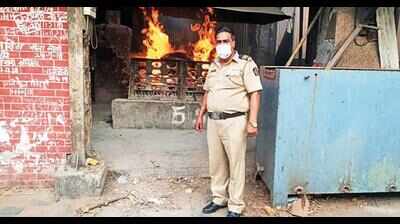
Constable Dnyandeo Ware was recently felicitated by the department
He has had a rough day, having laid to rest over a dozen unidentified people who died of various causes in a span of 24 hours. Ware has worked on the Police department’s hearse for two decades and has witnessed every major tragedy during this time that cost Mumbaikars their lives.

His family is understandably worried about his going to work during the second wave, given his co-morbidities. But Ware, who has cremated 50000 unidentified individuals in his career so far, says it’s his life’s mission to give dignity to those who don’t have their kin around to perform last rites.
“Mee punya kamavto aahe (I’m earning virtues),” he says, explaining why he won’t stop working, even though about 50 bodies that the hearse ferried since last year tested positive for Covid. Ware adds that he finds the job more satisfying than routine police station duties.
The Police department used to have 12 hearses, one for each police zone. Gradually, the number of vehicles shrunk and only three are operational now. Ware drives the hearse that covers some of the busiest public hospitals such as Sion, JJ, Nair, GT, St George and the Tuberculosis Hospital at Sewri.
When an unidentified individual is found dead in south or central Mumbai, the police station staff summon Ware. He steers the hearse to the location accompanied by two workers appointed for carrying bodies. After being ferried to a hospital, a policeman conducts a panchnama on the deceased and the body is moved to a morgue. If the relatives of the deceased cannot be located within 15 days, then Ware is summoned again. This time, he ferries the body to the crematorium.
“If the deceased individual’s faith is known, then his last rites are carried out in accordance to his customs,” said Ware who performs all duties a family member would have, including lighting the pyre and praying for the soul of the departed.
Typically, constables posted as a hearse drivers are transferred after five years of service. But Ware, who joined the police department in 1995, has been on hearse driving duty since 2001 and is keen to continue till he retires.
“The job is challenging.... I have to check paperwork and ensure that bodies don’t get swapped at the hospital,” he said. He was recently felicitated by joint police commissioner (law and order) Vishwas Nangre Patil.
What do his folks at home think of his job? His wife, who ensures he carries a tiffin of her home cooked meals every day, says she is "very proud" of him.

About the Author
Nitasha NatuEnd of Article
FOLLOW US ON SOCIAL MEDIA










Hot Picks
TOP TRENDING
Trending Stories
In City
Entire Website
- The Secret Behind NFL Marriages: How These Couples Make It Work
- UPI transaction limit to change from September 16! Here are the new limits for various UPI payments
- When Laura Loomer said she's single because she's too focused on Donald Trump
- South Delhi shooting: Sleuths see killing as a message to big businessmen
- Top 10 sports stars turned power couples: From Agassi-Graf to Conner-Comaneci
- 3 Zodiac Signs Most Likely to Become Multimillionaires
- Narayana Murthy faces backlash for parenting remarks on social media; users say, "after working 72 hours a week, there’s barely time left to have babies…”
- 'Would not fit in ... ': Princess Diana's brother warned Prince Harry about marrying Meghan Markle
- The 3 Strongest Zodiac Signs: Powerhouses of the Zodiac Wheel
- Dark Side Of Each Zodiac Sign
- Donald Trump 'safe' after gunshots heard nearby, campaign says
- CM Kejriwal says he will resign in 48 hours: Does this mean early elections in Delhi?
- She called 9/11 an ‘inside job’. Why is she part of Trump campaign?
- Trump's 'mass deportation' threat evokes images of WW2 internment camps
- Union minister calls Rahul Gandhi 'terrorist'; 'seek psychiatric help', says Cong
- AK-47 found, suspect arrested after shooting near Trump's golf course: Key details
- Will Germany’s suspension of Schengen entry end the Europe dream?
- Wipro to employees: Attend office at least 3 days-a-week or risk losing…
- Who could be the next Delhi CM if Kejriwal resigns?
- 'Gambhir wasn't a friend, we were ...': Former Indian opener's bold revelation

Popular Categories
Hot on the Web
Top Trends
Trending Topics
World Largest HorseEID WishesOnam WishesPriyanka Chopra TattooKottukkaali OTT ReleaseEngineers Day WishesGoat CollectionHair LossSudha MurtyMalayalam ProducersIndia's Best Dancer 4Simi GarewalDilli BabuIndian National ParksLaung BenefitsVikas SethiApple iPhone 16Donald TrumpAadhar Card UpdateWordle Answer
Living and entertainment
Latest News
Four Zodiac Signs That Are Hard to Control'Message for Modi': Opposition takes jab at BJP over Nitin Gadkari's 'PM post' claimNetflix denies filmmaker Soham Shah’s plagiarism allegations over Squid Games, says claim holds 'no merit''Virat bhaiya's passion and dedication for the game is...': Sarfaraz KhanFather rapes and murders 8-year-old daughter in Madhya Pradesh, throws body in wellBakuchiol: Nature’s answer to youthful skin radianceSaudi Arabia footballer Fahad Al-Muwallad hospitalized after fall from balconyNeeraj Chopra misses second Diamond League title by an agonising 1 cm; finishes second behind AndersonRain washes out England-Australia T20I series finale"Miami Dolphins Owner Stephen Ross Eyes Multi-Billion Dollar Deal: The $7 Billion Power Play"Rajkummar Rao hails Kareena Kapoor Khan's The Buckingham Murders as a 'gripping thriller'MoS Finance likely to be convenor of GoM on GST compensation cessRole Rewind: Did you know Ranveer Singh and Deepika Padukone's love story has a strong Kareena Kapoor Khan connection?How to set up partner sharing in Google PhotosIndia, Pakistan players involved in heated exchange during Asian Champions Trophy. WatchNoida authority fraud: 2 arrested in Rs 3.9 crore scam linked to fake bank accountsGovinda’s wife Sunita Ahuja talks about losing their premature daughter at three months: ‘That’s why I brought up Yash in a cocoon’5 ways cottage cheese can transform your well-being
Copyright © 2024 Bennett, Coleman & Co. Ltd. All rights reserved. For reprint rights: Times Syndication Service