
- News
- Now, you can get a Van Gogh in zardozi
This story is from March 20, 2016
Now, you can get a Van Gogh in zardozi
A growing appetite for the handmade takes embroidery from clothing to canvas
A growing appetite for the handmade takes embroidery from clothing to canvas
What do Wikileaks founder Julian Assange, Britpop pinup Jarvis Cocker, writer Germaine Greer and some of UK’s prisoners have in common? They all sewed a portion of an artwork to commemorate the 800th anniversary of the Magna Carta last year. The 13-metre-long embroidered scroll, currently touring art galleries in the UK, was a metaphoric statement on civil liberties and the threads that bind, but it was also something else — a token of embroidery’s growing clout as a medium of art.
After paint and print’s dominance on wall art, needlework is now having a moment. For proof, visit two ongoing exhibitions — a handloom and handicraft display organised by the World Crafts Council, in Delhi, featuring the classic Tree of Life articulated, among other ways, as hand-embroidered wall panels; the other, an art sale on StoryLTD.com (an offshoot of Saffronart) of embroidered interpretations of painted masterpieces. The former depicts the Tree of Life in gossamery chain-stitch; the latter recreates Frida Kahlo in ari. Both have estimates of a couple of lakhs. We’ll have more embroidery next month in Delhi, at a symposium organised by Yes Institute on ‘Reinventing Traditional Embroidery’.
“Hand-crafted art is once again in vogue. Thirty years ago did you hear of the term ‘organic’ food? No, because everyone ate organic, just like textile art was a natural component of people’s homes, not just their clothes,” says Ahmedabad-based artist Asif Shaikh.
India is no stranger to textile art — its woven, printed, dyed and embroidered traditions have long been markers of cultural milestones in the home and on the person. Over the years, hand embroidery largely came to inhabit clothing, but now the chain and satin stitch, French knot, zardozi and other finger work are moving off the cuff to ‘canvas’.
Shaikh, whose commissions typically include clothing, also creates wall panels. At the Tree of Life exhibition, 12 of his embroidered panels are on display, including a 1-inch miniature best appreciated with a magnifying glass. Some pieces are collaborations with bandhini and kalamkari artists. A show-stopper is his iridescent Tree of Life in woven peacock feather, embroidered with beetle wings and pleated silver thread. “It was stolen at a previous Tree of Life exhibition in Malaysia, but eventually recovered,” recounts Shaikh. Someone told him the theft was a sign his art had ‘arrived’ — that it could now be counted among stolen but recovered masterpieces like Edvard Munch’s The Scream.
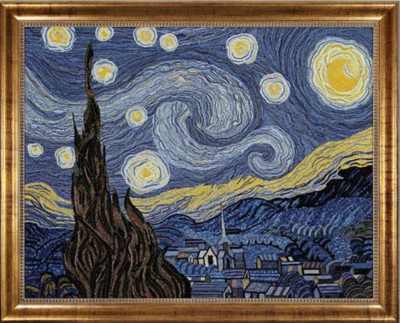
The Scream is incidentally one of the artworks on sale at StoryLTD. This 35x28-inch, ari-embroidered work in rich silk thread, has an estimate of Rs 4 lakh. It is among 15 interpretative pieces created by The House of Shalimar, an embroidery studio in Mumbai, that include Van Gogh’s Starry Night in metallic cords and chenille and Matisse’s The Dinner Table in sequins and zardozi. “These works are typically picked up by corporate offices and hotels,” says a company representative.
As with other art, you can buy needlework off a gallery or auction, or commission a piece. Asif Shaikh has been flown to homes in Chicago and London to design their art, and even their furnishing and linen. “Depending on the theme and style — whether Awadhi, Kashmiri, Deccan — I co-opt other artists from across the country,” says Shaikh, whose artisan network counts 200.
On the other hand, a client could task a designer and art consultant like Robin Greene with conceptualizing and delivering a mural, which would bring Greene to an embroidery house like Raintree in Mumbai. Greene and Neha Malhotra, founder of Raintree, are about to collaborate on two commissions — for a house and hotel in London. “We are trying to use traditional techniques like hand embroidery and hand-sewn appliqué within new contexts,” says the London-based Greene on email.
Raintree — whose ambit has thus far been couture for clients like Alexander Wang and Kenzo — is now attempting wall art. “A wall panel is not a seasonal piece,” Malhotra says, “It can’t be overpowering because it’s always going to be on the wall. One can’t put it away in the closet.”
Art marketers admit it’s exciting, but early days yet for embroidered art. The House of Shalimar hasn’t had much success through online sales though they say direct marketing has been more fruitful. “The rich want to show Raza and Husain and other ‘labels’ to go with their labelled furniture,” notes Shaikh. Like Husain, he too signs his work — in fine chain stitch.
Reap What you Sew
Rakhi Peswani has, for 12 years, favoured the stitch to the stroke. The Bengaluru-based artist — whose oeuvre encompasses themes of human labour, craftsmanship and urban effect — has turned out abstractions and still-lifes in daisy and satin stitch. “I’m not in the business of producing embroidery, but art,” she maintains. “People have said you don’t know embroidery; that’s like telling Bhupen Khakar, you don’t know how to draw,” says Peswani. “I’m not interested in acquiring textile skills; I’m interested in the aspect of image-making and in notions of unskilled work.”
The studied selection of her fabric and sewing techniques, combine with the meditativeness of the method to offer intimate, textured sketches. “I’d worked with needlework in the hostel when studying fine art in Baroda, but was never confident of showing it to the faculty as art,” says Peswani, who learnt to sew from her mother, a seamstress.
End of Article
FOLLOW US ON SOCIAL MEDIA
Photostories

Hot Picks
TOP TRENDING
Popular Categories
Hot on the Web
Top Trends
IND vs AUS Live ScoreBaba Siddique NewsVirat KohliRussell WilsonsSpacex StarshipRahul DravidWho was Baba SiddiqueBabar AzamNTA SWAYAM July RegistrationLawrence BishnoiAmazon LayoffsTaylor SwiftManagement Colleges of IndiaTop Medical Colleges of IndiaTop Engineering Colleges of IndiaTop Pharmacy Colleges of IndiaLive Cricket Score
Trending Topics
Diwali WishesDussehra 2024 QuotesDussehra WishesVettaiyan OTT ReleaseVettaiyan CollectionVettaiyan ReviewNatasa StankovicDevara CollectionBigg Boss 18Deepika PadukoneShraddha KapoorRatan Tata Passed AwayJigra Movie ReviewVettaiyan Movie ReviewSwatantrya Veer SavarkarDussehra 2024Star Health Hacker DemandedViral MemesUltimate Football Codes October 2024Wordle Answer
Living and entertainment
Latest News
How each zodiac sign handles emotional distance in relationshipsDid BTS' V get promoted to corporal in the South Korean military? recent appearance at an orchestra event has fans speculatingSalman Khan’s security beefed up after Baba Siddiqui’s murder; ‘Sultan’ star looked uncomfortable after visiting the late politician’s family at 3 amRanji Trophy: Thriller in the making as Krunal Pandya fifty helps Baroda lead by 226 runs vs MumbaiOver 70 injured at Devaragattu Banni stick festival during Dussehra celebrationsPassion missing, players don’t want to work hard, lament former intl’sHow tomato, potato, onion influence food inflationBiker’s death ignites village fury in Odisha's Boudh, massive traffic jam on NH-57Reliance Jio sends 'complaint letter' to telecom minister Jyotiraditya ScindiaWomen's T20 World Cup: Why India need Pakistan victory over New Zealand to secure semifinal berthSpaceX's fifth Starship test flight achieves historic booster catchNews brief: 'Who is listening? Modi?': Kapil Sibal takes a dig at RSS chief Mohan BhagwatPapankusha Ekadashi 2024: Date, Parana Time, Puja Rituals and SignificanceKenya's Ruth Chepngetich breaks women's world record at Chicago MarathonZodiac signs likely to have soul connectionsAI’S Oppenheimer'Points towards failure of CM': Sanjay Raut slams Maharashtra govt over Baba Siddiqui's killingMahela Jayawardene returns as Mumbai Indians head coach
Copyright © 2024 Bennett, Coleman & Co. Ltd. All rights reserved. For reprint rights: Times Syndication Service