
- News
- Going Carnatic on Coltrane
This story is from December 13, 2015
Going Carnatic on Coltrane
On a recent trip to Delhi, composer-saxophonist-improviser Rudresh Mahanthappa talked about why jazz is anything but definitive
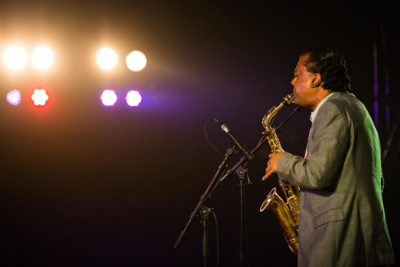
On a recent trip to Delhi, composer-saxophonist-improviser Rudresh Mahanthappa talked about why jazz is anything but definitive
It’s hard to pin down the ‘jazz’ Rudresh Mahanthappa plays. But he’s okay with that. In an age when critics are only too keen to slot every musician into a genre, the work of this alto-saxophonist and composer — all New York swagger, and brimming with subversive twists and conspiratorial turns — is the perfect comeback to those who over-intellectualize music.
“I don’t know what understanding jazz really means,” he says. “You just take what you want from the music and enjoy it, whether it’s the fire of it, or the energy, or the delicacy of it. What is there to understand? Just listen!”
Mahanthappa was in Delhi for the Jazz Utsav; his third visit to India after 1998. On the road since October, Mahanthappa and band-mates Dan Weiss (drums) and Rich Brown (bass) played an incredibly tight set, but allowed each other space to stretch out. Their music had a stormy menace; it had edge and spark.
This is how Mahanthappa sees jazz: At its core, it is music that’s truly American. It’s a hybrid, multicultural, cross-pollination between Western classical, Cuban and African. It’s music that’s always updating, whose identity is defined in new surroundings.
He should know, he has had a hand in inflecting it with Carnatic influences. Yet there was a time when he didn’t want to go anywhere near Indian music. “The problem was that non-Indians often assumed I was an expert on Indian music because of my name and the colour of my skin. For a long time it was such a burden to bear that I avoided listening to Indian music, because I felt like I had to know something about it even though no one had taught me anything. But then when I started thinking more about it, I treated it the way I treated jazz, where I would try to learn from albums and figure out their structures in an informal way.”
Mahanthappa’s friendship with Kadri Gopalnath, the man who introduced the saxophone to Carnatic music, shaped him musically and personally. “When I was on my Guggenheim Fellowship, I hung out with Kadri for a month. I went to his house, and we would work on a different raga every day. We had already made an album together (‘Kinsmen’, 2008). With someone like Kadri, who respected me as a musician, I could say ‘let’s work on this today’. And we’d try to play it, whatever raga. He knew I was going to take the information and do something else with it,” he says.
The musician says many of his fans are not necessarily jazz lovers but they like what he does, and that’s more important to him. “It’s not important to me that they know who Charlie Parker and John Coltrane are,” says Mahanthappa. “I think that’s why the album with Kadri was so successful. It reached a whole other section that has nothing to do with jazz.”
The innovator would next like to take a stab at making music for children (he’s father to a 3-year-old). “There are people making amazing original children’s music. There are rock bands for kids, and the compositions are amazing. I have an idea to do something with songs that are currently in children’s TV shows — not the theme song but something that recurs within the show. Maybe soon…”
End of Article
FOLLOW US ON SOCIAL MEDIA
Hot Picks
TOP TRENDING
Trending Stories
In Section
Entire Website
- Mysuru-based woman’s startup bags top honour
- Unni Vavavo a hit again, thanks to Alia Bhatt’s kid
- 'Don’t drag us into your agenda’: SC dismisses NCPCR plea seeking SIT probe into Jharkhand shelter homes
- 'Opened multiple bank accounts': Rs 382 crore tax notice leads to Aadhaar, PAN misuse scam in Thane
- Flyers denied airport lounge access, issue sorted in evening
- 10 most stressed states in the U.S. in 2024; check out the list
- Delhi's maximum temperature soars to 37°C, rain likely to return tomorrow
- "We Have Decided To Part Ways Respectfully": WWE Hall of Famer Announces Separation from Wife Wendy Barlow
- This is what Damian Priest said about Jey Uso’s Intercontinental Championship win
- 49ers’ Christian McCaffrey Travels to Germany for Achilles Treatment: What It Means for His Season
- Delhi roots, Colombo heights: New Sri Lankan PM Amarasuriya's link to India
- Kangana in dock again, BJP condemns MP's remarks on farm laws
- Why renaming Port Blair as Sri Vijaya Puram is a mockery of history
- Israeli strike kills Hezbollah's top missile commander; toll hits 569
- J&K polls phase 2: 239 candidates in fray; 20 diplomats to be observers
- Who would win if all-out war breaks out between Israel, Hezbollah?
- After flirting with China, is Maldives back to loving India?
- Apple cuts price of iPhone 15 & iPhone 14 models, here's new price list
- US Intel says Russia pumping for Trump as Ukraine brings war to Pennsylvania
- Badlapur case: Akshay Shinde's father seeks probe into 'fake encounter'

Popular Categories
Hot on the Web
Top Trends
Trending Topics
Living and entertainment
Latest News
'Virat shuru hoga Australia se': Basit Ali says Kohli's low scores vs Bangladesh not an issueAstrology-Inspired Characters in Movies: A Cosmic Connection on the Big ScreenTest | War 2: Hrithik Roshan, Kiara Advani's romantic chemistry grabs attention in viral picsAstrology-Infused Plotlines: The Cosmic Connection in Bollywood and HollywoodEC to have 'zero tolerance' towards use of money power in Jharkhand assembly pollsThrowback: When Parineeti Chopra shined in yellow during her joyful haldi ceremony celebrationsICAI CA Final Exam for Nov 2024 postponed due to Diwali, new exam date announced: Check official notice hereEpic Last 'Monster' Standing match and more exciting matches announced for WWE RAW (9/30)Alia Bhatt reveals she and Ranbir Kapoor chose Raha's name at Jr NTR's house: 'He wished to pick the same name for his daughter'Donald Trump shares 'nail salon gossip' that Kamala Harris paying $700 for...When Remo D'Souza opened up about his heart attack and revealed how Salman Khan stayed in constant touch with his wife over the phoneAstrological Themes in Popular Film FranchisesBiden acknowledges he's running out of time as violence escalates in Middle-East: Aides‘My brother is critical but stable’; Veteran actor Manoj Mitra’s brother debunks death hoaxTirupati Laddu controversy: Prakash Raj vows to meet Pawan Kalyan for one-on-one discussionSocial media owners, generative AI biggest threats to online news: Experts warnSean 'Diddy' Combs predicted his arrest for 'freak offs' in 1999 video: They're gonna probably be arresting me doing all types of crazy thingsFrom Witty Signs to Dominant Plays: A Night of Entertainment at the Bills vs. Jaguars Matchup
Copyright © 2024 Bennett, Coleman & Co. Ltd. All rights reserved. For reprint rights: Times Syndication Service