
- News
- Glitter in the gutter
This story is from August 2, 2015
Glitter in the gutter
Bengaluru's streets may not be paved with gold but its drains are specked with it. And a group of boys is turning the dust into their daily bread

Inside, with brooms in hand, the youngsters start raking the thick, oily, grey-black sludge that shimmers in the morning light. They are looking for Element 79.
The, manholes - with covers removed and placed on the edge, on Avenue Road, Cubbonpet, Nagarthpet, Anchepet, Siddanna lane and Kilari Road - are guarded by emaciated boys who warn vehicle drivers and passers-by to look out. You could mistake them, as we did, for manual scavengers hired by civic agencies to clean the sewers. This is, in fact, underground scavenging, but with a difference.
Avenue Road - and its adjoining lanes - is a hub for goldsmiths and jewellers. There are more than 300 goldsmiths in this area who work for the city's top jewellers. The gold dust from these workshops/units often ends up in the drains, and that is the gossamer lode the young boys are purposefully hunting.
"We scour the area from early morning till around 7:30 am to collect the sludge from the gutters. We then take it to be filtered," explains Karthik who makes the most of the golden hours in the gutters before he switches to his primary job as an auto driver. Most times, however, he finds mud and nothing else, complains Karthik, who joined the tribe of treasure-hunters three years ago.
The occasional extra buck - and the hope of making it - makes the task worth their while. After all, gold hovers around Rs 23,000 per 10 gm now.
At the filtering units adjoining the railway tracks at Okalipuram, we found around 20 people, mostly women, busy silting the waste (brass often is a collateral find). They use mercury to draw out any accumulated gold. Once it is collected, the gold is sold to dealers in the same area.
M Krishnachari, who has been a goldsmith for the past 45 years, explains how the gold specks land up on roads and in drains. "When we melt gold, there's a small amount of wastage - for every 10 gm, at least 1 gm is lost. This ends up on our hands and feet. We usually rinse our hands and feet outside the store which is how the gold flows into the gutters," he says.
Vishwanatha, of Vishwanatha Antique Dye Works who specializes in embossed work, says it is difficult to estimate how much gold the boys collect on a daily basis. "It is really a question of luck. Sometimes when we send our workers to get some polishing done, they put the gold in their pockets and lose it. So these boys may get entire nuggets of gold; at other times, they have to separate the dirt from the gold powder," he says.
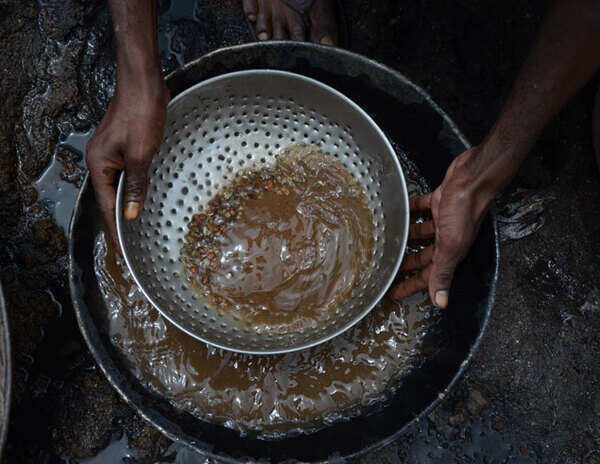
Collecting the muck and depositing it at Okalipuram gets the boys Rs 400 a day. "If we manage to get any gold or precious metal, we have regular buyers who pay us a little less than the market price. But it's okay for a couple of hours' job," says Santosh, a daily wager from Okalipuram.
The wiry Babu (24) doubles up as filtering staff. He says business has been hit badly of late. "The tribe (of collectors) has grown and everyone is looking in the same places, at the same time," he says. Babu earns an extra Rs 400 for labouring over mounds of sand, most of which contains human excreta, in search of the elusive micro particles.
The ramshackle filtering set-ups draw residents of the slum adjoining the railway lines. "After finishing household chores we spend time silting until sundown. We get paid Rs 250 per day for this work," says Priya, who lives nearby.
Isn't it revolting to search for gold amid human excreta? "Saar, are people who live above these gutters as decent as they look? They do worse jobs than this to lead a luxurious life," Santosh retorts. He then quietly shuts the lid of the manhole and walks away with a bag full of silt and muck, hoping he has struck gold.
- Courtesy Bangalore Mirror
End of Article
FOLLOW US ON SOCIAL MEDIA

Hot Picks
TOP TRENDING
Popular Categories
Hot on the Web
Top Trends
Trending Topics
Devara CollectionBigg Boss Kannada 11 Launch Live UpdatePawan KalyanJungle SafariStree 2 OTT ReleaseRose GardenDevara CollectionOTT Release MovieMasala OmeletteEmergencyDevaraTaaza Khabar 2 Twitter ReviewDevara Movie ReviewHealthy RaitasSwatantrya Veer SavarkarColdplay India tour 2025Smartphone DealsApple Macbook Air M1Amazon SaleWordle Answer
Living and entertainment
Latest News
West Bengal CM Mamata Banerjee holds meeting to address flood situation in North BengalSetting them up to flourish: Why parents and school are a tag teamAir Arabia launches early bird promotion on 500,000 seats from INR 5,727!Diljit Dosanjh presents a gift to his Pakistani fan at his Manchester concert - WatchFormer Deputy Chief minister Alla Nani faces legal trouble after lift incident in EluruIndian wushu team creates history, bags seven medals at junior worldsWall collapse near Mahakal temple: Two cops, two civic staffers, temple official suspendedAishwarya Rai Bachchan touches Nandamuri Balakrishna's feet as a sign of respect, the Telugu star blesses herCovid lockdown on earth led to dip in Moon's temperature: StudyHost Kiccha Sudeep to Bigg Boss Kannada 11 contestant Aishwarya Shindogi: Come back as a stronger personManipur CM Biren accuses Kuki militants of abducting 2 Manipuri youthsKhatron Ke Khiladi 14 winner: Karan Veer Mehra lifts the trophy and Krishna Shroff becomes the first runner-upWhat to expect after a facelift procedure"It sounds like they really had to squeeze responses out of Vince": WWE Hall of Famer discusses Vince McMahon's reluctance in speaking during Netflix seriesColleagues remember braveheart Delhi Police constable Sandeep: 'Would rush to crime scene alone'10 desk exercises for 40-plus men for a healthy lifeBaloch Human Rights slam Pakistan and China, call it 'a failed state'A killing & a tipping point
Copyright © 2024 Bennett, Coleman & Co. Ltd. All rights reserved. For reprint rights: Times Syndication Service