
- News
- Art can’t be a precious item hidden in galleries. It has to be visible everywhere, says Satish Gujral
This story is from December 17, 2017
Art can’t be a precious item hidden in galleries. It has to be visible everywhere, says Satish Gujral
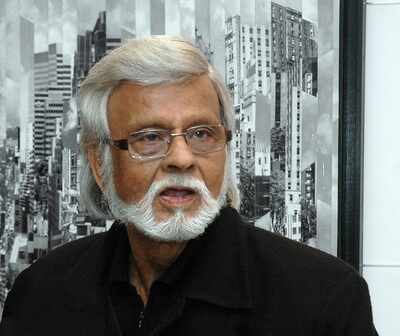
Satish Gujral’s life in art began 70 years ago with a poignant series of paintings on the Partition. Then followed a range of public ceramic murals after Independence, sculptures in bronze, wood and granite, and architecture that extends from the Belgian Embassy in Delhi to the palace estates in the Gulf. Gujral’s work has often redefined the experimental spirit of Indian modern art.
A serious criticism of the city today is that it lacks public space and, hence, public activity. Where do you locate art when there is no constructed arena for its display or participation?
Earlier, most art was public because it was incorporated in important buildings. But gradually it became a precious item, for sale in a gallery. For people to develop an understanding, art should be placed in public areas. Art is a language that cannot be understood, unless it is communicated. And communication can only happen if art is made visible everywhere – in the subway, on roads, railway stations, parks, in and on public buildings. That’s why Nehru insisted that 2% of all public building budgets should be spent on art. I don’t want the people of my country to say ‘I don’t understand art’. It will only be possible when art is taken to them, to places where they can see it. You learn a language only when it’s spoken to you.
Our cities are inhabited by businessmen, migrant labour, office workers, slum dwellers, executives, rag pickers, etc. In such a diverse spectrum, what role can art play?
Does public art have a role in social and cultural causes, or educating the public?
When public art was promoted in
What is the significance of the almost nine-foot-tall bronze Trinity sculpture you recently donated to Bikaner House?
An expectant mother has no idea what her child is going to look like; similarly, as an artist, I never have a clear picture in my head when I begin to create something. Artists don’t think, they create! But ‘Trinity’, on which I worked for four years, represents the eternal cycle of creation, preservation and rebirth. The figures draw inspiration from Brahma, Vishnu and Mahesh and portray the perseverant spirit of mankind in the likeness of the divine. When an artist conceives something, it is hoped the public will also see it the same way.
There seems to be a common sensibility between your sculptural and architectural work….
When people first created art, paintings, sculptures and buildings were not identified as different streams. They were all one — art! With time, these have been segregated to different forms of profession and passion. Today some claim to understand paintings, but not sculpture; even less relate to architecture. But each of them contributes to build the strength of the other. Sometimes when I see a sculpture it reminds me of a poem. When I designed the Belgian Embassy, it was even published in jewellery magazines, because they connected with the art in the architecture.
An artist’s own work is the best form of autobiography. Is there a single idea that defines your work?
An artist is driven by his desire to create. And the desire has no end to it! Even after so many years of creating, I could never look at one project or painting and call it the defining moment of my life. My autobiography will always find its true definition in the changes that I embrace in the four-five years it takes to create new works. I am always sustained by what comes next.
The 93-year-old spoke to Gautam Bhatia on his Trinity sculpture recently unveiled at Delhi’s Bikaner House, and his efforts to bring art to the public
A serious criticism of the city today is that it lacks public space and, hence, public activity. Where do you locate art when there is no constructed arena for its display or participation?
Earlier, most art was public because it was incorporated in important buildings. But gradually it became a precious item, for sale in a gallery. For people to develop an understanding, art should be placed in public areas. Art is a language that cannot be understood, unless it is communicated. And communication can only happen if art is made visible everywhere – in the subway, on roads, railway stations, parks, in and on public buildings. That’s why Nehru insisted that 2% of all public building budgets should be spent on art. I don’t want the people of my country to say ‘I don’t understand art’. It will only be possible when art is taken to them, to places where they can see it. You learn a language only when it’s spoken to you.
Our cities are inhabited by businessmen, migrant labour, office workers, slum dwellers, executives, rag pickers, etc. In such a diverse spectrum, what role can art play?
When we talk about music, it reaches out to all kinds of people. That is because music as a language communicates a message to the audience, any audience; similarly, art communicates thoughts and narrates stories to anyone who’s exposed to it. If art moves you, it hardly matters if you are a roadside beggar or a company executive.
Does public art have a role in social and cultural causes, or educating the public?
When public art was promoted in
Mexico in the ’50s, it received support from the leaders of the revolution. Local artists created murals on buildings so citizens could witness the revolution. But that was unusual; you can’t force social issues on the public through art. Just because art is visible on the street doesn’t mean it becomes an instrument of propaganda; slogan-making is not art. Creativity, wherever it occurs, should be allowed to run free.
What is the significance of the almost nine-foot-tall bronze Trinity sculpture you recently donated to Bikaner House?
An expectant mother has no idea what her child is going to look like; similarly, as an artist, I never have a clear picture in my head when I begin to create something. Artists don’t think, they create! But ‘Trinity’, on which I worked for four years, represents the eternal cycle of creation, preservation and rebirth. The figures draw inspiration from Brahma, Vishnu and Mahesh and portray the perseverant spirit of mankind in the likeness of the divine. When an artist conceives something, it is hoped the public will also see it the same way.
There seems to be a common sensibility between your sculptural and architectural work….
When people first created art, paintings, sculptures and buildings were not identified as different streams. They were all one — art! With time, these have been segregated to different forms of profession and passion. Today some claim to understand paintings, but not sculpture; even less relate to architecture. But each of them contributes to build the strength of the other. Sometimes when I see a sculpture it reminds me of a poem. When I designed the Belgian Embassy, it was even published in jewellery magazines, because they connected with the art in the architecture.
An artist’s own work is the best form of autobiography. Is there a single idea that defines your work?
An artist is driven by his desire to create. And the desire has no end to it! Even after so many years of creating, I could never look at one project or painting and call it the defining moment of my life. My autobiography will always find its true definition in the changes that I embrace in the four-five years it takes to create new works. I am always sustained by what comes next.
End of Article
FOLLOW US ON SOCIAL MEDIA
Hot Picks
TOP TRENDING
Trending Stories
In Section
Entire Website
- Centre seeks review of SC's mineral royalty judgment
- 'At 2:30 in the night, Rohit Sharma texted me and asked...'
- Schools closed across various states till 16th September: Here’s why
- Live wire snaps, boy recalls science lesson, saves lives with sister
- Many parts of Chennai face power supply disruption due to fire at Manali substation
- Aadhaar card update: Do you have to compulsorily update details on your Aadhaar every 10 years?
- Kevin Spacey allegedly demands $100,000 to vacate Baltimore residence, new owner says actor tries to 'paint himself as victim’
- Who is Jared Isaacman? Billionaire who stepped out of SpaceX capsule for first private spacewalk
- NMC approves expansion: GMC to offer 200 MBBS seats and more PG seats in 2024-25
- Veteran CPM leader Sitaram Yechury passes away
- Mausam GPT: Will be able to start or stop rain in 5 years, says govt
- Will Kejriwal get bail? SC to deliver verdict on Delhi CM's plea
- ‘I was molested in ambulance in which my husband was fighting for life’
- When Ishan Kishan's double ton sparked Virat’s ...
- TMC’s Mahua Moitra files complaint against Sebi chief with Lokpal
- Paralympics 2024: PM Modi interacts with athletes, shares video
- Drone bombs and rockets: Is Manipur slipping out of control?
- Refund on iPhone 15 & 14: Apple's policy says conditions applied
- Gurjot - Worked in a 'chappal' factory, now playing hockey for India
- Nurse mutilates drunk doctor's private parts with blade, escapes rape bid

Popular Categories
Hot on the Web
Top Trends
Trending Topics
Alia BhattMalaika Arora Father DeathArbaaz KhanNatasa StankovicMr Bachchan OTT ReleaseNational Parks In IndiaSelena GomezGOAT CollectionVikas Sethi DeathMalayalam ProducersIndia's Best Dancer 4Simi GarewalDilli BabuIndian National ParksLaung BenefitsVikas SethiiPhone 16Microsoft 365 OutageCsir Ugc Net 2024Wordle Answer
Living and entertainment
Latest News
India successfully flight tests surface-to-air missileFintech Moneyview turns unicorn, 6th one this yearDigest this: Unhealthy gut may be linked to Parkinson’s diseaseCSIR UGC NET 2024 result declared: Steps to download scorecards at csirnet.nta.ac.inWho was Illia 'Golem' Yefimchyk, the Belarusian bodybuilder who consumed 2.5 kg of meat and 108 sushi pieces daily before his death at 36?WWE Star Discusses Why Sid Vicious Deserves a Hall of Fame SpotCatching up with sports stars in DelhiSalman Khan surrounded by bodyguards as he arrives at Malaika Arora's mother's house to offer his condolences - WATCHMallika Sherawat makes big screen comeback in Rajkummar Rao's 'Vicky Vidya Ka Woh Wala Video'; director reveals why he cast herNIA raids pro-Khalistan preacher Amritpal Singh's relative's house in AmritsarA vision unfolds: How Levitation is crafting tomorrow’s enterprise solutionsTragedy strikes at fundraiser: Mother of two dies after marshmallow-eating competitionMan shot near Delhi's Greater Kailash-I gym, gang war suspectedHow a balanced pH helps maintain your skin’s youthful appearanceStree 2 box office collection: Shraddha Kapoor and Rajkummar Rao starrer clocks Rs 539 croreISL-11 opener: Familiar foes back in businessJanki Bodiwala stuns in traditional Gujarati attire at USA Navratri celebrationsBiden to host fourth quad summit with PM Modi, Albanese, and Kishida in Delaware on September 21: White House
Copyright © 2024 Bennett, Coleman & Co. Ltd. All rights reserved. For reprint rights: Times Syndication Service