
What Steve Jobs did when he needed his best ideas: The simple habit he shared with some of history’s greatest thinkers
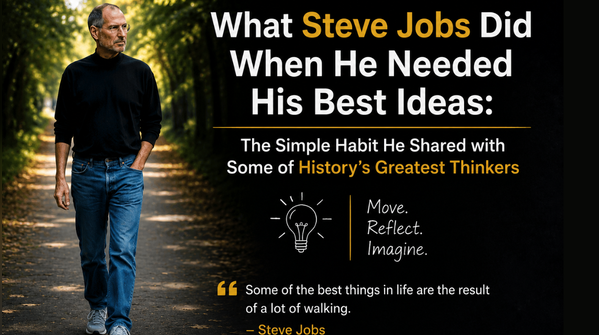
Science has proved that this simple habit can increase brain’s productivity
When Walter Isaacson showed up to interview Steve Jobs about his potential biography, he expected a straightforward conversation. Instead, Jobs had other plans. He asked Isaacson to go for a walk. "I didn't yet know that taking a long walk was his preferred way to have a serious conversation," Isaacson later wrote. That walk turned into Jobs offering Isaacson the chance to write his biography, a major decision that came not from a boardroom, but while the two were simply moving.
Jobs wasn't alone in this habit. Walk through the history of brilliant thinkers, and you'll find the same pattern over and over. Aristotle instructed students while they wandered, and Charles Darwin had a path explicitly installed for thinking, to be paced daily. Mark Zuckerberg and Twitter co-founder Jack Dorsey swore by walking meetings. Even LinkedIn CEO Jeff Weiner practices the same habit.
This wasn't some trendy productivity hack they were all following. Rather, it seems like different minds, separated by centuries and industries, all arrived at the same conclusion: walking clarifies thinking. And now we're finally getting the science to explain why.
Image: AI
The 60 percent boost that changed how we think about thinking
Here's what Stanford University researchers discovered when they decided to study this properly. They asked 176 college students to complete creative tasks while sitting, and then again while walking. In one experiment, participants were given several sets of three objects and told to come up with alternative uses for them. The researchers found that participants were "overwhelmingly" more creative when walking as opposed to sitting. Your Thyroid may be reacting to what’s on your plate: Doctor warns about the foods that help, harm, and confuse most people
The numbers were striking. Walking boosts creative thinking by an average of 60 percent. But here's the really interesting part: creative thinking from walking remained high shortly after sitting back down. So you don't need a four-hour hike. A quick walk before your meeting gets the job done.
But the Stanford team also found something important that doesn't apply to every situation. Sitting is a better option when you need to solve a problem that only has one right answer. In the study, test subjects were asked to come up with a single word that combines with the words "cottage, Swiss, and cake." Subjects who were sitting were better able to figure out that the correct answer was cheese. So walking won't help you balance your spreadsheet. But it's gold when you need to think sideways.

Why your brain behaves differently on its feet
The neuroscience behind this is actually pretty elegant. Because walking doesn't demand much conscious effort, your attention is free to wander—to overlay the world before you with a parade of images from your mind's theater. This is precisely the kind of mental state that studies have linked to innovative ideas and strokes of insight.
Think about what happens when you're at your desk staring at a blank screen. You're hyper-focused on the problem at hand. Your brain is trying to force an answer. But breakthroughs don't usually come from brute force. They come when your mind is doing something else entirely—when you're not trying so hard. That's exactly what walking does. It breaks the grip of that hyper-focus and lets your imagination run in the background.
Jobs intuitively understood this, even without the neuroscience backing it up. His approach became known as the "10-minute rule"—when faced with a challenging problem, he would take a break and go for a walk, allowing his mind the freedom to wander and refresh. Ten minutes. That's all it took for his brain to shift gears.

The Apple campus walking culture
On the Apple campus in Cupertino, walking wasn't a solo activity. Jobs and chief designer Jony Ive were often seen taking regular "brainstorming walks" around the Apple campus, and Pixar employees told researchers that Jobs "was always big on going for walks with people". This wasn't Jobs trying to be inspirational or quirky. It was his actual working method. The iPhone didn't get designed in a conference room. It got thought through while Jobs and Ive were moving.
Other tech leaders caught on to the same pattern. Jack Dorsey tells Fortune that he prefers the outdoors, saying "If I'm with a friend we have our best conversations while walking". There's something about movement that makes conversations deeper and more honest. You're not staring across a table. You're shoulder to shoulder, going in the same direction.
Walking meetings also changed the power dynamics of the room. When everyone's sitting around a table, there's a hierarchy. The person at the head matters more. But when you're walking side by side, that disappears.

The oldest idea that feels brand new
There's something nice about needing Stanford researchers and neuroscience to validate what Aristotle already knew. He founded the Lyceum in Athens and taught his students while they walked. They called his school the Peripatetic school because of it. That was in 335 B.C.
For over two thousand years, brilliant minds kept circling back to the same thing. They would put on their shoes, step outside, and let their thoughts untangle as their feet moved. Darwin. Aristotle. Jobs. The researchers write that "walking opens up the free flow of ideas".
The truth is, we know this intuitively. It's why people call showering one of the best places for ideas—the motion, the shift in scenery, the change of routine. Walking does the same thing, except you can bring someone with you and hash out the thinking in real time. You're not locked in place. You're not staring at a screen. You're just moving, thinking, and letting your brain work the way it apparently wants to when it's going to produce something new.
The next time you're stuck on something, don't sit there longer. Get up. Step outside. And maybe you'll come back with the idea that changes everything.
Featured In etimes

