- News
- entertainment
- kannada
- music
- Music therapy for special children
Trending
This story is from January 12, 2014
Music therapy for special children
Sampoorna Music Therapy Centre is helping autistic children achieve their developmental goals using music
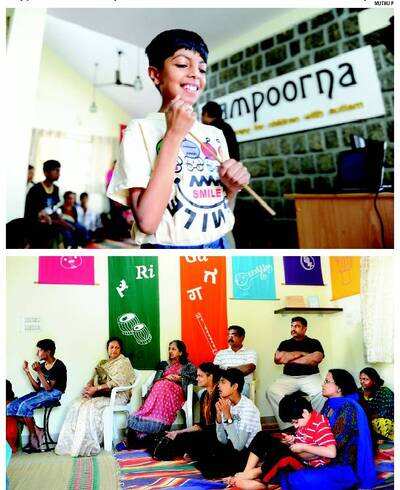
Forget a hug; they wait for just one side long glance that their little bundle of joy will cast in their direction.

He is the affable director of Sampoorna Music Therapy Centre for Children with Autism near Horamavu for children with autism. But before that, he is the father to Ananth, his 11-year-old autistic son — who, right from the age of three, surprised Anantharaman and his wife Kavita Krishnamoorthy, founder of the Kilkili Trust, with his prodigious musical talent.
Autism is a neurological disorder characterised by social impairments and communication difficulties. Children on the autism spectrum experience difficulty in communication and social interaction. They are focused in their own inner world and may have atypical behaviour due to these underlying sensory processing issues.
MUSICAL LEARNING
Let’s make him learn through music, Krishnamoorthy would tell her husband every time she saw their son engrossed, listening to Carnatic music. Anantharaman would reply, “Let him be. Let’s not take away the joy of music by forcing him to learn something else through it.”
But the question lingered. Krishnamoorthy discussed music as therapy with noted musician, Bombay Jayashree, who happens to be Anantharaman’s cousin. They decided to begin a pilot project called the Buddy’s Group. Abhinaya, a student of Bombay Jayashree, had expressed her willingness to sing for the group of seven children. She came from Chennai once a fortnight and sang songs for 45 minutes. After six months, the kids indicated the sequence of songs that would be sung. “It was an eye-opener,” says Ananthamurthy.
And one book would convince him further.
Music Therapy, Sensory Integration and the Autistic Child by Dorita S Berger reinforced what Krishnamoorthy had been telling him all along. The author espoused how the simplicity of music could be understood by a child with autism in a way that words cannot, and how this can lead to verbal communication once patterns are established.
The foundation for Sampoorna wasset.AtleastinthemindofGanesh. Then came what he calls, “a coincidence.” Krishnamoorthy came back home one day, excited about a meeting she had with the Autism Society of India where she discussed music therapy with VR Ferose, the then MD of SAP Labs. He had expressed a willingness to raise funds for such a school provided someone would lead the initiative. “I found myself saying yes even before I could process what it would entail,” he recalls. This was in September 2012.
A SLOW PROCESS
Sampoorna started off in January 2013, commencing its operations from a rented premise. SAP Labs employees personal contributions alone came to Rs 11 lakh. The main goal of music therapy at Sampoorna is not to make a musician out of a child, but to make planned use of interactive music (vocal, instrumental and rhythmic movements) towards achieving certain developmental goals of autism.
Music sessions at Sampoorna are 45 minutes long. There are 13 children, from the age of 3 to 13. There is just one girl at Sampoorna — autism is known to manifest mainly in boys.Every child attends two sessions in a week, an individual session and a group session, which has about four children together. The first three months are chaotic, says Anantharaman.
The little kids are kicking and screaming, protesting to get out. It is traumatic for the child, parents and the therapist. “I have to regularly counsel the therapists, telling them that it is okay if a session didn’t go the way it was planned,” says Anantharaman who coincidentally, is a trained behavioural scientist. Sadly, there are no certifications for music therapists in India. “My music therapists are learning through experience and a willingness to be with these children.”
Shruthi V Kumar, a music therapist at Sampoorna, stands by the door and greets the kids with a song — “Hello, (child’s name), Welcome to Sampoorna”. “There was a three-year-old boy who did not acknowledge anything at all. He would just gaze of out the window,” says Kumar. Until she sang Krishna nee begane baro.
The boy sat on her lap. Now he is four years old. He still doesn’t speak but when she sings he sits in front of her and sometimes, makes sounds. “That’s a huge response,” she says, with evident joy. There are other instances too.One boy with very poor gross motors kills over a period of eight months wants to play the metal gong, striking the right notes with precision. “He can play a musical instrument better than me,” says Kumar, herself an accomplished Carnatic singer.
THE REWARD IS SELF ESTEEM
These little milestones drive the parents and the therapists. “I challenge the popular belief that autism impairs the motivation to learn,” says Anantharaman. Through music therapy, which is a different route to improve fine and gross motor skills, he hopes to unleash the creativity in the child. At Sampoorna, music itself is an incentive. There are no other reward based lessons.
“The goals of music therapy are emotional, social and psychological based rather than practical and skill-based.” Plus, by playing an instrument, self-esteem is heightened.
But that is a long-term goal. A parent pulled out her son after six months at Sampoorna because he hadn’t learned to play an instrument. That hurt, says Anantharaman, but he understands. He too was like that. But as the child grows, parents learn to accept. And that’s when they begin to understand. When something doesn’t work, you don’t stop. You just change the approach.
The child is learning, the child is observing, the child understands love. The child can’t show that he or she knows. It is timefortheparenttoknow.“And wait for that sudden flash of acknowledgement,” says Anantharaman.
End of Article
FOLLOW US ON SOCIAL MEDIA








Photostories
entertainment videos
Featured In Movies

Popular Categories
Entertainment NewsBollywood NewsTollywood NewsKollywood NewsMollywood NewsMovie ReviewsLatest Hindi MoviesLatest Tamil MoviesMX PlayerParenting TipsHome RemediesWeight LossBeauty TipsParenting TipsHindi VideosHindi Video SongsBhojpuri Music VideosLatest Telugu MoviesBhojpuri Music VideoHindi TV News
Trending in Entertainment
Latest MoviesBollywood MoviesHollywood MoviesTamil Movies 2024Telugu Movies 2024Malayalam Movies 2024Kannada Movies 2024Marathi Movies 2024Bengali Movies 2024Top Rated Movies 2024Best Hindi MoviesBest English MoviesBest Telugu MoviesBest Tamil MoviesBest Malayalam MoviesBest Kannada MoviesBest Bengali MoviesUpcoming Hindi MoviesBest Movies Of All TimeBest Hindi Movies of All Time
Trending in Etimes
Horoscope TodayNumerology Predictions TodayWalking BenefitsBreast Cancer DiagnosisYung Filly Rape CaseTaylor Rousseau GriggBelly FatSean Diddy CombsOzempic PersonalityDepression RiskBelly Fat LossDurga Visarjan 2024Toxic FriendshipDonald TrumpElon MuskDussehra 2024Durga Ashtami 2024Multitasking TipsSaraswati Visarjan 2024
Trending in TV
Trending in Lifestyle
Trending in Regional
Movie Reviews
Binny And Family ReviewLove, Sitara ReviewWill & Harper ReviewWolfs ReviewYudhra ReviewJo Tera Hai Woh Mera Hai ReviewKahan Shuru Kahan Khatam ReviewHis Three Daughters ReviewNever Let Go ReviewDancing Village: The Curse Begins ReviewTransformers One ReviewFirst Love ReviewBerlin ReviewThe Buckingham Murders Review
Upcoming Hindi Movies
Upcoming Regional Movies
Latest News
How each zodiac sign handles emotional distance in relationshipsBook review: 'The Scientist Entrepreneur' by Dr Kalpana Sankar is a nuclear scientist’s inspiring journey of women’s empowermentDid BTS' V get promoted to corporal in the South Korean military? recent appearance at an orchestra event has fans speculatingParas Mhambrey joins Mumbai Indians as bowling coachSalman Khan’s security beefed up after Baba Siddiqui’s murder; ‘Sultan’ star looked uncomfortable after visiting the late politician’s family at 3 amRanji Trophy: Thriller in the making as Krunal Pandya fifty helps Baroda lead by 226 runs vs MumbaiOver 70 injured at Devaragattu Banni stick festival during Dussehra celebrationsBiker’s death ignites village fury in Odisha's Boudh, massive traffic jam on NH-57Women's T20 World Cup: Why India need Pakistan victory over New Zealand to secure semifinal berthSpaceX's fifth Starship test flight achieves historic booster catchKrushna Abhishek shares a heartwarming post for mama Govinda; says 'jab body mein adha blood supremely talented actor Govinda ka ho...'News brief: 'Who is listening? Modi?': Kapil Sibal takes a dig at RSS chief Mohan BhagwatKenya's Ruth Chepngetich breaks women's world record at Chicago MarathonZodiac signs likely to have soul connectionsAI’S Oppenheimer'Points towards failure of CM': Sanjay Raut slams Maharashtra govt over Baba Siddiqui's killingMahela Jayawardene returns as Mumbai Indians head coachMidnight queues, long waits, bad advice: It's not easy getting therapy in India
Other Group Sites -
ETimes is an Entertainment, TV & Lifestyle industrys promotional website and carries advertorials and native advertising.