- News
- entertainment
- kannada
- movies
- Are commuters paying a high price for bad service?
Trending
This story is from February 21, 2014
Are commuters paying a high price for bad service?
Bangalore buses need a makeover
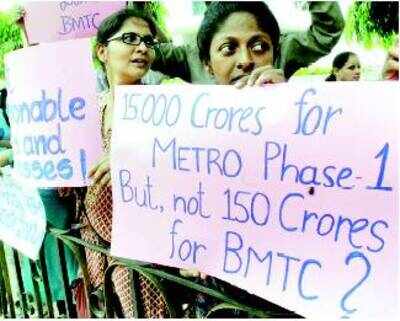
On Tuesday, Bangalore’s bus commuters, under the aegis of the Bangalore Bus Prayaanikara Vedike (BBPV), kickstarted the ‘50 Paise’ campaign at the Majestic Bus Stand.
Along with reducing current bus fares to make them affordable for passengers, the campaign also urged the Bangalore Metropolitan Transport Corporation (BMTC) — the government agency that operates the bus service in the city — and the state government to turn Bangalore’s public transport system into a serviceoriented model, rather than a profit-making entity. As part of the campaign, the BBPV is planning to collect 10 lakh signatures from citizens and submit a memorandum to chief minister Siddaramaiah.
“Bus fares in Bangalore are much higher when compared to cities like Mumbai and Chennai. It has become hard for commuters from lower income groups to afford ticket prices. The monthly bus pass costs 725 ( 925 for red board buses). We fear that prices will go up further, as a hike in diesel prices is likely in the coming days,” says Manohar Elavarthi, who is spearheading the campaign.
“With the 50 Paise campaign, we are demanding that commuters be charged 50 paise per kilometre of travel. We will also hold a public rally on March 4 to demand a revised fare structure,” adds Manohar.
Transport expert L Hemant Kumar agrees that bus rates are high, but adds that there are reasons for it. “Currently, the BMTC spends 40% of its revenue in paying the salaries of its employees, 35% on fuel at market price, and the rest on solving issues like low ultilization of buses due to high traffic movement on roads, which reduces the number of trips per day,” he says. BMTC officials maintain that the corporation does not get any government subsidies to run it and revenue takes care of all its overheads.
With the frequent hikes in bus fare, commuters accuse the BMTC of becoming a profitmaking entity. “There needs to be a debate about whether an organization providing an essential service like public transport should operate on the principle of profit and loss? Public money is invested in other departments, but there is no clamour for profit,” wrote Vinay K Sreenivasa, a prominent voice of the BBPV, in an article addressed to the BMTC.
Manohar adds that the focus of the BMTC should be to provide a service. “In Chennai, the state government has released 200 crore to the city transport corporation to provide affordable and comfortable service to commuters,” he says.
While reiterating that public transport has to be economical to get more people to use it, MA Saleem, additional commissioner of police (traffic, Bangalore city) says the BMTC also needs to increase its fleet on the road and provide better connectivity for Bangaloreans. “Once people figure out that there is timely service to all parts of the city at reasonable rates, people will prefer public transport to their own vehicles, thereby reducing congestion on the roads,” he adds.
A recent study titled ‘Urban Bus Transport Service Quality and Sustainable Development: Understanding the Gaps’ conducted by the Indian Institute of Science (IISc) and MS Ramaiah Institute of Management point out that there’s a distinct lack of customer satisfaction in Bangalore. The survey highlighted issues like poor maintenance of buses and bus stops, low frequency of buses during peak hours, non-availability of first-aid boxes and and unfriendly staff on buses. Regular commuters also cited issues with hygiene, given that buses are rarely given a wash, and uncomfortable seating (if available), as the upholstery is often age-old.
“I am a regular bus commuter. Boarding a bus during peak hours is nothing short of fighting a mini-battle as you push your way through a longqueue of passengers. This won’t be the case if there are more buses plying at regular intervals. Moreover, all the buses are old and need to be replaced soon,” says child rights activist Nagasimha Rao.
Along with reducing current bus fares to make them affordable for passengers, the campaign also urged the Bangalore Metropolitan Transport Corporation (BMTC) — the government agency that operates the bus service in the city — and the state government to turn Bangalore’s public transport system into a serviceoriented model, rather than a profit-making entity.
COSTLY COMMUTE
“Bus fares in Bangalore are much higher when compared to cities like Mumbai and Chennai. It has become hard for commuters from lower income groups to afford ticket prices. The monthly bus pass costs 725 ( 925 for red board buses). We fear that prices will go up further, as a hike in diesel prices is likely in the coming days,” says Manohar Elavarthi, who is spearheading the campaign.
Bangalore buses need a makeover
“With the 50 Paise campaign, we are demanding that commuters be charged 50 paise per kilometre of travel. We will also hold a public rally on March 4 to demand a revised fare structure,” adds Manohar.
Transport expert L Hemant Kumar agrees that bus rates are high, but adds that there are reasons for it. “Currently, the BMTC spends 40% of its revenue in paying the salaries of its employees, 35% on fuel at market price, and the rest on solving issues like low ultilization of buses due to high traffic movement on roads, which reduces the number of trips per day,” he says. BMTC officials maintain that the corporation does not get any government subsidies to run it and revenue takes care of all its overheads.
Bus for the masses?
With the frequent hikes in bus fare, commuters accuse the BMTC of becoming a profitmaking entity. “There needs to be a debate about whether an organization providing an essential service like public transport should operate on the principle of profit and loss? Public money is invested in other departments, but there is no clamour for profit,” wrote Vinay K Sreenivasa, a prominent voice of the BBPV, in an article addressed to the BMTC.
Manohar adds that the focus of the BMTC should be to provide a service. “In Chennai, the state government has released 200 crore to the city transport corporation to provide affordable and comfortable service to commuters,” he says.
While reiterating that public transport has to be economical to get more people to use it, MA Saleem, additional commissioner of police (traffic, Bangalore city) says the BMTC also needs to increase its fleet on the road and provide better connectivity for Bangaloreans. “Once people figure out that there is timely service to all parts of the city at reasonable rates, people will prefer public transport to their own vehicles, thereby reducing congestion on the roads,” he adds.
Ill-maintained and unfriendly buses
A recent study titled ‘Urban Bus Transport Service Quality and Sustainable Development: Understanding the Gaps’ conducted by the Indian Institute of Science (IISc) and MS Ramaiah Institute of Management point out that there’s a distinct lack of customer satisfaction in Bangalore. The survey highlighted issues like poor maintenance of buses and bus stops, low frequency of buses during peak hours, non-availability of first-aid boxes and and unfriendly staff on buses. Regular commuters also cited issues with hygiene, given that buses are rarely given a wash, and uncomfortable seating (if available), as the upholstery is often age-old.
“I am a regular bus commuter. Boarding a bus during peak hours is nothing short of fighting a mini-battle as you push your way through a longqueue of passengers. This won’t be the case if there are more buses plying at regular intervals. Moreover, all the buses are old and need to be replaced soon,” says child rights activist Nagasimha Rao.
End of Article
FOLLOW US ON SOCIAL MEDIA









entertainment videos
Featured In Movies

Popular Categories
Entertainment NewsBollywood NewsTollywood NewsKollywood NewsMollywood NewsMovie ReviewsLatest Hindi MoviesLatest Tamil MoviesMX PlayerParenting TipsHome RemediesWeight LossBeauty TipsParenting TipsHindi VideosHindi Video SongsBhojpuri Music VideosLatest Telugu MoviesBhojpuri Music VideoHindi TV News
Trending in Entertainment
Latest MoviesBollywood MoviesHollywood MoviesTamil Movies 2024Telugu Movies 2024Malayalam Movies 2024Kannada Movies 2024Marathi Movies 2024Bengali Movies 2024Top Rated Movies 2024Best Hindi MoviesBest English MoviesBest Telugu MoviesBest Tamil MoviesBest Malayalam MoviesBest Kannada MoviesBest Bengali MoviesUpcoming Hindi MoviesBest Movies Of All TimeBest Hindi Movies of All Time
Trending in Etimes
Horoscope TodayNumerology Predictions TodayProject 2025Taylor SwiftUS Presidential Debate Key TakeawaysSpringfield Eating PetsMelania TrumpJoe WilsonVice Presidential DebateMeghan MarkleKamala HarrisDonald TrumpPatriot Day 2024Diabetes RiskHappy Mindfulness Day 2024Trump Vs HarrisJoe JonasNational Day of Encouragement 2024Dave Bautista
Trending in TV
Trending in Lifestyle
Trending in Regional
Movie Reviews
Visfot ReviewThalapathy Is The G.O.A.T ReviewRebel Ridge ReviewDetective Conan vs. Kid the Phantom Thief ReviewBeetlejuice Beetlejuice ReviewPad Gaye Pange ReviewA Wedding Story ReviewThe Diary Of West Bengal ReviewTikdam ReviewKinds Of Kindness ReviewAfraid ReviewThe Deliverance ReviewBlue Lock: Episode Nagi ReviewDaddio Review
Upcoming Hindi Movies
Upcoming Regional Movies
Latest News
Manju Warrier expresses gratitude for birthday wishes: "Forever humbled and grateful"Jiiva and wife escape with minor injuries after a road accidentThe Zodiac Signs Most Naturally Inclined to HealingWhy Banyan trees survive for centuries and spread indefinitely?Telangana government pushes for increased flood relief from CentreNBA 2K25 locker codes September 2024: Locker codes revealed and know how to reveal themDonald Trump and Kamala Harris shake hands as they meet for first time on debate stage: Watch the 'awkward' momentBRS pushes for disqualification of turncoat MLAs after High Court rulingKamala may have won debate. But election is still too close to callVarun Dhawan shares unfiltered reaction to Janhvi Kapoor's 'Daavudi' song from 'Devara: Part 1': 'So freaking good...''On basis of fairness and equality': Bangladesh seeks good relations with India, says YunusMpox kills two, six other confirmed cases in Cameroon: GovernmentJr NTR starrer 'Devara: Part 1' completes censorship formalities; receives UA certificateJalen Ramsey demands action against Miami Police following Tyreek Hill's pulled from car49ers RB Christian McCaffrey misses win over JetsWWE Superstar Blames the Company for Failing to Utilize Omos’ PotentialArbaaz Khan spotted outside Malaika Arora's house along with police after the tragic news of her father's demise by alleged suicide - WATCH VIDEOShivaji statue collapse: Sculptor’s custody extended till September 13
Other Group Sites -
ETimes is an Entertainment, TV & Lifestyle industrys promotional website and carries advertorials and native advertising.