- News
- entertainment
- hindi
- music
- Poet Neeraj, who wrote karwan guzar gaya, no more
Trending
This story is from July 19, 2018
Poet Neeraj, who wrote karwan guzar gaya, no more
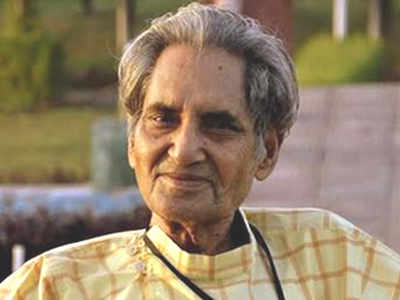
Gopaldas Neeraj (PTI file photo)
A Padma Bhushan awardee, Neeraj had suffered a head injury after a fall in Agra and was undergoing treatment there, Dr Rajesh Malhotra, chief of the AIIMS trauma centre, told PTI.

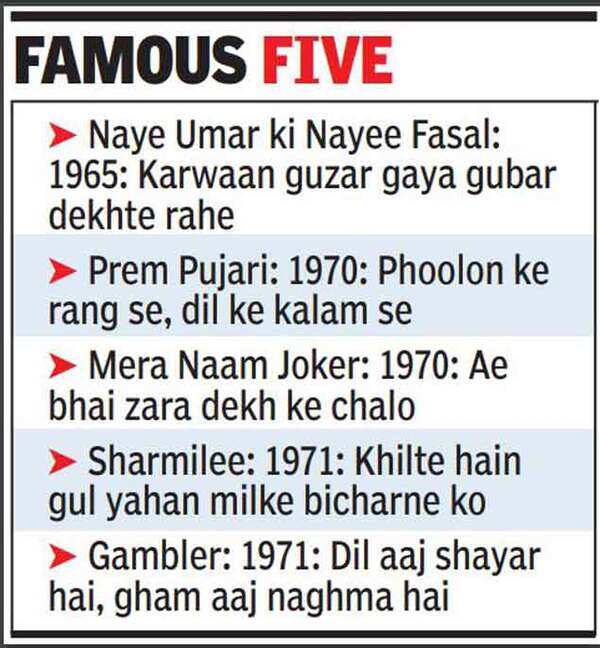
Neeraj's most memorable songs came in megaflops such as Mera Naam Joker, Prem Pujari, Tere Mere Sapne and Gambler. But the poet, who was born in Etawah in Uttar Pradesh, also wrote for box-office winners such as Sharmilee and Cha Cha Cha.
For Neeraj, poetry and film songs went hand-in-hand. His verse was often a creative blend of Hindi and Urdu. He would dexterously and seamlessly glide from one language to another. Songs like Shokhiyon mein ghola jaaye phoolon ka shabab and Phoolon ke rang se (both from film, Prem Pujari) typify this rare gift. He could also write a geet such as Jeevan ki bagiya mahkegi (Film: Tere Mere Sapne) with the same felicity.
Neeraj, whose real name was Gopaldas Saxena, lost his father at an early age. He quit studies, did odd jobs before going back to education and earned his post-graduate degree. He taught Hindi literature in Aligarh, the city he loved and where he lived much of his later life.
In his prime, he was a hugely popular poet who presence guaranteed a kavi sammelan's success. Satyanand Nirpuam, editorial director, Rajkamal Paperbacks, recalls being told that in the 1960s and 70s, Neeraj's books were a standard gift between young lovers. "He was like a rock star. Even our biology teacher would find excuses to quote his poetry in class," he recalls. "Neeraj was an extremely sensitive poet who explored love in all its dimensions but he could be philosophical too," says writer Sheoraj Singh "Bechain".
Actor Chandrashekhar's reformist musical, Cha Cha Cha (1964) was his first film. Woh hum na thhey and Subah na aayee, poetic declarations of a defeated heart, announced his arrival in the competitive and classy Hindi songwriting scene of the 1960s.
The following year Karwan guzar gaya, one of his most popular poems, was used in Nai Umar Ki Nai Fasal. The poem captures the existential plight of idlers and dreamers, referred to by Greek poet Homer as "the lotus eaters." Music director Roshan produced the perfect minimalist tune to match its mood and singer Mohd Rafi rendered it pitch perfect to create a classic.
Kanyadaan's Likhe jo khat tujhe, sung by Mohd Rafi, was his first major chartbuster, its popularity reflected in the iconic radio hit parade show, Binaca Geetmala in 1969. The following year, the lyricist penned the most successful song of his career, Rangeela re, which finished third in the annual charts of Binaca Geetmala. After the mid-1970s, when action became the dominate theme in Bombay cinema, Neeraj's assignments became less frequent. It didn't help that he developed creative differences with some top music directors of the time. But as a poet he continued to enrich the world of Hindi literature.
(With inputs from PTI)
End of Article
FOLLOW US ON SOCIAL MEDIA








Photostories
entertainment videos
Featured In Movies

Popular Categories
Entertainment NewsBollywood NewsTollywood NewsKollywood NewsMollywood NewsMovie ReviewsLatest Hindi MoviesLatest Tamil MoviesMX PlayerParenting TipsHome RemediesWeight LossBeauty TipsParenting TipsHindi VideosHindi Video SongsBhojpuri Music VideosLatest Telugu MoviesBhojpuri Music VideoHindi TV News
Trending in Entertainment
Latest MoviesBollywood MoviesHollywood MoviesTamil Movies 2024Telugu Movies 2024Malayalam Movies 2024Kannada Movies 2024Marathi Movies 2024Bengali Movies 2024Top Rated Movies 2024Best Hindi MoviesBest English MoviesBest Telugu MoviesBest Tamil MoviesBest Malayalam MoviesBest Kannada MoviesBest Bengali MoviesUpcoming Hindi MoviesBest Movies Of All TimeBest Hindi Movies of All Time
Trending in Etimes
Horoscope TodayNumerology Predictions TodayWalking BenefitsBreast Cancer DiagnosisYung Filly Rape CaseTaylor Rousseau GriggBelly FatSean Diddy CombsOzempic PersonalityDepression RiskBelly Fat LossDurga Visarjan 2024Toxic FriendshipDonald TrumpElon MuskDussehra 2024Durga Ashtami 2024Multitasking TipsSaraswati Visarjan 2024
Trending in TV
Trending in Lifestyle
Trending in Regional
Movie Reviews
Binny And Family ReviewLove, Sitara ReviewWill & Harper ReviewWolfs ReviewYudhra ReviewJo Tera Hai Woh Mera Hai ReviewKahan Shuru Kahan Khatam ReviewHis Three Daughters ReviewNever Let Go ReviewDancing Village: The Curse Begins ReviewTransformers One ReviewFirst Love ReviewBerlin ReviewThe Buckingham Murders Review
Upcoming Hindi Movies
Upcoming Regional Movies
Latest News
Challenging Aspects in Astrology: What They Mean for YouNew Zealand pile pressure on India after routing Sri LankaInfosys to no longer send job offer letters and attachments, the company will ...Sena vs Sena: Dusshera rallies in Mumbai turn political as Shinde, Uddhav take aim at each otherIn the land of Ram, a Ramlila that unites Hindus and Muslims'Singham Again' stars Ajay Devgn, Kareena Kapoor, Rohit Shetty spotted at airport as they jet off for Raavan Dahan in Delhi - Watch VIDEOPapankusha Ekadashi 2024: Date, Parana Time, Puja Rituals and Significance'Bigg Boss OTT 3' contestant Ranvir Shorey admits lack of patience for 'Bigg Boss', enters the show unprepared7 dead, 1 missing after car plunges into canal in HaryanaETimes Pic of the day: When Indrajith Sukumaran bumped into Mukesh Ambani at a traffic signalDid you know NTR is the only actor to play both Lord Rama and Ravana?TDB will go ahead with online darshan bookings at Sabarimala temple'Ab ki baar 300 paar': Fans go crazy as India pile up 297 against Bangladesh'Really sympathetic...We want him bowling': Pat Cummins shows solidarity with Cameron Green during injury recoveryThe Great Indian Kapil Show 2: Kareena Kapoor Reveals hubby Saif Ali Khan is jealous of her bond with sister Karisma; says, “He thinks I talk to her more than him”Ex-Delhi University professor GN Saibaba passes awayWho is judge Arun Subramanian? New Judge assigned to Sean 'Diddy' Combs sex-trafficking casePrasanth Varma shares his passion for superhero films inspired by mythology and magic
Other Group Sites -
ETimes is an Entertainment, TV & Lifestyle industrys promotional website and carries advertorials and native advertising.