- News
- entertainment
- hindi
- music
- Light, hope and sound
Trending
This story is from April 10, 2010
Light, hope and sound
A group of blind Egyptian female musicians wows Indian audiences
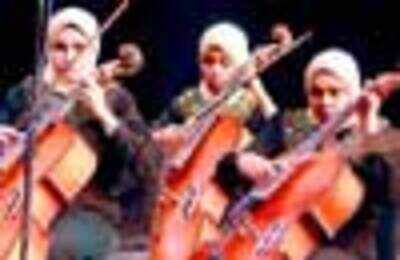
Backstage, it’s cacophony. The 36 members of the Al Nour Wal Amal Chamber Orchestra haul their instruments about, test them.
Hala lubricates the outer slide of her trombone and tries it. Satisfied, she plays a snatch. Shaimaa Yehiya works her violin and Ziana Khalil, oboe across her lap, feverishly munches on what looks like an airline snack — pre-show nerves, perhaps. They have every note memorised. The Egyptian Blind Girls Chamber Orchestra — the only one of its kind — has no use for music sheets or the conductor’s baton. But at the Kamani Auditorium, they play without a glitch, a mix of western and oriental classical music — Mozart, Brahms, Mohamed Abdel Wahab.
“My siblings are normal people, they don’t have any disability,” says Shaimaa, 26. They don’t have her gift either. She’d joined the Al Nour Wal Amal (Light and Hope) Association, a Cairo-based NGO for blind girls and women, at eight. After just one year of training at the ‘Music Institute’, she was inducted into the orchestra and delivered her first international performance at 13 in Toronto.
“I grew up listening to Western music on the radio,” says Shaimaa. She mostly got English pop but also a fair amount of Mozart, Beethoven and Bach. “I love the violin,” she says smiling. As with most of the others, Shaimaa’s family is ordinary. Her father’s a labourer and mother a homemaker. With a degree in English language from a Cairo university, she’s the “highly educated one.” “My parents are so proud. They think I’m the best.”
They can’t see the expressions of delight or wet eyes but can hear the spontaneous applause, perhaps even sense when listeners are rising to their feet. The claps and hoots after her solo bit puts a grin on Vasma Faad’s face that’ll stay till the end. The orchestra’s Sudanese conductor
Teaching the girls is different but not difficult. “It’s easy,” he says with a snort of laughter. “They know Braille and their ears are sensitive, they never go wrong taking dictation. Play any note and they can tell whether it’s ‘c’ or ‘d’.” He dictates the relevant sections from the music sheets to the four parts. The musicians note them down in Braille, memorise and practice individually before being put together.
Their problems have come from elsewhere. On their way to Qatar some years ago, they were stopped by the airline; the maximum number of blind passengers allowed on board was 30. “Six members of our orchestra are halfblind. They were tested and we went,” says Osman recounting the harrowing experience, now an amusing anecdote. In Delhi, the bridge shoots out of the double bass ending the concert for Shehnaz and Zehen. They fumble to their seats and wait to be led off the stage.
Follow us on Twitter for more stories
Hala lubricates the outer slide of her trombone and tries it. Satisfied, she plays a snatch. Shaimaa Yehiya works her violin and Ziana Khalil, oboe across her lap, feverishly munches on what looks like an airline snack — pre-show nerves, perhaps.
“My siblings are normal people, they don’t have any disability,” says Shaimaa, 26. They don’t have her gift either. She’d joined the Al Nour Wal Amal (Light and Hope) Association, a Cairo-based NGO for blind girls and women, at eight. After just one year of training at the ‘Music Institute’, she was inducted into the orchestra and delivered her first international performance at 13 in Toronto.
“I grew up listening to Western music on the radio,” says Shaimaa. She mostly got English pop but also a fair amount of Mozart, Beethoven and Bach. “I love the violin,” she says smiling. As with most of the others, Shaimaa’s family is ordinary. Her father’s a labourer and mother a homemaker. With a degree in English language from a Cairo university, she’s the “highly educated one.” “My parents are so proud. They think I’m the best.”
A group of women volunteers started Al Nour Wal Amal Association in 1954 for the education, vocational training and integration of blind women. Its Music Institute was founded in 1961 by Sanaha El Kholy of the Academy of Arts, the Cairo Conservatory and the Egyptian Opera House. The orchestra has played in 17 countries, even Vienna and Paris; audience sizes ranged from 500 to 5,000.
They can’t see the expressions of delight or wet eyes but can hear the spontaneous applause, perhaps even sense when listeners are rising to their feet. The claps and hoots after her solo bit puts a grin on Vasma Faad’s face that’ll stay till the end. The orchestra’s Sudanese conductor
Ali Osman, 50, has taught at the Academy of Arts. “‘Conductor’ is not the right word. I’m a coach,” says Osman. On stage, he’s remarkably unassuming: he names the piece, clicks fingers for the count and withdraws to a corner.
Teaching the girls is different but not difficult. “It’s easy,” he says with a snort of laughter. “They know Braille and their ears are sensitive, they never go wrong taking dictation. Play any note and they can tell whether it’s ‘c’ or ‘d’.” He dictates the relevant sections from the music sheets to the four parts. The musicians note them down in Braille, memorise and practice individually before being put together.
Their problems have come from elsewhere. On their way to Qatar some years ago, they were stopped by the airline; the maximum number of blind passengers allowed on board was 30. “Six members of our orchestra are halfblind. They were tested and we went,” says Osman recounting the harrowing experience, now an amusing anecdote. In Delhi, the bridge shoots out of the double bass ending the concert for Shehnaz and Zehen. They fumble to their seats and wait to be led off the stage.
Follow us on Twitter for more stories

About the Author
Shreya Roy ChowdhuryEnd of Article
FOLLOW US ON SOCIAL MEDIA









entertainment videos
Featured In Movies
Popular Categories
Entertainment NewsBollywood NewsTollywood NewsKollywood NewsMollywood NewsMovie ReviewsLatest Hindi MoviesLatest Tamil MoviesMX PlayerParenting TipsHome RemediesWeight LossBeauty TipsParenting TipsHindi VideosHindi Video SongsBhojpuri Music VideosLatest Telugu MoviesBhojpuri Music VideoHindi TV News
Trending in Entertainment
Latest MoviesBollywood MoviesHollywood MoviesTamil Movies 2024Telugu Movies 2024Malayalam Movies 2024Kannada Movies 2024Marathi Movies 2024Bengali Movies 2024Top Rated Movies 2024Best Hindi MoviesBest English MoviesBest Telugu MoviesBest Tamil MoviesBest Malayalam MoviesBest Kannada MoviesBest Bengali MoviesUpcoming Hindi MoviesBest Movies Of All TimeBest Hindi Movies of All Time
Trending in Etimes
Horoscope TodayNumerology Predictions TodayProject 2025Taylor SwiftUS Presidential Debate Key TakeawaysSpringfield Eating PetsMelania TrumpJoe WilsonVice Presidential DebateMeghan MarkleKamala HarrisDonald TrumpPatriot Day 2024Diabetes RiskHappy Mindfulness Day 2024Trump Vs HarrisJoe JonasNational Day of Encouragement 2024Dave Bautista
Trending in TV
Trending in Lifestyle
Trending in Regional
Movie Reviews
Visfot ReviewThalapathy Is The G.O.A.T ReviewRebel Ridge ReviewDetective Conan vs. Kid the Phantom Thief ReviewBeetlejuice Beetlejuice ReviewPad Gaye Pange ReviewA Wedding Story ReviewThe Diary Of West Bengal ReviewTikdam ReviewKinds Of Kindness ReviewAfraid ReviewThe Deliverance ReviewBlue Lock: Episode Nagi ReviewDaddio Review
Upcoming Hindi Movies
Upcoming Regional Movies
Latest News
Kapil Sharma gives fans a peek into his Ganesh Chaturthi festivities with wife GinniNot MS Dhoni and Rohit Sharma, Gautam Gambhir calls this Indian player 'Shahenshah'. WatchPolice registered 10 cases against Ganapati mandals for using laser beam lightsThe Zodiac Signs Most Naturally Inclined to HealingPolicy of 'Padak Lao, Pad Pao' will be implemented again for the sportspersons, says Deepender HoodaBest 20000mAh Power Banks To Power Your Devices Wherever You GoWalking dog in Goa? Mouth guard, leash soon to be mustKamala may have won debate. But election is still too close to callCommunal violence erupts in Karnataka during Ganpati Visarjan, section 144 imposedMpox kills two, six other confirmed cases in Cameroon: GovernmentTrump's claim about sending Taliban leader Abdul his house photo fuels social media frenzyFinding divinity in a world addicted to noiseOmar fighting for chair, I’m fighting for people of Kashmir, says Engineer Rashid after walking out of TiharTovino Thomas praises Prithviraj Sukumaran as director: "One of the brilliant directors I have ever worked with"Border Gavaskar Trophy: When Sourav Ganguly's Brisbane heroics set the tone for an enlivening seriesLive wire snaps, boy recalls science lesson, saves lives with sisterTNA Champion accepts WWE Star's street fight challengeHow to make an egg mask for ultimate hair growth
Other Group Sites -
ETimes is an Entertainment, TV & Lifestyle industrys promotional website and carries advertorials and native advertising.