- News
- entertainment
- hindi
- music
- It's a rare honour: Lopamudra Mitra
Trending
This story is from August 7, 2011
It's a rare honour: Lopamudra Mitra
Lopamudra Mitra, who is part of the Panchakanya concert tonight, says it’s a priviledge to share the stage with Lataji
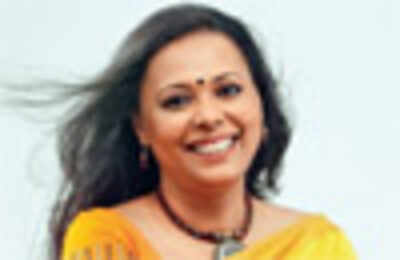
You are performing at the Panchakanya concert today along with Lata Mangeshkar...
It’s a privilege for any musician to be able to sing songs on the same theme on a stage that also has been graced by her. What adds special relevance is that even as we sing Tagore today, we realize that the songs have so much of a contemporary appeal.

This is your fifth year of being a part of the Panchakanya concert...
True. This concert is important because it gives me a platform to share the stage with those whom we consider to be our Gods in music. Last year, I sang with Asha Bhonsle.
It’s been 15 years since you have been singing. Why do you still say that you suffer from stage fright?
My stage fright has increased because I didn’t have anything to lose earlier. Today, I realize that every concert is different. Every member of the audience is different and their expectations from me are different and have increased manifold. Simple things like which song do I begin my show with, whether the scale is right or if my voice is sounding okay - I have all these doubts before I begin a show.
What happens on stage then?
This is something I have never shared before. When I sing, I see colours. For me, a song is a collective whole of the tune and the lyrics. Often when I am singing or even thinking about a song, I associate it with colours. They just come like flashes in my mind. It’s very important as well as extremely difficult for a musician to be able to surrender to the supreme power on stage and believe that he/she should just perform and leave the rest to God.
How have you set your musical priorities today?
When I started my career, I was sure that I would never shift to Mumbai. I take huge pride in Bengal and I wanted to become a singer who could pull off a show with just Bengali songs. It’s not that I can’t sing one or two Hindi numbers in a concert. But, I never do that.
But then, you’ve also sung an item number, “Mahi Re”...
This song too conveys my spirit. The lyrics of this Jeet Gannguli song from “System” go like: “Jokhoni chute gechi benche thakar gaan/Tokhoni dhushor otit dei je pichhu tan/Ghire nei kalo andhar/Tobu mon bole mahi re”. I don’t make any hierarchical judgment when I am singing a song. Every song that I sing has a unique space. For me, each of them is like an offering to my ultimate God - my listener.
You’ve adapted poetry to songs. How has your approach to such a style of adaptation changed over the years?
It’s a sad truth that despite us saying that poetry is something that Bengalis love, fact is that expressing love for poetry is just a fad these days. How many can actually recite or even analyze Saktida or Nirendranath Chakraborty’s works? Most importantly, how many can actually read Bengali literature to be able to appreciate the essence of such works? So, adapting poetry into songs is very challenging now. When I started off with such songs, it was primarily because of my love for the subject treated in such poetry as well as because of the absence of good lyricists. We could use the lines of poetry as good lyrics. I also had this strong desire that when I lent my voice to these poems, I would do that in such a way that the songs became synonymous with me. Maybe, someday, I will again try doing the same just to see if the audience is still open to appreciating it.
Your earlier songs are still so popular at your shows. Does your approach to the lyrics change now that you’ve weathered so much as a human being and a musician?
Yes, it has. When I decided to sing “Benimadhob”, I wasn’t convinced with the line: “Kemon hobe ami jodi noshto meye hoi”. I didn’t want this girl to be portrayed as a failure. But my composer asked me to refer to the last scene in Ritwik Ghatak’s “Meghe Dhaka Tara” where Supriya Devi says: “Dada, ami banchte chai”. After that scene, the film concludes with another lady taking a walk down the road, pausing for a while when the strap of her slipper snaps and then continuing ahead. I was told to associate this scene when I sang those lines “Benimadhob, ami tomar bari jabo”. Today, however, when I sing, this line has a different connotation. Benimadhob is no longer a story for me. Benimadhob is a metaphor for music. When I say “ami tomar bari jabo”, I am addressing it to my music. When I sang “Abani bari achho”, I couldn’t initially understand the angst of identity crisis. Today, I know because I realize that despite having done so many things in life, I am shrouded with that one identity of being the singer Lopamudra Mitra. Even for my mother, after I became a singer, this identity became the most important one.
Where is the struggle for a musician like you now?
Right now, there is no struggle. I am very happy with the kind of work I am doing. I don’t really care much about what people are saying. Hence, I did “Monfokira” and “Ananda” my way. I sing Tagore in my style. But yes, what intrigues me is when the music labels claim that the albums are not selling. I can’t seem to understand how that’s possible when people constantly are making request for Bengali songs (they must have heard it from albums). I can’t ascertain why if the sale of albums is so bad, companies
strangely want to even produce them? It’s a
paradox that I don’t understand.
You’ve often been called a feminist. How do you define feminism?
I don’t believe in feminism. There is no point trying to be in a constant fight with the other gender. There is no point in fighting with oneself to register a protest to get a 50 per cent right share. The moment a woman thinks of herself as a person, things will no longer seem like a battle. Fact is, even though we might be angry with the opposite sex, it is true that in many contexts they are much weaker than women.
What does being Lopamudra Mitra mean now?
I only do what I believe in. I am very open and equally emotional. I can accept stuff till a point. But beyond that, I become ruthless.
Does being Lopamudra also mean marriage to someone much younger to her?
My husband, Joy, is younger to me. Amader ekta maar piter somporko. When I say Joy is five years younger to me, he will immediately correct me and say: “Four years, 11 months”. That’s how we fight. When we get married after years of being in a relationship, it’s obvious that we will reach a stage where we will fight. Maybe, when either of us isn’t around, we will understand the worth of the other person. As for the age difference, Joy might be younger to me in terms of years but I am younger to him in terms of my heart’s age.

About the Author
Priyanka DasguptaEnd of Article
FOLLOW US ON SOCIAL MEDIA







Photostories
entertainment videos
Featured In Movies
Popular Categories
Entertainment NewsBollywood NewsTollywood NewsKollywood NewsMollywood NewsMovie ReviewsLatest Hindi MoviesLatest Tamil MoviesMX PlayerParenting TipsHome RemediesWeight LossBeauty TipsParenting TipsHindi VideosHindi Video SongsBhojpuri Music VideosLatest Telugu MoviesBhojpuri Music VideoHindi TV News
Trending in Entertainment
Latest MoviesBollywood MoviesHollywood MoviesTamil Movies 2024Telugu Movies 2024Malayalam Movies 2024Kannada Movies 2024Marathi Movies 2024Bengali Movies 2024Top Rated Movies 2024Best Hindi MoviesBest English MoviesBest Telugu MoviesBest Tamil MoviesBest Malayalam MoviesBest Kannada MoviesBest Bengali MoviesUpcoming Hindi MoviesBest Movies Of All TimeBest Hindi Movies of All Time
Trending in Etimes
Horoscope TodayNumerology Predictions TodaySean Diddy MotherKarachi Airport ExplosionKamala HarrisJimmy KimmelBelly FatHurricane MiltonSunita WilliamsDepression RiskBelly Fat LossBarbra StreisandSnoring Prevention TipsDonald TrumpElon MuskRelationship TipsLake Michigan DiscoveryRelationship TipsEkadashi in October 2024
Trending in TV
Trending in Lifestyle
Trending in Regional
Movie Reviews
Binny And Family ReviewLove, Sitara ReviewWill & Harper ReviewWolfs ReviewYudhra ReviewJo Tera Hai Woh Mera Hai ReviewKahan Shuru Kahan Khatam ReviewHis Three Daughters ReviewNever Let Go ReviewDancing Village: The Curse Begins ReviewTransformers One ReviewFirst Love ReviewBerlin ReviewThe Buckingham Murders Review
Upcoming Hindi Movies
Upcoming Regional Movies
Latest News
India set to discuss surge in silver imports with UAEAmbala Cantt Assembly Election Result 2024: BJP's big gun Anil Vij leading in early trendsAquarius, Daily Horoscope Today, October 08, 2024: . You are likely to receive recognitionNavratri as Spiritual Detox: 9 days to cleanse your mind, body and soulUrban apathy drags voter turnout in HaryanaWhy are the CEOs of most luxury brands stepping down?Alia Bhatt just cannot keep calm on watching 'Singham Again' trailer, says 'all the dynamite in one frame' for the big multi-starrer led by Ajay DevgnGurgaon Haryana Assembly Elections Results 2024: BJP's Mukesh Sharma leading as per early trendsMelania: What Donald Trump and Barron said about bestseller before releaseNCERT to triple textbook production, aims to print 150 million books this year: Edu ministerMonetary policy committee meet: RBI moving closer to rate cutWatch: Team India arrives in Delhi ahead of 2nd T20I against Bangladesh'I own a Glock and yes, I’ve fired It,' says Kamala on 60 Minutes; rules out solo talks with PutinEr Rashid calls for keeping govt formation on hold to press for statehood restorationHarivanshrai Bachchan believed that his son Amitabh Bachchan was a reincarnation of his father: 'Uske roop mein mere pitaji ki aatma aa rahi hai'Kathua (SC) Assembly Election Result 2024: BSP's Sandeep Majotra leading in early trendsHappy Durga Puja 2024: Best Messages, Quotes, Wishes, and Images to Share on Durga PujaThe Chiefs Remains Undefeated As They Improved to 5-0 Victory Over the New Orleans Saints on Monday Night Football
Other Group Sites -
ETimes is an Entertainment, TV & Lifestyle industrys promotional website and carries advertorials and native advertising.