- News
- entertainment
- hindi
- music
- Exclusive: My dad’s purpose on Earth was to popularise the santoor, says Rahul Sharma
Trending
This story is from June 12, 2022
Exclusive: My dad’s purpose on Earth was to popularise the santoor, says Rahul Sharma
Pandit Shivkumar Sharma breathed his last on May 10. The santoor maestro, often called the king of 100 strings, left behind a rich legacy of music. In an exclusive interview with Bombay Times, his son, Rahul Sharma, who has trained under the legendary santoor player and has had the privilege of performing with him several times, talks about the musical genius that was Pandit Shivkumar Sharma.

In an exclusive interview with Bombay Times, his son, Rahul Sharma, who has trained under the legendary santoor player and has had the privilege of performing with him several times, talks about the musical genius that was Pandit Shivkumar Sharma.

Your father, Pandit Shivkumar Sharma, was a legend. His demise left music lovers and artistes from the music circle heartbroken. As a son and a disciple, how are you dealing with it?
He was an awakened soul. So, it’s not that unki death ho gayi, I feel that he has just gone into another realm where he is in a happy
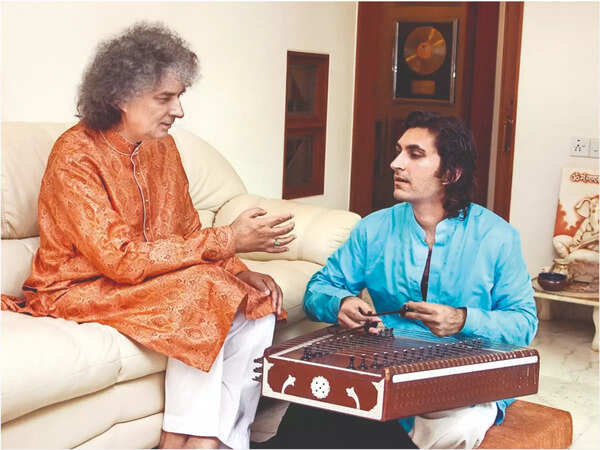
environment, and is having concerts there. We’ve come to terms with it. The fact that I shared more than a half of my life travelling and performing with him helped me see a lot of it. He lived an extraordinary life till the age of 84, saw great success, travelled all over the world, passed the knowledge of santoor to me, and was passing it on to my son as well. So, the legacy continues. On May 10, he just left us suddenly, there was no suffering, he went peacefully. I think his purpose on Earth was to popularise the santoor, establish it and pass it on.
Tell us about your fondest memories of him…
There are so many of them... But I remember going to Disneyland in Orlando with my parents when I was around 12 years old. My dad sat with me on all the rides, there was no talk of music. It was all about ice-creams and rides. Around four years ago, he had a huge concert at the Hague in Holland, a jugalbandi with Pandit Hariprasad Chaurasia, but he wasn’t well and could not go.
So, Hariji told my dad, “The only person who can replace you in this concert is Rahul.” I flew to Holland and performed with Hariji. Imagine my plight when I had to fill in his large shoes. My dad saw the video of the entire concert several times and was proud that his son took his place deservingly.
The kind of work he did in popularising santoor and the stature he gave the instrument in the world of music was phenomenal. You also became part of that process once you became a performer…
Certain ancient instruments have been around for a long time, but the santoor was relatively new. Establishing an instrument in your lifetime and giving it stature and taking it to that level where it’s being performed worldwide is phenomenal. That is an achievement which happens once in centuries. He did not only devise his unique style of playing the santoor, but he also made modifications, created techniques... it was literally like writing a new language. There is also a lot of math going on in the santoor. You learn all that when you learn the instrument, and that’s when you realise the vast work this person has done. My lessons began when I was around 12. However, a little before that, he gave me the instrument to try playing it. He probably saw some inclination. While growing up, I’d hear my father play santoor with Pandit Hariprasad Chaurasiaji’s flute. For me, santoor and flute are the most soothing instruments. I developed an interest in santoor around my teenage years.
Did he ever push you into pursuing santoor as a solo performer?
He had his own way of doing it (smiles). When I told him that maybe I should go to Europe to learn Western classical music, he said, “What will you do with that? First, there is a conductor and then there are soloists. So, either you will be one of the 40 soloists or a conductor who doesn’t write the music. But here, you are up on the stage, creating your music.” That kind of hit me and I realised that it made sense. Of course, finding a guru is very difficult, but I had a guru at home. So, he didn’t let me stray in that sense because I was growing up in the 80s, and you had all kinds of influences with global exposure.
Your father and Pandit Hariprasad Chaurasia composed music for films like Silsila, Chandni and Lamhe, and they were popularly called Shiv-Hari. Did he ever want you to compose music for films as well?
No. In fact, he told me not to go that way.
Why? He had achieved a lot of success as a film music composer.
Unhone bahut late shuru kiya tha composing. He was already in his 50s when he did it. The early period of his life was completely devoted to the santoor. Later, he introduced santoor in the film industry and music direction happened. So, he told me to learn the instrument first. I would accompany them as an assistant for their recordings. A couple of songs were composed by me. The tune of the song Kabhi Main Kahoon (Lamhe) was given by me. It was initially made for Chandni (1989). I had composed it as a theme when Rishi Kapoor and Sridevi appeared on the screen. When we started working on Lamhe (1991) after Chandni, Aditya Chopra suggested that we make it into a full-fledged song. I also worked with them on Parampara (1993) and a couple of other films like Sahibaan (1993). But my father felt that it would be too risky. He said, “If the film flops, what will you do? What if two-three films flop? Who is going to give you a film after that? If you don’t know the classical aspects of santoor, you can’t play it on stage.” He was worried because composing music for films depends on the movie’s success. I focussed on the santoor and we got to travel all over the world to perform, which was amazing.
You began composing for films in early 2000. What was your father’s reaction?
I was very interested in composing. In 2002, when my song Jaane Dil Main from Mujhse Dosti Karoge, sung by Lataji and featuring Hrithik Roshan and Rani Mukerji, became popular, my dad was happy. However, he was also a bit apprehensive and was worried that I would be swayed into films with this success, as I was only 26 at that time. He thought I would neglect santoor. But then I did a good 60 santoor albums over the years. My only regret is that I couldn’t have my last talk with him as a student.
Tell us about your son Abhinav’s equation with your father.
They had a very unique relationship. My father was on cloud nine when he was born. When he started showing interest in music at the age of three-four, my dad started teaching him. I think they bonded very differently. My dad always said Abhinav is his favourite. Dad taught Abhinav for around three-four years. Even during the lockdown, when we would do video calls, he would set up the harmonium and my son would sit on the keyboard to learn. That continued till the end. On the Thursday before he passed away, I had sent him a video where I was teaching Abhinav something. And dad said, “Uske dono haathon ka balance bahut achcha hai. Rahul, isko sikhate rehna, aur isko hansee mazak mein sikhana. Don’t make it too
serious for him.” That was his last message to me. So, the legacy of Padma Vibhushan Pandit Shivkumar Sharma will always continue.

About the Author
Debarati S SenEnd of Article
FOLLOW US ON SOCIAL MEDIA








Photostories
entertainment videos
Featured In Movies
Popular Categories
Entertainment NewsBollywood NewsTollywood NewsKollywood NewsMollywood NewsMovie ReviewsLatest Hindi MoviesLatest Tamil MoviesMX PlayerParenting TipsHome RemediesWeight LossBeauty TipsParenting TipsHindi VideosHindi Video SongsBhojpuri Music VideosLatest Telugu MoviesBhojpuri Music VideoHindi TV News
Trending in Entertainment
Latest MoviesBollywood MoviesHollywood MoviesTamil Movies 2024Telugu Movies 2024Malayalam Movies 2024Kannada Movies 2024Marathi Movies 2024Bengali Movies 2024Top Rated Movies 2024Best Hindi MoviesBest English MoviesBest Telugu MoviesBest Tamil MoviesBest Malayalam MoviesBest Kannada MoviesBest Bengali MoviesUpcoming Hindi MoviesBest Movies Of All TimeBest Hindi Movies of All Time
Trending in Etimes
Horoscope TodayNumerology Predictions TodaySean Diddy MotherKarachi Airport ExplosionKamala HarrisJimmy KimmelBelly FatHurricane MiltonSunita WilliamsDepression RiskBelly Fat LossBarbra StreisandSnoring Prevention TipsDonald TrumpElon MuskRelationship TipsLake Michigan DiscoveryRelationship TipsEkadashi in October 2024
Trending in TV
Trending in Lifestyle
Trending in Regional
Movie Reviews
Binny And Family ReviewLove, Sitara ReviewWill & Harper ReviewWolfs ReviewYudhra ReviewJo Tera Hai Woh Mera Hai ReviewKahan Shuru Kahan Khatam ReviewHis Three Daughters ReviewNever Let Go ReviewDancing Village: The Curse Begins ReviewTransformers One ReviewFirst Love ReviewBerlin ReviewThe Buckingham Murders Review
Upcoming Hindi Movies
Upcoming Regional Movies
Latest News
India set to discuss surge in silver imports with UAEAmbala Cantt Assembly Election Result 2024: BJP's big gun Anil Vij leading in early trendsAquarius, Daily Horoscope Today, October 08, 2024: . You are likely to receive recognition5 of gang involved in extortion, robberies, nabbed; 3 pistols,18 rounds recoveredUrban apathy drags voter turnout in HaryanaWhen Trump allowed Melania to watch top-secret Special Forces operation: 'Did she have security clearance?'Why are the CEOs of most luxury brands stepping down?Gurgaon Assembly Elections Results 2024: AAP relies on Congress, BJP rebels to gain footholdAlia Bhatt just cannot keep calm on watching 'Singham Again' trailer, says 'all the dynamite in one frame' for the big multi-starrer led by Ajay DevgnMelania: What Donald Trump and Barron said about bestseller before releaseNCERT to triple textbook production, aims to print 150 million books this year: Edu ministerMonetary policy committee meet: RBI moving closer to rate cut'I own a Glock and yes, I’ve fired It,' says Kamala on 60 Minutes; rules out solo talks with PutinEr Rashid calls for keeping govt formation on hold to press for statehood restorationKathua (SC) Assembly Election Result 2024: Counting of votes todayHappy Durga Puja 2024: Best Messages, Quotes, Wishes, and Images to Share on Durga PujaVaibhav & Athulya Ravi's 'Chennai City Gangsters' trailer'Nervous Nineties': Sachin Tendulkar’s 'unwanted' record in international cricket
Other Group Sites -
ETimes is an Entertainment, TV & Lifestyle industrys promotional website and carries advertorials and native advertising.