- News
- entertainment
- hindi
- music
- music-events
- Ronu, Rafique's jugalbandi in Mumbai
Trending
This story is from November 29, 2010
Ronu, Rafique's jugalbandi in Mumbai
Flautist Ronu Mazumdar and sitarist Rafique Khan go head-to-head in an entertaining jugalbandi.
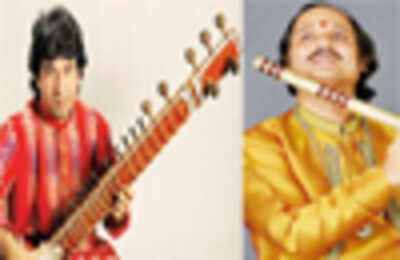
The term jugalbandi has been defined as co-ordinated music by a pair of performers and it can either be in vocals or in instrumentals. On December 4, Ronu Muzumdar will play a jugalbandi with sitarist Rafique Khan at an evening programme organised by Sangeet Bharati.
The flautist has played with musicians of the caliber of Shahid Pervez, Tarn Bhattacharya and Vishwamohan Bhatt.

Senior musicians like Ravi Shankar and Ali Akbar Khan or Vilayat Khan with Bismillah Khan combined forces to produce fantastic music. "Jugalbandis between musicians belonging to different systems was the in thing in the 1980s," says Ajoy Chakraboty, the Patiala gharana singer who has performed in duet with Dr M Balamurali Krishna. "Since there is an element of curiosity at work and also a sense of happening about the music being played or sung, jugalbandis are a hit with the audience," adds Ronu.
Sitar player Rafique Khan has performed with Ronu Majumdar in Banglore and Manglore. The 41-year-old musician, who shot into the limelight thanks to duets with his brother and sitar player Shafiq Khan, playes mostly solo concerts nowadays.
Khan has had the benefit of learning from a long line of skilled sitar players from his family. He has trained under his father Abdul Karim Khan, his two distinguished elder brothers Usman Khan and Bale Khan, and his uncle
Ghulam Dastgir Khan. Khan's style is an amalgam of gayaki and tantkari (stringed instrument music) and draws a lot from vocal music while playing.
He blends vocal music in his strokes, like' jhamjhama' in which a cluster of notes is produced in a swift manner. His 'gamak' (a technique in which a vibrating effect is achieved) patterns and his interaction with rhythm are the most impressive aspects of his playing.
"Most of the sitar players prefer to render their compositions set to the 16-beat teen taal," said Khan. "I make an attempt to deviate from this trend. I like to play slow-tempo gat compositions set to the seven-beat rupak taal or to the nine-beat matta taal. The audience needs and appreciates rhythmic variety.
Ronu Majumdar is a versatile musician and I enjoy playing in duet with him," says Rafique Khan. At his concert this fortnight, they will be accompanied on the tabla by Mukundraj Deo.
The evening programme will also feature Vinayak Torvi, the Banglore-based classical singer who is considered to be the heir to Bhimsen Joshi, the most celebrated vocalist of the last century. He hails from Dharwad in north Karnataka which is regarded as one of the most fertile regions for Hindustani music.
It has produced musicians of the stature of Mallikarjun Mansur, Gangubai Hangal, Basavraj Rajguru and Kumar Gandharva. Usually, celebrity performers hate spending time teaching but Bhimsen Joshi himself offered to teach Torvi. If not the war of instruments, the vocals will be a treat.
Follow us on Twitter for more stories
End of Article
FOLLOW US ON SOCIAL MEDIA









Photostories
entertainment videos
Featured In Movies

Popular Categories
Entertainment NewsBollywood NewsTollywood NewsKollywood NewsMollywood NewsMovie ReviewsLatest Hindi MoviesLatest Tamil MoviesMX PlayerParenting TipsHome RemediesWeight LossBeauty TipsParenting TipsHindi VideosHindi Video SongsBhojpuri Music VideosLatest Telugu MoviesBhojpuri Music VideoHindi TV News
Trending in Entertainment
Latest MoviesBollywood MoviesHollywood MoviesTamil Movies 2024Telugu Movies 2024Malayalam Movies 2024Kannada Movies 2024Marathi Movies 2024Bengali Movies 2024Top Rated Movies 2024Best Hindi MoviesBest English MoviesBest Telugu MoviesBest Tamil MoviesBest Malayalam MoviesBest Kannada MoviesBest Bengali MoviesUpcoming Hindi MoviesBest Movies Of All TimeBest Hindi Movies of All Time
Trending in Etimes
Horoscope TodayNumerology Predictions TodayAustria ElectionJoe BidenKamala HarrisPopulated Indian CitiesAlcohol Cancer RiskIsrael Beirut WarSunita WilliamsIsrael Hezbollah WarNepal FloodBarbra StreisandSnoring Prevention TipsDonald TrumpMagnesium DeficiencyRelationship TipsLake Michigan DiscoveryElon MuskEkadashi in October 2024
Trending in TV
Trending in Lifestyle
Trending in Regional
Movie Reviews
Binny And Family ReviewLove, Sitara ReviewWill & Harper ReviewWolfs ReviewYudhra ReviewJo Tera Hai Woh Mera Hai ReviewKahan Shuru Kahan Khatam ReviewHis Three Daughters ReviewNever Let Go ReviewDancing Village: The Curse Begins ReviewTransformers One ReviewFirst Love ReviewBerlin ReviewThe Buckingham Murders Review
Upcoming Hindi Movies
Upcoming Regional Movies
Latest News
Zodiac Signs as Romantic Movie CouplesJapanese artist’s tribute to Indian classical dance formAnanya Panday unveils her Amol Palekar-inspired look in quirky BTS PICS from 'CTRL’Sanjay Dutt celebrates 'Gandhigiri', shares a scene from 'Lage Raho Munna Bhai'Women's T20 World Cup 2024: Teams, format, venues, defending champions and more FAQs answeredGovinda's bullet injury: Mumbai police not convinced with actor's version but rule out foul playGovt proposes to bring motorcycles under ‘contract carriage’ by amending MV ActHaircuts and colours to try out this PujoTriptii Dimri denies skipping the Jaipur event after allegations of charging an appearance feeMaharashtra assembly polls: Deputy CM Ajit Pawar meets Union home minster Amit Shah amid Mahayuti tensions over NCP, seat-sharingWatch: Orry channels Aishwarya Rai in a hilarious tribute to Shah Rukh Khan and Amitabh Bachchan starrer 'Mohabbatein'NFL insider reveals Raiders’ asking price for star wide receiver Davante Adams amid trade speculationAnanya Panday on being called the upcoming Alia Bhatt: I can't touch what she has doneFormer WWE Champion Jeff Hardy talks about “addiction struggles”'Scam marathon' under JMM-Congress-RJD rule 'biggest obstacle' to Jharkhand's development: PM ModiWhy you must run in the morning on an empty stomachManipur CM Biren Sing bats for political talks to resolve crisis in stateWHO chief praises PM Modi on 10th anivarsary of Swachh Bharat mission
Other Group Sites -
ETimes is an Entertainment, TV & Lifestyle industrys promotional website and carries advertorials and native advertising.