- News
- entertainment
- events
- goa
- Revisiting childhood on Chikal Kalo
Trending
This story is from July 26, 2018
Revisiting childhood on Chikal Kalo
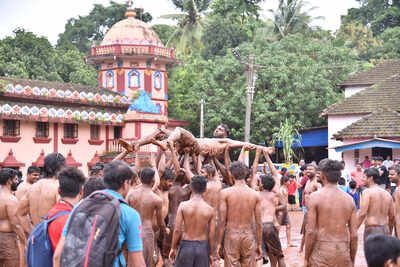

The ground opposite Devaki Krishna Temple becomes a playground for over 300 revellers on this day. Boys and men of all ages chant ‘Hari Vithal, Jai Vithal’. Bare-chested, and clad in only their shorts, they take part in several games. Meanwhile, young boys and girls form their own groups and play in the mud together. Women, however, do not take part in these games and only watch from the periphery of the ground.
“Gopal Kalo is celebrated twice every year – once during Ashadi Ekadashi and once during Karthik Ekadashi. However, since it only rains during Ashadi Ekadashi, which falls in the second or third week of July, we celebrate Chikal Kalo during this time. The festival derives its name from ‘chikal’ or wet mud. During Karthik Ekadashi, the games are played at a mandap,” says Premanand
Naik, a local.
Premanand has been taking part in the festival since the last 50 years. “I am told the festival dates back to 400 years. I’ve been taking part in it ever since I was a child. The festival celebrates the naughty nature of Bal Krishna, and everybody, regardless of age, becomes baby Lord Krishna for the day. We play games and pranks on each other. There are around ten traditional games that we play, which are believed to be the games Lord Krishna originally played with his friends,” he says.
The festival includes games like chakra (a group of boys holding hands and forming a wheel), a folk version of blind man’s buff, tug-o-war, a game where men form a tunnel and others run through it, and more.
Before the festival commences, oil is generously smeared all over the bodies of the participants. “Traditionally, shopkeepers from general stores poured oil on the revellers. We still do it to protect them from cold and infection,” says Premanand.
The festival also sees villagers distributing sweets and snacks to the revellers. “We distribute bols, which are made with grated coconut, besides fruits and snacks,” says Premanand.
“We light a candle in the temple on the day of Ekadashi. Exactly 24 hours later, the Chikal Kalo commences. Before the festival begins, devotees offer prayers and seek blessings,” says Manoj Shirodkar, a local.
The festival ends with the breaking of the dahi handi. “After that, four-five people take a bath in the nearby pond and go back to the temple to wind up the afternoon prayers. Food is then served to the revellers by the families from the village,” says Manoj.
Villagers, tourists and Goans from other places come to witness the festivities. “We let everybody take part. Earlier it was just the boys and men from the ward who were allowed, but now we even have friends from other places in Goa who come to celebrate this unique festival that doesn’t take place anywhere else in India,” says Girish Navelkar.
“Earlier, children used to play these games regularly. When we were younger, all of us would get together to play traditional games. However, nobody plays them now. So, this festival also helps retain such traditional games, that are passed on to our future generation,” Pramanand concludes.
End of Article
FOLLOW US ON SOCIAL MEDIA






Photostories
entertainment videos
Featured In Movies

Popular Categories
Entertainment NewsBollywood NewsTollywood NewsKollywood NewsMollywood NewsMovie ReviewsLatest Hindi MoviesLatest Tamil MoviesMX PlayerParenting TipsHome RemediesWeight LossBeauty TipsParenting TipsHindi VideosHindi Video SongsBhojpuri Music VideosLatest Telugu MoviesBhojpuri Music VideoHindi TV News
Trending in Entertainment
Latest MoviesBollywood MoviesHollywood MoviesTamil Movies 2024Telugu Movies 2024Malayalam Movies 2024Kannada Movies 2024Marathi Movies 2024Bengali Movies 2024Top Rated Movies 2024Best Hindi MoviesBest English MoviesBest Telugu MoviesBest Tamil MoviesBest Malayalam MoviesBest Kannada MoviesBest Bengali MoviesUpcoming Hindi MoviesBest Movies Of All TimeBest Hindi Movies of All Time
Trending in Etimes
Horoscope TodayNumerology Predictions TodayWalz Vs VanceJD VanceKamala HarrisPopulated Indian CitiesAlcohol Cancer RiskNational Boyfriend Day 2024Sunita WilliamsDepression RiskNepal FloodBarbra StreisandSnoring Prevention TipsDonald TrumpMagnesium DeficiencyRelationship TipsLake Michigan DiscoveryRelationship TipsEkadashi in October 2024
Trending in TV
Trending in Lifestyle
Trending in Regional
Movie Reviews
Binny And Family ReviewLove, Sitara ReviewWill & Harper ReviewWolfs ReviewYudhra ReviewJo Tera Hai Woh Mera Hai ReviewKahan Shuru Kahan Khatam ReviewHis Three Daughters ReviewNever Let Go ReviewDancing Village: The Curse Begins ReviewTransformers One ReviewFirst Love ReviewBerlin ReviewThe Buckingham Murders Review
Upcoming Hindi Movies
Upcoming Regional Movies
Latest News
ICC Women’s T20 World Cup ninth-edition: Will India capture their first title? Key players, schedule, and where to watchPower outages, water shortages emerge as Hurricane Helene smashes US' SoutheastEver wondered how business and corporate laws provide organisations with a competitive edge? Learn their nuances with IIM Calcutta5 must follow rules of Ayurveda to lose 5kg in 30 days'Was screaming, hitting him': 5-year-old Florida boy suffers cardiac arrest on Disney rollercoaster rideMicrosoft launches developer feedback program to address Xbox platform pain pointsKiara Advani shakes up the internet with her backless crochet and ruffle-dressTwo youths held captive in Manipur’s Kangpokpi released after week-long abductionNavarathri is all about inspiration and motivation: Shivani NarayananBank of America faces outage leading to zero balance glitches, hilarious memes flood social mediaWho is S Iswaran? Former Singapore minister of Indian origin sentenced to one year in prisonMahima Chaudhry reveals she begged Ajay Devgn and Prakash Jha to keep her near-fatal car accident secret: 'I feared industry boycott'There’s a huge angle of woman empowerment also in our story of Ram and Vaishnavi: Shiv SagarGlobal Chess League 2024: Indians in action, teams, format, scoring system, timeCan mosquitoes spread HIV? Here’s what you need to knowSomen Mishra sets record straight on Alia Bhatt and Vasan Bala 'Jigra' controversy: We were DYING to get Alia on boardVijay's 'GOAT' gets an OTT release; official date announced!This Is Why Tarot Cards Are Classified As Potential, Consciousness, Subconscious And Superconscious
Other Group Sites -
ETimes is an Entertainment, TV & Lifestyle industrys promotional website and carries advertorials and native advertising.