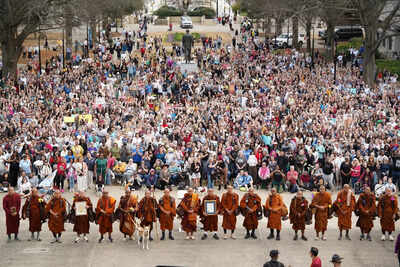
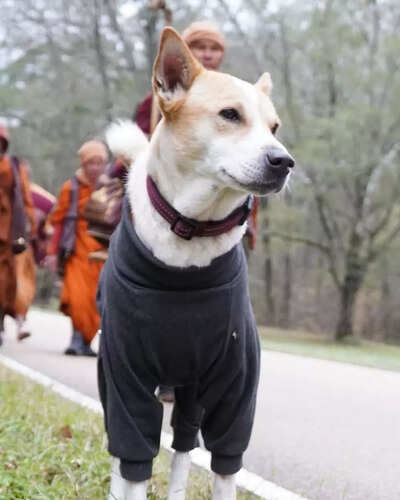
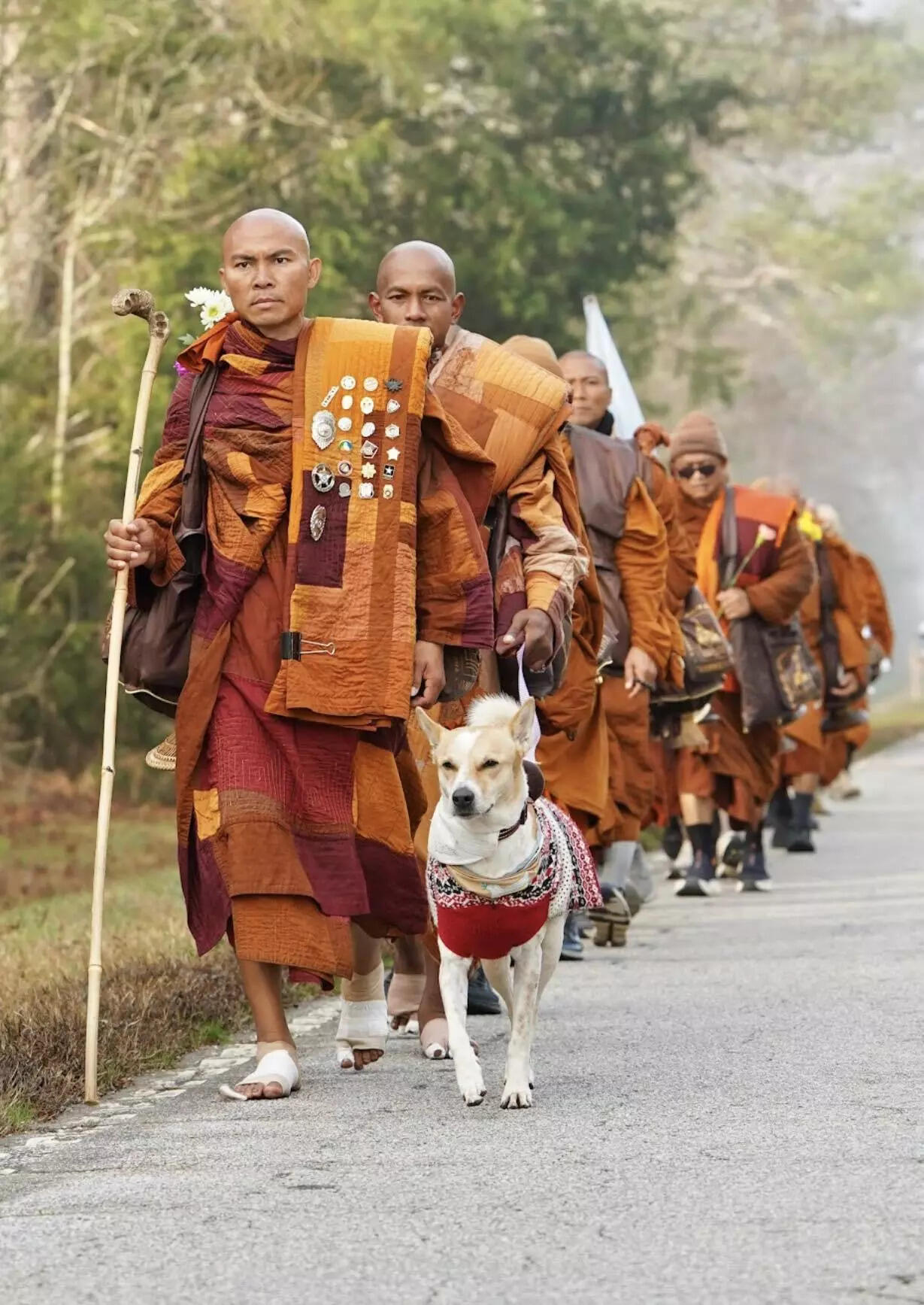
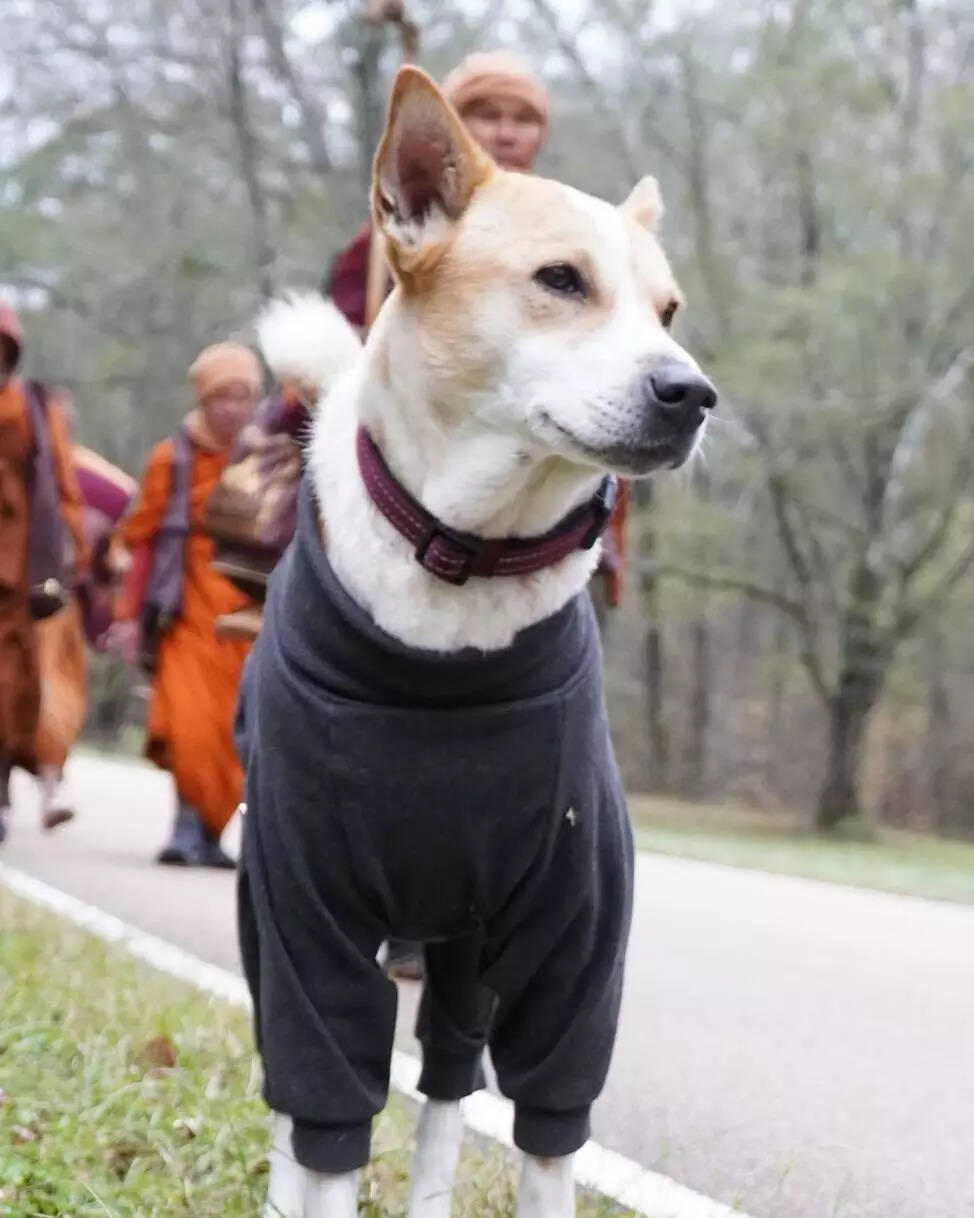
From afar, Aloka looks like a miracle on four legs, a Kolkata stray dog who attached himself to a group of Buddhist monks and ended up leading them across India and now the United States. But behind every serene photograph lies a full-scale human apparatus: paperwork teams, fundraisers, airport handlers, support vans, recovery schedules, and an army of volunteers who make it possible for him to simply walk at the front.
This is the part of the story that rarely shows up on Instagram, the machinery it takes to turn one pariah dog into a travelling symbol of peace.
The pariah who refused to stay behindAloka first appeared on the monks’ peace walk at Kolkata Airport. “Many dogs follow us when we walk, but they usually drop out… Only him, Aloka, kept coming back,” recalls Bhikkhu Pannakara, the monk who named him Aloka, meaning “light.”
He walked more than 3,000 km across India, across highways, rain-beaten roads and blistering heat. When an injury once forced monks to put him in a truck, he jumped off and returned to walking. That stubborn spirit turned into responsibility: if they were going to continue the walk abroad, the monks decided they couldn’t leave him behind in India.
That decision triggered the real marathon - the paperwork, the money, the logistics.
The India–U.S. move: A bureaucratic marathonBringing a former Kolkata street dog into the U.S. was as hard as walking 3,000 km across India. India is a high-risk rabies country, so Aloka needed the canine equivalent of a visa.
I called home to Fort Worth, Texas, to my members and said, ‘I want to bring Aloka home.’ They didn’t ask a single question. They just said, ‘Okay,’ and then they started cooking to raise funds. They raised $14,000 for Aloka. With that, I was able to do all the paperwork, vaccinations, and buy the airplane ticket for him to travel to JFK in New York for quarantine. He stayed there for 28 days. After those 28 days, my master, one of our members, and I flew to New York, rented a vehicle, and brought him back to Fort Worth.
Bhikkhu Pannakara
Monks spent months navigating paperwork, including:
- ISO microchip
- Updated rabies vaccination
- Rabies antibody titer test with strict waiting period
- Export health certificate
- DGFT & AQCS clearance
- CDC dog import form
- Pre-booked quarantine at JFK
- IATA-approved travel crate
- Cargo reservations on a flight from India
- Every step had strict timelines , missing one could collapse the entire plan.
Funds raised: ₹11.7 lakh (USD 14,000) entirely through community cooking at the Fort Worth temple. Volunteers chopped vegetables, cooked, and sold meals for weeks.
After flying to the U.S., Aloka spent 28 days in CDC quarantine at JFK, monitored alone while fees, vet reports, and paperwork were processed.
Only after quarantine did the monks fly to New York, rent a van, and bring him to Texas.
Bhikkhu Pannakara, “He deserved better. If he went back to Bodhgaya, he would become a stray dog again.” The paperwork, fundraising, and logistics behind this single dog’s move were the real marathon, far more complex than the thousands of kilometres he walked.
The operation that moves with him now Those calm videos of Aloka walking on open roads exist because a dozen people are running a moving backstage.
- A support van carrying water, food, medical kits, bedding and cold-weather jackets.
- Volunteers lifting him during rough stretches, monitoring hydration, and checking paws for injury.
- Route teams coordinating with police, city halls and highway departments.
- Content teams filming daily reels that keep millions engaged.
- Temple volunteers handling donations, equipment, signage and public interactions.
- A medical routine tracking inflammation, lameness, joint fatigue and temperature stress.
On January 12, 2026, Aloka underwent knee surgery at Charleston Veterinary Referral Center. The surgery , performed pro bono , brought together a specialist team including orthopedic surgeon Dr. Patricia Sura, cardiologist Dr. Sophy Jesty, anesthesiologist Dr. Emmett Swanton and veterinary nurse Tiffany, with coordination by Rhonda Holliman and support from Dr. Amy Wagner in South Carolina. Right after the operation, Dr. Jesty gave an update: “He already has his breathing tube out… as his followers know, he has had a chronic right hind limb lameness that worsened recently.” Dr. Sura added, “Aloka has a tear in his cranial cruciate ligament , one of the most common orthopedic injuries in dogs. Our goal is to get him back to the venerable monks as soon as possible. It’s not only his habitat; it’s his job.”
The surgery was free. But everything surrounding it - transport, medication schedules, rehabilitation walks, reduced-pace ceremonies , relies on the same people who have carried this journey since Day 1. Post-op instructions now require him to walk 10 minutes, six times a day. And once again, it is monks and volunteers who gently lift him, time his walks and adjust the entire 120-day march around one recovering dog.
Aloka has a tear in his cranial cruciate ligament, and that is one of the most common injuries we see in dogs. Our goals are to get him back with the venerable monks as soon as possible, because that’s very important - it’s not only his habitat, it’s his job, and he wants to keep walking. But while he’s with them, he’ll need to rest and follow some specific instructions in the coming days, just to be sure that his recovery is as smooth as possible.
Dr. Patricia Sura , Surgeon