- News
- entertainment
- bengali
- movies
- Manikda had a computer memory: Soumitra Chatterjee
Trending
This story is from June 27, 2017
Manikda had a computer memory: Soumitra Chatterjee
With so many common strands connecting Satyajit Ray and Soumitra Chatterjee, we invited the actor to the famous Bishop Lefroy Road residence for a very special chat with Sandip Ray in his father’s book-lined study. Excerpts:
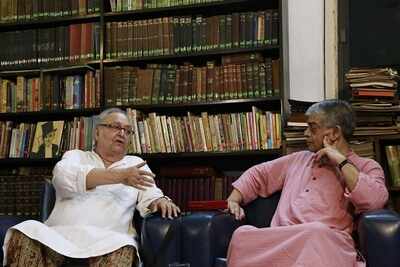

Soumitrada, every year, on Satyajit Ray’s birthday (May 2), you make it a point to visit his Bishop Lefroy Road residence. How old is the practice?
Sandip: We came to this house in 1970. It must be since then…
Soumitra: I used to visit Manikda’s old house before that. Ever since I grew close to the Ray family, I’ve met him on his birthday. There was a time when mashima (Suprabha Ray) would cook on his birthday.
Sandip: But more and more guests started pouring in with every passing year…
Soumitra: Yes, the crowd would take a toll on his health in the later years. So, he used to check into a hotel and spend his birthday there. He would often leave Kolkata to spend the day in another place. Only his family was aware and would be with him.
Sandip: It was like running for cover!
Thirty years back, Legion d’honneur, or Legion of Honour — the highest civilian French distinction — was bestowed on Satyajit Ray. Sandipda, do you remember the time?
Sandip: Back then, Baba was not keeping well. He informed the authorities about his health condition and requested them to have the award ceremony here. He also mentioned that he was deeply honoured. The French president, Francois Mitterrand, came down to Kolkata and the gala event was held at National Library.
What was it like for you, Soumitrada?
One day, I was going through my letters and found one from the French ambassador. Though I don’t remember the exact words, it said the Legion d’honneur will be given to me. He also congratulated me on the award and said the date of receiving it would be mutually decided.
Going back a little, Aparajito, the second film of The Apu Trilogy, received the Golden Lion at Venice Film Festival. It was before Soumitrada forayed into films with Apur Sansar. How were Ray’s films perceived by the Kolkata audience?
Soumitra: I want to make a point here — Satyajit Ray never said that he was going beyond the periphery of mainstream cinema. He only believed in one thing — films were either good or bad. To him, there were no categories like art films and commercial films. He said every film had to be “commercial”, or no one would be able to make a film. After Pather Panchali, he said that he had no intention of negating the box office. No filmmaker wants to have a private projection of his film within the four walls of his home. But he was certain that box office could be conquered by doing films he believed in. The biggest example of that was Pather Panchali.
Sandip: At the beginning, Pather Panchali didn’t do well. Later, it picked up. The pace at which it did was phenomenal.
So, the buzz was slow…
Sandip: After winning a few awards, there was a strong word-of-mouth publicity. Only a handful had seen the film in the beginning, but those who saw it, loved it. Then, there were some heart-warming reviews. Back then, reviews were taken seriously. That’s how Pather Panchali became a rage.
Soumitra: After that, when the film won an award at Cannes, Bengalis suddenly woke up to it. People came to the theatre in hordes. In case of Aparajito, there was a mixed response. It was definitely ahead of its times.
In this house, makeup tests would happen…
Sandip: Back then, there was no concept of a look test.
Soumitra: The name is new, but the concept is old. In Apur Sansar, Manikda asked me to grow my hair and said he would cut it accordingly. But I had a makeup test for many films. All outlines of the makeup were sketched by Manikda. He would then hand it over to the makeup man. Only during Sakha Proshakha, I had two makeup tests. A few of us had suggestions about what he had drawn initially; one among them was boudi (Bijoya Ray). She said it was becoming like Ghare Baire. So, Manikda started drawing again.
From costumes, look, makeup, light and ambience, Satyajit Ray had the final word on everything…
Sandip: In many cases, Baba would
cast an actor by simply talking to
him for a few minutes. Even you did not have a screen test for Apur Sansar (looks at Soumitrada)…
Soumitra: I had a screen test, but it happened much later — after I was selected. Later, I realised it was to make me more camera-friendly.
Sandip: When he would read out the script, half the job was done for the actors.
Soumitra: The idea was to understand the nuances of the script. For those he did not read out the full script, but just a scene, the actor knew what he was expected to do. During Apur Sansar, he rehearsed a scene where Apu was coming back after watching a play and talks about his ambition of writing an autobiography. For that scene, he first took us to the studio and rehearsed it. After that, we went to the location, used the railway trolley and did the rehearsal. Again before the shot, we had one or two rehearsals. He had to take a close-up of mine separately, as there was an issue with the railway trolley. So, we again went to Technicians’ Studio, where I was called alone. Despite the fact that there was no other actor, the light was recreated by Subrata Mitra and Manikda took a close-up of mine. It was a huge learning experience!
Sandipda, you had mentioned that he maintained a kheror khata (notebook), where he would write the original script. Later, the team would again come up with fresh handwrittren copies of the script. Were you too involved in the process?
Sandip: Later, I would use it. There was no concept of photocopies then. Once the script was written, he would hand out copies to the team.
Soumitra: That became a practice later. During Apur Sansar, I was the only
one to have got a copy of the script. He did it to prepare the debutant called Soumitra Chatterjee.
Sandip: Was the description in English?
Soumitra: The narrative used to be typed out in English, but the dialogues were in Bengali.
He was also against actors mugging up lines…
Soumitra: He believed in spontaneity and would ask the actors not to cram the lines. He was against a mechanical approach. I still remember what he told me first, ‘Besh koyekbar porbe kintu ekebare jhara mukhostho kore boshona’. He knew that would be a problem if he wanted to change the lines.
Sandipda says that you are the fastest learner he had ever seen…
Sandip: His memory is still phenomenal. He was also the fastest to finish
dubbing.
Soumitra: Utpalda (Dutt) was also brilliant.
Sandip: That’s okay, but I have seen you speak long lines at one go! I think during the shoot, you knew you would have to dub again.
Soumitra: Manikda also had a computer memory. He used to sit with a hanky covering his mouth. His assistants later devised a short-hand method to maintain notes that would help them give cues during dubbing. But when everything failed, the computer called Satyajit Ray, would be switched on. During dubbing, he would remember how an actor spoke six months back! No one had a memory like that.
Sandip: In Ghare Baire, Sandip’s character (Soumitra) had a long speech. I remember how smoothly the shoot went off. Even during dubbing, there were no issues. The perfection was eerie.
There must have been also those who were not fast learners. Did Satyajit Ray ever lose his cool?
Soumitra: I never saw him lose his cool with actors; he was like a tree nurturing them under his shadow. Everyone would feel important with him around and stayed away from discriminating. At times, he would say, ‘Soumitra ke ekta chair dao’. That gesture itself would make you feel special. I was amazed by the way he would deal with child actors. He never used to treat them as kids and never spoke to them in gibberish. The child actor was another person and they would strike up an organic friendship. I remember an incident from Sonar Kella. We had shoot at a railway station and were tired after a whole day’s work. It was winter and we were on a 40-mile drive back. I was in the back seat with others, while Manikda and Kushal (Chakraborty) were in front. Kushal was in that age where he had a question for every answer. He had questions like ‘tara neel keno’? When he asked me, I said, ‘I will tell you later’. That was to avoid him. But Manikda, who worked the hardest, tirelessly answered all his questions. He even explained why the stars appeared blue!
For Sonar Kella, the first of the Feluda series, Kushal and Santosh Dutta were finalised before you. Soumitrada, how did you come on board?
Sandip: He had initially wanted to cast someone new as Feluda. Ultimately, that didn’t happen. Soumitra kaku even asked, ‘Apni toh amake Felu nilen; eto colourful villain, dazzling baccha ar Jatayur first appearance royechhe, ami ekhane ki korbo?’ To this, Baba said, ‘Tumi ja korar koro. Kintu beshi kichhu korona. Dekhbe utre jabe’.
Soumitra: When Feluda started coming out starting with Badshahi Angti, like every other Bengali, I fell in love with him. We would sit and discuss the stories after they appeared in Sandesh. After a Pujabarshiki edition, I once said, ‘Manikda, I feel the illustrations look like you.’ He jokingly said, ‘But everyone has been telling me that I am inspired by you’. I believe the illustrations started resembling me much later. I feel Shanku and Felu are two faces of Satyajit Ray. Their eagerness to learn, bravado, mental makeup are all his. He had a familial commitment to write for children, so that kids learn and start questioning, but none of the stories had anything preachy about them.
Sandip: It’s a fact that there is a lot of Satyajit Ray in both the characters. Feluda stories are also travelogues and spoke about the places that Baba visited. He sent Felu to the places where he shot, visited, loved. But he sent Shanku to places he could not visit. So, Shanku was far more difficult. He would write to his friends asking them to send him information, road maps, picture postcards from different parts of the world.
Sandipda, any memories of the camaraderie between Satyajit Ray and Soumitra Chatterjee?
Sandip: In Apur Sansar, the shoot would be held in an elevated room in Tala. I was young and for me, the room was a major attraction. One day, I was gearing up to visit the sets, but Baba said, ‘Babu, you stay back. We are shooting an adult scene’. With Ashani Sanket, I started getting involved with his projects. I would take pictures of the shoot. Before shooting, I realised how Gangacharan had become Soumitra kaku’s favourite character. He had researched a lot and would keep notes. While the lights were being set, I would see from a distance that Soumitra kaku was
writing something. That’s an important document. Later, the excerpts were printed. But I think someone should come forward and publish the full document. I also remember the famous trolley chapter!
Soumitra: It was dusk and we needed to shoot with a huge trolley. The electricians were all busy, so I was moving the trolley. After two shots, he removed the cover from his head, saw me and said, ‘Goodness, it’s you!’ I am ever so grateful to him for letting me learn the technicalities of a shoot. About Khokon (Sandip Ray), from a young age, I have seen him draw and take pictures. He would stand next to his father at a time when his head didn’t even reach the camera. In Ashani Sanket, he not just assisted Manikda, but also cinematographer Soumendu Roy. The still photographer also peaked with his help.
So, was Satyajit Ray more of a friend or mentor?
Soumitra: He is a great friend. And also a great mentor. Beyond everything, he is my biggest inspiration. I don’t spend a day without thinking of him. But not in an emotional way. Life makes you go through many trials and tribulations. That’s when I think of Tagore, of Manikda and ask myself, ‘If they could, why can’t I?’ Also, I learnt to do many things at the same time from them.
Last but not the least, do awards make a difference?
Soumitra: Most don’t, as they have lost their credibility. Particularly, the National Film Awards. When I was young, I used to think: ‘This time, won’t they give me the award?’ I’ve crossed that age. But this award from France has made me happy on many levels. France can be called the cultural capital of the world. Also, it’s a government award and after whom am I getting it? Satyajit Ray! He made me what I am. So, I am happy. At the same time, I think if I could connect with him somehow, I would have told him, ‘Manikda, kichhu mone korben na eta amake diyechhe (laughs)’.

About the Author
Zinia SenEnd of Article
FOLLOW US ON SOCIAL MEDIA
Visual Stories









Photostories
entertainment videos
Featured In Movies
Popular Categories
Entertainment NewsBollywood NewsTollywood NewsKollywood NewsMollywood NewsMovie ReviewsLatest Hindi MoviesLatest Tamil MoviesMX PlayerParenting TipsHome RemediesWeight LossBeauty TipsParenting TipsHindi VideosHindi Video SongsBhojpuri Music VideosLatest Telugu MoviesBhojpuri Music VideoHindi TV News
Trending in Entertainment
Latest MoviesBollywood MoviesHollywood MoviesTamil Movies 2024Telugu Movies 2024Malayalam Movies 2024Kannada Movies 2024Marathi Movies 2024Bengali Movies 2024Top Rated Movies 2024Best Hindi MoviesBest English MoviesBest Telugu MoviesBest Tamil MoviesBest Malayalam MoviesBest Kannada MoviesBest Bengali MoviesUpcoming Hindi MoviesBest Movies Of All TimeBest Hindi Movies of All Time
Trending in Etimes
Horoscope TodayNumerology Predictions TodayMoon DengHelicopter Crash NewsKamala HarrisJimmy KimmelBelly FatSean Diddy CombsSunita WilliamsDepression RiskBelly Fat LossMexican Mayor MurderToxic FriendshipDonald TrumpElon MuskOzempic SubstituteLake Michigan DiscoveryWeight Loss WalkCovid XEC Variant Symptoms
Trending in TV
Trending in Lifestyle
Trending in Regional
Movie Reviews
Binny And Family ReviewLove, Sitara ReviewWill & Harper ReviewWolfs ReviewYudhra ReviewJo Tera Hai Woh Mera Hai ReviewKahan Shuru Kahan Khatam ReviewHis Three Daughters ReviewNever Let Go ReviewDancing Village: The Curse Begins ReviewTransformers One ReviewFirst Love ReviewBerlin ReviewThe Buckingham Murders Review
Upcoming Hindi Movies
Upcoming Regional Movies
Latest News
Ambala Cantt Assembly Election Result 2024: BJP's big gun Anil Vij defeats Chitra Sarwara by over 7000 votesUniversity of East Anglia Introduces £4,000 Scholarship for Indian Students: Explore Courses, Eligibility, and BenefitsTodd Phillips explains SHOCKING CLIMAX of 'Joker: Folie à Deux', reveals Arthur Fleck acceptance of his true identityThe Power of Navratri: Honoring Goddess Durga and Manifesting Desires3 reasons why Jimmy Uso can betray Roman Reigns and join forces with Solo SikoaThis is the stock trading app linked to Rs 500 crore investment fraud; YouTubers Elvish Yadav, Bharti Singh among 5 summonedMonetary policy committee meet: RBI moving closer to rate cutIndian branded pharma sector to see a decline in growth: Report2024 Haryana assembly election result: 5 reasons why BJP's victory is significantKathua (SC) Assembly Election Result 2024: BJP's Dr Bharat Bhushan wins by 12,177 votesHappy Durga Puja 2024: Best Messages, Quotes, Wishes, and Images to Share on Durga PujaTaylor Swift surpasses Rihanna in Music Rich list: A look at her impressive net worthAlexander Zverev scrapes through, set to face David Goffin at Shanghai Masters pre-quartersRoh Yoon Seo shines as a supportive sister in 'Hear Me: Our Summer'Best TVs Of 2024 In India: Top Picks For Every BudgetSuhana Khan pens a fun caption directed to Shah Rukh Khan and Karan Johar along with picture of ‘birthday girl’ Gauri KhanKarcher launches autonomous cleaning devices, robotic vacuum cleaners; aims to expand India operationsHaryana Election Results: Why Jalebi is trending and its association with Rahul Gandhi
Other Group Sites -
ETimes is an Entertainment, TV & Lifestyle industrys promotional website and carries advertorials and native advertising.