
- News
- Elections News
- Transgender community wants its votes to count
This story is from April 15, 2019
Transgender community wants its votes to count

Picture used for representational purpose only
“We have no special legislation to look into our requirements — be it in education, employment or even domestic matters. The government should launch schemes to ensure that the members of our community are not forced to beg or perform at weddings to earn a living,” said Kale, who is originally from Pune.
“The government should consider giving jobs to members of the transgender community based on their education levels,” concurred 30-year-old Payal Khalade, a transgender from Pune.
This demand for a right to earn a dignified living resonates the most with the younger members of the community — and the fight for employment opportunities has been an uphill task.
“If young members of the community try to get a job, they are ridiculed. This pushes them back to dancing at weddings or birthdays,” Ashok Suryavanshi, the founder-president of Maitri, a community-based organization in Kolhapur, told TOI.
“The government must ensure that transgenders get proper education and job security — so that they can aspire for a promising future,” he said.
“In fact, we have included around five transgender board members in our team,” he added.
A transgender member working with Maitri said the stigma too must be erased. “We are a marginalized group and more efforts must be made for our betterment,” the member said.
Ballot for change
The election process can become the most powerful way of effecting change. But traditionally, voting among the transgender community members has had a poor record for various reasons.
“Transgender individuals don’t come out in large numbers to vote because they are not aware. There is very little help that reaches them,” Khalade explained.
Suryavanshi pointed out that transgenders do not have access to basic facilities and face rejection from society. A lot of them, therefore, do not take part in the election process. He said around 80 transgenders were given voting cards in Kolhapur; however, many of them did not want to vote during the last Lok Sabha elections.
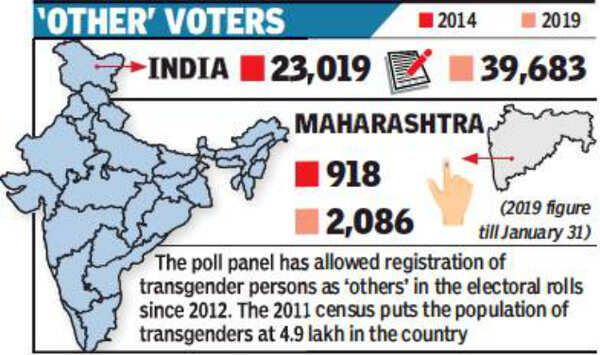
Maharashtra had a little more than 2,000 transgenders as registered voters till January 31, 2019. This is more than double the number of registered transgender voters in the 2014 elections. In 2012, there were none. As per the data for the 2019 election, the Kolhapur constituency has around 74 transgender voters in the electoral roll. Experts, however, believe the number should be around 2,000 in Kolhapur alone.
In Nashik, most members of the transgender community were issued voter ID cards during the last election. However, during the 2017 Nashik Municipal Corporation polls, when some of them tried looking for their names in the voters’ list, they were not successful.
Santosh Kshatriya, a counsellor at the Manmilan Bahuuddeshiya Sanstha in Nashik, who works with the MSM (men who have sex with men) and transgender communities, added transgenders also face problems if they shift locations.
But most agree that if the system has to change, then the society and the mindset need to change. “In Marathi, it is called ‘mataparivartan’. Members of the community must come out to vote,” said Chandani Gore, another transgender from Pune.
EC finds an icon
The Election Commission (EC) is making efforts to bring about change. It has appointed transgender activist Gauri Sawant as one of the state’s 12 ‘Election Icons’ for the 2019 Lok Sabha polls.
Sawant too has a Pune connect. Born Ganesh Sawant, Gauri was raised in a conservative family here in the city. Years of struggle later, she founded an NGO and adopted a girl in 2001. After her appointment as an icon, Gauri told TOI that she would reach out to the community and explain why it is important to vote and that many countries still do not give them the right to do so.
End of Article
FOLLOW US ON SOCIAL MEDIA

Hot Picks
TOP TRENDING
Popular Categories
Hot on the Web
Top Trends
IND vs BAN Live ScoreUGC NET Result 2024Rohit SharmaKamindu MendisDU ElectionIsrael StrikesMichael VaughanHigh Paying Freelance JobsElon Musk Dating MeloniUS FDAKerala Lottery ResultsShaheen AfridiTamil Nadu NEET UG CounsellingWho is Dominik Mysterios WifeChina SubmarineIsrael Hezbollah WarLive Cricket Score
Trending Topics
Devara CollectionNavya Naveli NandaPawan KalyanJungle SafariStree 2 OTT ReleaseRose GardenDevara CollectionOTT Release MovieMasala OmeletteEmergencyDevaraTaaza Khabar 2 Twitter ReviewDevara Movie ReviewHealthy RaitasSwatantrya Veer SavarkarColdplay India tour 2025Smartphone DealsApple Macbook Air M1Amazon SaleWordle Answer
Living and entertainment
Latest News
Vineeth Radhakrishnan calls Tovino Thomas a ‘phenomenal performer’ after watching 'ARM'Celebrating the legacy of Maggie Smith: Professor McGonagall's iconic moments in 'Harry Potter'Once in a blue moon: Delhiites breathe easy, AQI drops to 80Kamala Harris pledges to revive bipartisan border security bill blocked by TrumpCease-work at Sagore Dutta Hospital in Kolkata after 'assault' on junior doctorsThe Blaze Star is about to explode: All the details on how to watch it and where to lookTop Tory leadership contender pledges ban on UK visas to Indians if India does not accept returnsHoroscope Today, September 28, 2024: Read your today's astrological predictionsTapSwap Daily Codes for September 28, 2024: Earn coins and cryptocurrency by completing tasksWrestling Veteran Supports Rikishi's Take on Jacob Fatu's Backstage Meeting with Triple HMinimum wages for unorganised sector to rise as variable DA upPremium Soundbars with Dolby Audio: Top Picks OnlineHC ticks off Punjab for not releasing Ayushman funds to private hospitalsMicrosoft CEO Satya Nadella says, for me a true leader is who …Policybazaar eyes new model for mediclaimsBLACKPINK's Jennie drops exciting solo comeback teaser with puzzle images; Fans speculate October release dateVirgo, Daily Horoscope Today, September 28, 2024: Career advancements and new opportunities are likelyCyclists from Poland, Kenya to take part in second Race Across India from October 10
Copyright © 2024 Bennett, Coleman & Co. Ltd. All rights reserved. For reprint rights: Times Syndication Service