
- News
- Elections News
- Low-income colonies saw high turnout
This story is from April 25, 2017
Low-income colonies saw high turnout
Though the capital registered a record turnout in the municipal elections with 53.53% of voting, data for the 270 municipal wards show that the poll percentage was relatively lower in the upscale and middle-class wards than outer Delhi, slums and unauthorised colonies.
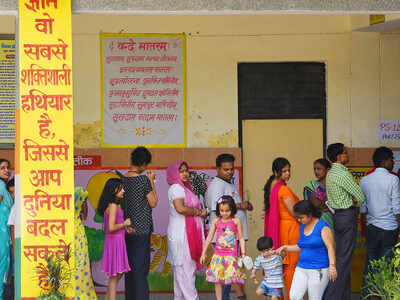
People queuing up to cast their votes.
The 104 wards in south and north corporations recorded a total of 51.5% and 54.1% of voting respectively, while the east civic body witnessed the highest turnout — 56.05%. Voting figures released by the state election commission show that affluent localities like Greater Kailash, Vasant Kunj, Preet Vihar, Patparganj, Kalkaji and Chittaranjan Park — where RWAs are quite active — were lagging behind when compared to the residents in their neighbouring slums.
Areas which recorded 60% and above polling either fall in outer Delhi or belong to unauthorised colonies and slum clusters. The voter turnout in majority of the wards with upscale colonies remained below 50%. For instance, the Greater Kailash ward recorded only 42.4% of voting while the Bhati ward, which comprises slum and rural areas, recorded 65% of polling. Dwarka A, which is a model ward and a home to upper middle-class population, recorded only 40.8% of polling. The turnout in other urban wards like RK Puram, Lajpat Nagar, Hauz Khas, Safdarjung Enclave, Munirka, Malviya Nagar and Defence Colony was below 50%. Vasant Vihar and Vasant Kunj had 46.7% and 45.2% of voting respectively.
Similarly, in old Delhi, which has densely populated wards like Chandni Chowk, witnessed 49.71% turnout but wards like Bakhtawarpur in north Delhi recorded the highest with 68.78% voting. In 2012, Bakhtawarpur had the highest share of voter turnout—68%. Affluent areas like Civil Lines and Rajinder Nagar witnessed 49.7% and 48.61% turnout respectively.
In the east, Sundar Nagri recorded the highest polling — 63.92%. Eight wards recorded more than 60% of voting and all of them have a large number of unauthorised colonies and slum clusters. Areas like Mayur Vihar, Patparganj and Preet Vihar just crossed the 50% mark. Shakurpur was the only ward to have a turnout below 50%.
Election officials claim that weather too had role in the low turnout in some areas. But many people from urban localities didn’t cast votes at all. RWAs claim that they urged people in their area to cast their vote. Kapil Kakkar, RWA president of Jangpura Extension, said that a circular was sent out in this connection.
“We requested people to opt for NOTA if they were dissatisfied with any party. It is important to give a message to the political parties for not taking voters seriously,” Kakkar said. Ashutosh Dixit, founder of United Residents’ Joint Action (URJA), claimed that posters were circulated on social media platform to the residents and they were urged to cast their votes.
End of Article
FOLLOW US ON SOCIAL MEDIA
Photostories

Hot Picks
TOP TRENDING
Popular Categories
Hot on the Web
Top Trends
Trending Topics
Karwa Chauth Moonrise TimingDhanteras 2024Fake PaneerKarwa Chauth WishesKarwa Chauth Mehendi DesignVicky Vidya Ka Woh Wala Video CollectionKarwa Chauth 2024Salim KhanAvinash MishraBigg Boss 18Kaun Banega Crorepati 16Kiccha Sudeep's Mother Death NewsVettaiyan CollectionBougainvillea Movie CollectionJuhi ChawlaLiam PayneTop Load Washing MachinesBest Premium LaptopsIntel LayoffsWordle Answer
Living and entertainment
Latest News
Diljit Dosanjh becomes 1st Indian artiste to feature on Billboard CanadaDenzel Washington reveals details about his character in "Gladiator II"; says, ‘I hadn’t done that before’Is Kanu Behl's film Despatch, starring Manoj Bajpayee, based on slain journalist J Dey's life?Top 5 Government/Defence schools in Delhi/NCR to consider for quality educationHandling 750 flights daily, Bengaluru's KIA airport celebrates air traffic controllers' critical roleBest Glass Top 3 Burner Gas Stove: Top Recommendations for Gourmet Home CookingKatrina Kaif flaunts mangalsutra during Karwa Chauth celebration with Vicky Kaushal and family'Will not let boat sink, but ... ': RJD hints at going solo in Jharkhand polls'Congressman by birth': Ex Hrayana minister Ajay Yadav makes another U-turn, returns to Congress in two daysRohini blast: Material used in blast outside Delhi school resembles crude bomb, says forensic lab sourcesWhen Janhvi Kapoor recalled about the ‘hectic itineraries’ made by her dad that gave her mother late Sridevi ‘anxiety’Delhi girl survives wrist cut but lover, overcome by sight of blood, diesTamil Nadu governor R N Ravi faces the music after omisson of ‘dravida’ from Tamil anthemLiam Payne passes away: Woman tweets that the singer ' jumped off his balcony'Google Pixel 9 Pro Fold review: Your refined AI foldable smartphoneED wraps up two-day raid at MUDA's head office, seizes key documents for investigationNewlywed Arti Singh Prepares for her first Karwa Chauth with hubby Deepak; shares a glimpse with fansHyperX Cloud Mini gaming headset quick review: Go for the comfort
Copyright © 2024 Bennett, Coleman & Co. Ltd. All rights reserved. For reprint rights: Times Syndication Service