
- News
- Water crisis turns key election concern
This story is from March 25, 2016
Water crisis turns key election concern
With election enthusiasm rising to fever pitch, the drinking water crisis in the state has turned into a key poll issue.
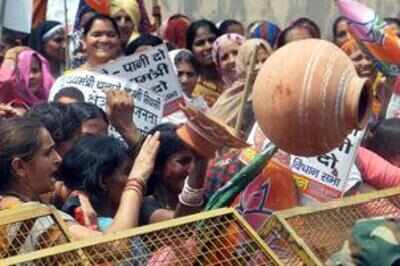
BJP activists carry earthen pots as they shout anti-Delhi Cong govt slogans during a protest in front of the Secretariat in New Delhi.
Guwahati: With election enthusiasm rising to fever pitch, the drinking water crisis in the state has turned into a key poll issue.
According to the 2011 census, only 55% households have a source of drinking water on the premises, 27% households have a source of drinking water nearby and 19% have a source of drinking water away from the premises.
The Census 2011 defines 'within the premises' as the area of the household and 'near the premises' as within 100 m of the household in urban areas and 500 m in rural areas.
"What's the point of living in the city if we don't get access to safe drinking water? For close to three years, there has been no supply of water and we have had to rely on hand pumps," said Arati Das, a resident of AT Road, one of the worst-hit areas in the city.
"Most people in our area suffer from stomach ailments. Political parties should take note of this. There's no point in making promises if they are not fulfilled," said Eshani Das, a school student. Most victims of water-borne diseases are schoolchildren.
Though the current government began implementing national flagship programmes on drinking water through the public health engineering department, challenges in effective use and maintenance of existing infrastructure persist. According to the 2013-14 Rapid Survey on Children (RSOC) in Assam, the percentage of households with access to any improved source of drinking water here was 87.2% as compared to 91% nationally. The 2011 census pegs the percentage share of households having improved source of drinking water facility at 68.6%. Dima Hasao district fares the worst with only 19.0% households having improved source of drinking water.
Though the state government began implementing national flagship programmes on drinking water through the PHE department, challenges in effective use and maintenance of existing infrastructure persist
According to the 2013-14 Rapid Survey on Children (RSOC) in Assam, the percentage of households with access to any improved source of drinking water here was 87.2% as compared to 91% nationally
According to the 2011 census, only 55% households have a source of drinking water on the premises, 27% households have a source of drinking water nearby and 19% have a source of drinking water away from the premises.
The Census 2011 defines 'within the premises' as the area of the household and 'near the premises' as within 100 m of the household in urban areas and 500 m in rural areas.
'Away' is defined as beyond 100 m of the household in urban areas and beyond 500 m in rural areas.
"What's the point of living in the city if we don't get access to safe drinking water? For close to three years, there has been no supply of water and we have had to rely on hand pumps," said Arati Das, a resident of AT Road, one of the worst-hit areas in the city.
"I am a school teacher and I urge political parties to ensure that the issue of drinking water is addressed. Water-borne diseases are common where I live," said Aparna Bhattacharjya, a schoolteacher of Nagaon Bengali High School.
"Most people in our area suffer from stomach ailments. Political parties should take note of this. There's no point in making promises if they are not fulfilled," said Eshani Das, a school student. Most victims of water-borne diseases are schoolchildren.
Though the current government began implementing national flagship programmes on drinking water through the public health engineering department, challenges in effective use and maintenance of existing infrastructure persist. According to the 2013-14 Rapid Survey on Children (RSOC) in Assam, the percentage of households with access to any improved source of drinking water here was 87.2% as compared to 91% nationally. The 2011 census pegs the percentage share of households having improved source of drinking water facility at 68.6%. Dima Hasao district fares the worst with only 19.0% households having improved source of drinking water.
Though the state government began implementing national flagship programmes on drinking water through the PHE department, challenges in effective use and maintenance of existing infrastructure persist
According to the 2013-14 Rapid Survey on Children (RSOC) in Assam, the percentage of households with access to any improved source of drinking water here was 87.2% as compared to 91% nationally
End of Article
FOLLOW US ON SOCIAL MEDIA
Hot Picks
TOP TRENDING
Trending Stories
In Section
Entire Website
- Arvind Kejriwal Resignation News Live Updates: 'I don't have lust for power' Arvind Kejriwal to resign from the post of Delhi CM in two days
- Arvind Kejriwal Resign Live Updates: 'I don't have lust for power' Arvind Kejriwal to resign from the post of Delhi CM in two days
- Famous NFL Superstars Who Are Friends Of Taylor Swift
- GK for Students: Why is International Day Of Democracy celebrated on September 15?
- Kolkata rape-murder case: Ex-principal Sandip Ghosh, policeman arrested for destruction of evidence
- Bengaluru woman sparks controversy with comments about Swiggy delivery executive, internet reacts
- 'Nafrat ki dukaan pe ...': PM Modi attacks Congress over 'brutality' in US
- Top 10 sports stars turned power couples: From Agassi-Graf to Conner-Comaneci
- Hamster Kombat Daily Cipher Codes and Combo Cards for September 15, 2024: Unlock up to 1 million coins
- Neeraj Chopra finishes second, misses out on title by 0.01 meters at Brussels Diamond League Final
- 'Don't have lust for power': Kejriwal to resign from Delhi CM post in two days
- Hindus should only engage with Hindus in property deals: BJP MLA Nitesh Rane
- Will Germany’s suspension of Schengen entry end the Europe dream?
- It took 'Didi', not CM Mamata to get junior doctors to Kalighat
- 'Its just hot water': Tea for Rs 340 at airport shocks Chidambaram, travelers
- Woman visits Delhi's Vasant Kunj flat for job ‘interview’, gets raped
- She called 9/11 an ‘inside job’. Why is she part of Trump campaign?
- Melinda Gates reveals the 'best part' of not working with ex-husband Bill Gates
- What had happened when Bangladesh last toured India for a Test series
- UPI transaction limit to change from Sept 16! Check new limits

Popular Categories
Hot on the Web
Top Trends
Trending Topics
World Largest HorseEID WishesOnam WishesPriyanka Chopra TattooKottukkaali OTT ReleaseEngineers Day WishesGoat CollectionHair LossSudha MurtyMalayalam ProducersIndia's Best Dancer 4Simi GarewalDilli BabuIndian National ParksLaung BenefitsVikas SethiApple iPhone 16Donald TrumpAadhar Card UpdateWordle Answer
Living and entertainment
Latest News
PM Modi's Sunday roadshow in Jamshedpur cancelled due to heavy rainHow to identify a real friendTCS teams up with Tata Electronics for ‘made-in-India’ chips4 types of tea to improve gut health and ease digestive issuesKashmir will soon get a government, but those blinkers are going to stayWeekly Career Horoscope, September 15 to September 21, 2024: Read your weekly astrological work predictions for all zodiac signs'Hindi must be made acceptable, not imposed'Zodiac Signs That Crave a Luxurious LifestyleMegha Akash marries Saai Vishnu, celebrities and fans extend their wishesRajkummar Rao hails Kareena Kapoor Khan's The Buckingham Murders as a 'gripping thriller'Coin Master free spins and coins for 15 September, 2024: Earn 7 million coins using today’s linksOnam 2024: Pearle Maaney, Sajan Surya, Malayalam TV celebs send warm wishesISL: Odisha's home run broken as Chennaiyin script 3-2 comeback win in season opener at KalingaMassachusetts state police recruit dies during boxing training exerciseDeepika Padukone gets discharged from the hospital, twins with Ranveer Singh in white as they bring home their newborn baby girl37 year old beats fatty liver condition with unbelievable weight lossWhat You’re Always Doing, According to Your Zodiac SignCouncillor's bro, 4 others held for hurling stones at Vande Bharat
Copyright © 2024 Bennett, Coleman & Co. Ltd. All rights reserved. For reprint rights: Times Syndication Service