
- News
- Leading the charge of the Right brigade...in Assam
This story is from May 20, 2016
Leading the charge of the Right brigade...in Assam
The name of Sarbananda Sonowal, BJP's CM candidate for the Assam assembly election, lends itself well to catchy slogans.
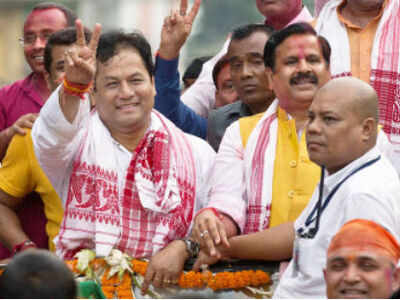
The name of Sarbananda Sonowal, BJP's CM candidate for the Assam assembly election, lends itself well to catchy slogans. Thus it was that the 'Achhe Din' of the 2014 Lok Sabha election gave way to 'Sabka Anand...Sarbanand' as BJP led a highly charged campaign in the northeastern state.
Backing the 53-year-old tribal CM candidate is PM Narendra Modi who called him the 'heera' (diamond) of the Union ministry and the biggest challenger to octogenarian Tarun Gogoi.
The youngest of four brothers, Sonowal is known to be a loner. He does not have too many friends and is a bachelor. Many complain that he dumps his friends the moment they disagree with him; others say this stems from his hatred of controversies.
Currently minister of state for sports and youth welfare, Sonowal has been a keen cricketer and footballer since his school days in Dibrugarh. He was the gymnasium secretary at his college, Kanhoi College in Dibrugarh. He holds a bachelor's degree in criminal justice from Dibrugarh University and a degree in law from Gauhati University.
Fifteen years after that historic day, Sonowal finds himself at the threshold of creating history again as he leads BJP in what may turn out to be the first saffron government in Assam. Not just BJP, Sonowal also has the difficult task of leading allies who are powerful in their own right. It is a measure of his quick journey from regionalism to nationalism that he led his former mentor in All Assam Students' Union (Aasu), Prafulla Kumar Mahanta, in an electoral alliance in the state.
A former Aasu president, Sonowal is only the second student leader-turned-politician to take a shot at winning the highest elected post in Assam after Mahanta himself. In 1985, Mahanta and his Aasu colleagues caught the world's attention by walking straight from varsity campuses to the corridors of power in Dispur.
Since his Aasu days, Sonowal has tasted power both as an MLA and an MP. Known to be a devout man, godmen and superstitious beliefs occupy pride of place in Sonowal's home and career. His houses in Dibrugarh and New Delhi are filled with feng-shui objects and he wears a gemstone on every finger of his hands. His colleagues say Sonowal never misses a chance to visit a temple. His religiosity was evident after the assembly polls, too. While other political leaders went on vacations, Sonowal went temple hopping.
A sharp dresser, the BJP leader even allows the stars to dictate his sartorial choices. Guided by the planets, he wears different coloured shirts on different days but sticks to black trousers and well-polished black shoes; this perhaps in tribute to a style introduced by him and Aasu general secretary Samujjal Bhattacharya during their student union days from 1992 to 1999.
Not just shirts, critics accuse Sonowal of changing parties and constituencies just as often. He made his political debut in 2001 when he joined AGP and went on to become an MLA from Moran constituency in Dibrugarh district. Three years later, he shifted to the Dibrugarh Lok Sabha constituency and became an MP by defeating Congress stalwart Paban Sing Ghatowar. He then walked out of AGP in 2011 to join BJP. In the 2014 LS polls, Sonowal chose to contest from Lakhimpur, which he won by defeating Ranee Narah of Congress. This time, he contested from river island Majuli and earned the sobriquet 'migratory bird' from Gogoi.
In spite of having represented many constituencies, a striking feature of his political career has been the fact that Sonowal has consistently failed to leave his mark on any of them. With the exception of the scrapping of the IM(DT) Act, Sonowal has nothing significant to show on his CV for all these years of being a public representative.
This might change with his election as CM, or so hope the residents of Majuli. Once Asia's biggest river island, Majuli, which is shrinking due to cyclic erosion by the Brahmaputra, has two dreams - to see Sonowal as CM and to travel down the Centre's promised bridge connecting it with the mainland.
Backing the 53-year-old tribal CM candidate is PM Narendra Modi who called him the 'heera' (diamond) of the Union ministry and the biggest challenger to octogenarian Tarun Gogoi.
In BJP's strategy of pitting 'tarun' (youth) against Tarun, Sonowal was tasked with leading the charge of the Right brigade.
The youngest of four brothers, Sonowal is known to be a loner. He does not have too many friends and is a bachelor. Many complain that he dumps his friends the moment they disagree with him; others say this stems from his hatred of controversies.
Currently minister of state for sports and youth welfare, Sonowal has been a keen cricketer and footballer since his school days in Dibrugarh. He was the gymnasium secretary at his college, Kanhoi College in Dibrugarh. He holds a bachelor's degree in criminal justice from Dibrugarh University and a degree in law from Gauhati University.
No stranger to adulation, Sonowal was thrust into limelight in 2005, when he won a long legal battle in the Supreme Court. He was instrumental in the scrapping of the controversial Illegal Migrants (Determination by Tribunal) Act, 1983, after it was proved that the legislature was protecting illegal migrants from Bangladesh. Sonowal returned to a hero's welcome in Guwahati as people lined up along the road from the airport to the city to shower him with flower petals. In a spontaneous show of emotion, Sonowal was given the title of jatiya nayak (national hero). Since then, there has been no looking back for him.
Fifteen years after that historic day, Sonowal finds himself at the threshold of creating history again as he leads BJP in what may turn out to be the first saffron government in Assam. Not just BJP, Sonowal also has the difficult task of leading allies who are powerful in their own right. It is a measure of his quick journey from regionalism to nationalism that he led his former mentor in All Assam Students' Union (Aasu), Prafulla Kumar Mahanta, in an electoral alliance in the state.
A former Aasu president, Sonowal is only the second student leader-turned-politician to take a shot at winning the highest elected post in Assam after Mahanta himself. In 1985, Mahanta and his Aasu colleagues caught the world's attention by walking straight from varsity campuses to the corridors of power in Dispur.
Since his Aasu days, Sonowal has tasted power both as an MLA and an MP. Known to be a devout man, godmen and superstitious beliefs occupy pride of place in Sonowal's home and career. His houses in Dibrugarh and New Delhi are filled with feng-shui objects and he wears a gemstone on every finger of his hands. His colleagues say Sonowal never misses a chance to visit a temple. His religiosity was evident after the assembly polls, too. While other political leaders went on vacations, Sonowal went temple hopping.
A sharp dresser, the BJP leader even allows the stars to dictate his sartorial choices. Guided by the planets, he wears different coloured shirts on different days but sticks to black trousers and well-polished black shoes; this perhaps in tribute to a style introduced by him and Aasu general secretary Samujjal Bhattacharya during their student union days from 1992 to 1999.
Not just shirts, critics accuse Sonowal of changing parties and constituencies just as often. He made his political debut in 2001 when he joined AGP and went on to become an MLA from Moran constituency in Dibrugarh district. Three years later, he shifted to the Dibrugarh Lok Sabha constituency and became an MP by defeating Congress stalwart Paban Sing Ghatowar. He then walked out of AGP in 2011 to join BJP. In the 2014 LS polls, Sonowal chose to contest from Lakhimpur, which he won by defeating Ranee Narah of Congress. This time, he contested from river island Majuli and earned the sobriquet 'migratory bird' from Gogoi.
In spite of having represented many constituencies, a striking feature of his political career has been the fact that Sonowal has consistently failed to leave his mark on any of them. With the exception of the scrapping of the IM(DT) Act, Sonowal has nothing significant to show on his CV for all these years of being a public representative.
This might change with his election as CM, or so hope the residents of Majuli. Once Asia's biggest river island, Majuli, which is shrinking due to cyclic erosion by the Brahmaputra, has two dreams - to see Sonowal as CM and to travel down the Centre's promised bridge connecting it with the mainland.

About the Author
Prabin KalitaEnd of Article
FOLLOW US ON SOCIAL MEDIA
Hot Picks
TOP TRENDING
Trending Stories
In Section
Entire Website
- Travis Kelce Net Worth 2024, Current Salary and More
- Jordan Love Luxurious Lifestyle: Expensive Properties, Net Worth, Car Collections and more
- Watching, downloading child pornography are offences under POCSO Act: SC
- Tirupati laddu controversy: Former TTD chairman moves SC, seeks probe into lab report
- EXCLUSIVE | Rohit Sharma to Akash Deep after no-ball drama: 'Aage badh, hota rehta hai'
- Coldplay India tour 2025: Band announces new show in Mumbai; check dates, how to book tickets and more
- Kerala lottery results: Win Win W-788 winners for 23 September 2024; first prize Rs. 75 lakhs, second prize Rs 5 lakhs and third prize Rs. 1 lakh
- Withdrawal symptoms: IMD issues orange alert for Tue
- Without these two players, India can't form a Test playing XI: Kamran Akmal
- Tamil Nadu to develop city's own 'Central Park' on 118 of 160 acres of MRC land
- Amit Shah's remarks on Bangladesh migrants deplorable: Dhaka
- PM Modi meets Ukraine prez, reaffirms India's support for peaceful resolution
- Why do Indians glorify overwork even if it kills them?
- Rate of unemployment unchanged at 3.2% in year ending June 2024
- Are Rohit, Virat past their 'prime'? Kapil says 'keep playing as long as...'
- Family kills rape survivor, frames 'rapist' out on bail
- As Sri Lankans swing left, will India get another hostile neighbour?
- Uncademy CEO: 'Didn’t clear JEE. But got the Coldplay tickets…'
- 3 railmen held for cooking up sabotage plot to earn rewards
- 356 killed as Israeli air strikes hammer Lebanon

Popular Categories
Hot on the Web
Top Trends
Tirupati Laddu ControversyPM Modi US Visit LiveAkash DeepEY Employee DeathRishabh PantIsrael Hezbollah WarVirat KohliAnura Kumara DissanayakeJetblue Flight Emergency LandingRyan RouthAwadhesh PrasadUGC NET ResultBengaluru Mahalakshmi MurderRohit SharmaBadlapur School Sexual Assault CaseShoaib AkhtarLive Cricket Score
Trending Topics
Laapataa LadiesZodiac SignsBigg Boss 18The Great Indian Kapil ShowChia SeedS ShankarOptical IllusionSharp Eye TestChiranjeevis FarmhouseSana KhanDevaraStree 2 CollectionAnupam MittalHealthy RaitasUrvashi RautelaColdplay India tour 2025Best Laptops For CodingPM Narendra ModiAnupam MittalWordle Answer
Living and entertainment
Latest News
SCERT Assam DElEd PET result 2024 declared at scertpet.co.in: Direct link, steps to downloadCathay Pacific bans two passengers as seat-reclining dispute turns 'xenophobic'Why tea and biscuit combination is bad for healthWhen Nitanshi Goel revealed she missed class 11 exams for 'Laapataa Ladies' promotionsTOI Dialogues: How Kanpur plays pivotal role in UP growth story? Experts weigh inToyota is building a car for NASA's Artemis III mission, and this is how it will look likeSupreme Court: Must stick to timeline for UAPA sanctionSuccess of humanity doesn't lie in battlefield: PM at UNYour Birth Chart Explained: Unlocking the Secrets of Your Cosmic BlueprintGoogle CEO Sundar Pichai after meeting PM Narendra Modi in US: “He pushed us to continue..”Family kills rape survivor, frames 'rapist' out on bailAlia Bhatt reveals Ranbir Kapoor sings Malayalam lullaby 'Unni Vavavo' to daughter Raha Kapoor: 'She cues, ‘Mumma vavo, papa vavo’'Sean 'Diddy' Combs music streams jump after arrest and indictmentHow Sachin Tendulkar became 'The Little Master'Amid Odisha custody abuse row, Puja held at police station; CCTVs installedBest Time To Upgrade To 4G & 5G Tablets: Lightning-Fast Performance At Unbeatable PricesEssential tips for building and maintaining a happy marriageWhat happens when you drink Kalonji water every morning?
Copyright © 2024 Bennett, Coleman & Co. Ltd. All rights reserved. For reprint rights: Times Syndication Service