
- News
- ‘Delhi is not about Lutyens’, it’s much more’
This story is from December 1, 2018
‘Delhi is not about Lutyens’, it’s much more’
The revolt of 1857 was not just a turning point in the history of India, but it also shaped the city of Delhi, said Swapna Liddle, author of ‘Chandni Chowk: The Mughal City of Delhi’.
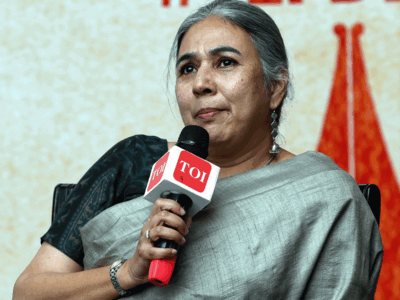
<p>‘Delhi is not about Lutyens’, it’s much more’</p><p>Photo by Prem Bisht<span class="redactor-invisible-space"><br></span></p>
It is highlighted by the fact that there is a memorial in Noida commemorating the battle,” Liddle pointed out.
Sohail Hashmi, a heritage walker who was among the earliest scholars to specialise in ethics and international relations, said Delhi has an undeniably rich history. In 1940, Delhi had a population of about 9 lakh. After the Partition, while one-third of the city’s population moved to Pakistan, over 6 lakh people migrated to the capital. Earlier, the most-spoken language here was Urdu but post-1947, it became Punjabi whereas now it is Bhojpuri and Maithili. This shows the multiculturalism of Delhi. This city always accepts people,” he said.
Highlighting the fact that New Delhi is not about Lutyens’ but way more than that, Liddle said that after the Partition, Delhi grew at an enormous rate. “The city was divided in districts and a lot of colonies were built after Independence. People migrated to the city to look for opportunities each day. This probably is because we failed to develop our smaller towns and the migration to metropolis compromised each other’s standard of life, said Liddle.
Hashmi highlighted the contribution of Sufi values and poet Amir Khusro’s works to enhance the culture of Delhi. “The Mughals built 13 gates in Delhi. A 14th one was later built by the British. Architecture was always the strong point of the Mughal Empire and it added to the development of Delhi as a city,” Hashmi added.
End of Article
FOLLOW US ON SOCIAL MEDIA
Photostories

Hot Picks
TOP TRENDING
Popular Categories
Hot on the Web
Top Trends
Trending Topics
Kaun Banega Crorepati 16Dhanteras 2024RajinikanthDiwali 2024 DateThe Great Indian Kapil Show 2Salim KhanVicky Vidya Ka Woh Wala Video CollectionSomy AliKaran JoharBigg Boss 18PapayaSaif Ali KhanPataudi PalaceGippy GerwalStar Singer 9 WinnerAnushka SharmaDiwali 2024Best Premium LaptopsF1 Us Grand Prix 2024Wordle Answer
Living and entertainment
Latest News
ED should remember there’s something called Article 21: SCMagic in the air: Celebrating Indian-Swiss friendshipMika Singh supports Salman Khan amid threats from Lawrence Bishnoi: ‘Uski maa ki, uski behen ki, jo dekhe idhar'ICC recommends changes in term of chairman, approves expansion of women's cricketVita Vea’s Surprise Return Could Tip the Scales for Buccaneers in Monday Night BattleDr. Dinshaw Pardiwala The Man Behind Every Comeback Story!Ranji Trophy: Mumbai drop Prithvi Shaw for Tripura matchCho Sae Ho ties the knot surrounded by friends at a star-studded wedding'STR 49' new poster: Silamabarasan's film with Ashwath Marimuthu is officialCommandos storm Maoist fortress of Abujmarh, kill 5Fresh injury setback for England as Jos Buttler ruled out of West Indies ODI seriesBringing social security to Mumbai's waste workers through government schemes“It was a challenge to get into Sahastra Raavan’s character and truly understand his motives” says Praneet Bhatt of Shrimad RamayanAaj Ka Panchang, October 22, 2024: Know Today's Shubh and Ashubh MuhuratRaj Nidimoru on why Samantha Ruth Prabhu wasn't their first choice for 'Citadel: Honey Bunny': 'Her Hindi was extremely minimal'ESA listing: Rane hopes to get justice for SattariUsgao, Shiroda panchayats declared tuberculosis-freeWho is Christy Clark? Former BC premier interested in replacing Trudeau if he steps down
Copyright © 2024 Bennett, Coleman & Co. Ltd. All rights reserved. For reprint rights: Times Syndication Service