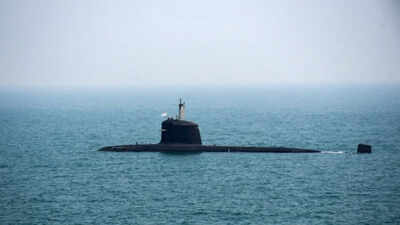
Submarines are among the most advanced machines ever created for operations beneath the sea. They are specially designed vessels capable of traveling underwater for long durations while carrying crew, equipment, weapons, or scientific instruments. Because they can move secretly below the ocean surface, submarines are extremely valuable in warfare, exploration, rescue missions, and underwater research.
Over time, submarine technology has developed from small manually powered craft into nuclear-powered vessels capable of staying submerged for months. Today, submarines are used not only by navies but also by scientists, rescue agencies, and private organizations.
Indian Navy Boosts Nuclear Deterrence With INS Aridhaman Submarine, Enforces Undersea Strike Power
A correct understanding of submarine types is important because many categories are often confused with each other. Some classifications are based on mission role, while others depend on propulsion system or operational purpose. Broadly, submarines can be divided into Military Submarines, Research and Scientific Submarines, Rescue Submarines, Tourist/Civilian Submarines, and Autonomous Underwater Vehicles.
1.Military Submarines
Military submarines are the most important and widely recognized category. These submarines are operated by naval forces for combat, surveillance, intelligence gathering, sea denial, and strategic deterrence. They are built for stealth, endurance, and firepower.
Military submarines are further divided into several sub-types depending on mission role.
A. Attack Submarines
Attack submarines are designed to destroy enemy submarines, warships, merchant vessels, and coastal targets. They are versatile combat submarines and form the backbone of many modern navies.
Their weapons usually include torpedoes, naval mines, and cruise missiles. Because modern cruise missiles are commonly launched from attack submarines, cruise missile strike capability is considered part of the attack submarine role rather than a completely separate submarine type.
Attack submarines are divided into two propulsion categories:- Nuclear Attack Submarines (SSN): These submarines are powered by nuclear reactors. Nuclear power allows them to remain underwater for months without refueling. They are fast, powerful, and ideal for long-range ocean missions. Countries such as United States, Russia, United Kingdom, and France operate such submarines.
- Diesel-Electric Attack Submarines (SSK): These submarines use diesel engines on the surface or while snorkeling, and battery power underwater. They are quieter during battery operation and highly effective in coastal waters. Many medium-sized naval powers prefer diesel-electric submarines because they are more affordable and easier to maintain.
B. Ballistic Missile Submarines (SSBN)
Ballistic missile submarines are strategic submarines built to carry submarine-launched ballistic missiles (SLBMs), usually nuclear armed. Their main purpose is deterrence.
These submarines remain hidden in oceans for long patrols so that even if their homeland is attacked, they can retaliate. This makes them a key component of the nuclear triad.
Countries such as India, China, United States, and Russia possess ballistic missile submarines.
They are usually larger than attack submarines because they must carry missile tubes and advanced communication systems.
C. Guided Missile / Converted Strike Submarines
Some submarines are modified versions of older ballistic missile submarines and converted to carry large numbers of cruise missiles or support special operations forces. Historically these were called guided missile submarines.
While the classification still exists in naval terminology, modern doctrine often treats them as specialized strike or support submarines rather than a mainstream separate category.
They are capable of launching land-attack cruise missiles, deploying commandos, and supporting intelligence missions.
D. Special Operations Submarines
Special operations submarines are used to deploy naval commandos, divers, reconnaissance teams, and underwater sabotage units.
They may be full-sized submarines modified with diver lockout chambers or smaller specialized craft attached to larger submarines. Their purpose is secrecy and covert insertion.
This category overlaps with midget submarines and swimmer delivery vehicles, because many small submarines are specifically designed for special forces use.
Midget submarines are very small submarines operated by a tiny crew, often between one and six personnel. Their missions include coastal patrol, harbor infiltration, reconnaissance, and special operations.
Because they are compact, they can enter shallow waters and narrow harbors where larger submarines cannot operate. In modern usage, many midget submarines are indeed part of special operations capability.
Thus, rather than being a completely separate strategic category, they are best understood as small military submarines used for niche missions.
2. Research and Scientific Submarines
Not all submarines are military. Research submarines are designed for scientific exploration and ocean study. These vessels help researchers understand marine ecosystems, geology, climate systems, and underwater life.
They are equipped with cameras, robotic arms, sensors, lights, sonar, and sample collection tools.
Scientists use them to study coral reefs, hydrothermal vents, deep trenches, and underwater volcanoes.
One famous example is Alvin, which has helped discover deep-sea life and explore historic wreck sites.
3. Deep-Sea Exploration Submersibles
Deep-sea submersibles are highly specialized underwater craft built to survive extreme pressure in the deepest parts of the ocean. Unlike standard submarines, they are usually smaller and focused on research or exploration.
They use reinforced pressure hulls made from titanium or advanced composites.
One historic example is Trieste, which descended into the Mariana Trench, the deepest known part of the ocean.
These vessels help scientists explore places where sunlight never reaches.
4. Rescue Submarines
Rescue submarines are built to save crews trapped inside damaged submarines underwater. They are compact, maneuverable, and capable of docking with disabled submarines.
They contain life-support systems and can transfer survivors safely to the surface.
Because submarine accidents can happen at great depth, rescue submarines are a critical part of naval emergency preparedness.
5. Tourist and civilian Submarines
Civilian submarines are used for tourism, private exploration, filmmaking, and underwater observation.
Tourist submarines allow passengers to safely view coral reefs, marine life, and underwater landscapes through viewing windows. They generally operate at shallow depths near coastal resorts.
Some private organizations also use submarines for underwater photography and seabed exploration.
6. Autonomous and Unmanned Underwater Vehicles
Modern underwater technology has introduced unmanned submarine-like systems known as autonomous underwater vehicles (AUVs) and remotely operated vehicles (ROVs).
These craft do not need onboard crews. They are used for:
- Mine detection
- Underwater inspection
- Pipeline surveys
- Cable maintenance
- Seabed mapping
- Scientific research
- Naval surveillance
As artificial intelligence improves, unmanned underwater systems are becoming more important for both civilian and military sectors.
Classification by power source
Submarines are also often categorized by propulsion system rather than role.
- Nuclear Powered: These submarines can remain submerged for months, travel globally, and sustain high speed. They are expensive and technologically demanding.
- Diesel-Electric: These submarines are quieter at low speed and cheaper to operate, but need to recharge batteries periodically.
- Air Independent Propulsion (AIP): Modern diesel submarines may use AIP systems that allow longer underwater endurance without surfacing. Many advanced conventional submarines now use this technology.
Importance of Submarines today
Submarines are valuable because oceans dominate global geography. Nations depend on sea routes for trade, energy movement, and security. Submarines help protect coastlines, track enemy fleets, gather intelligence, and maintain deterrence.
Scientists use submarines to understand climate change, marine biodiversity, and geological activity beneath the sea.
Industry also uses underwater vehicles to inspect pipelines, cables, and offshore infrastructure.
Submarines are best understood in broad categories rather than confusing overlapping labels. The main military types are attack submarines, ballistic missile submarines, special operations submarines, and small midget/coastal submarines. Beyond warfare, submarines also serve science, rescue, tourism, and industrial purposes.
From stealth nuclear vessels guarding national security to research craft exploring the ocean floor, submarines remain one of humanity’s most remarkable engineering achievements. As technology advances, future submarines will become quieter, smarter, and increasingly autonomous, expanding their importance in both defense and peaceful exploration.